


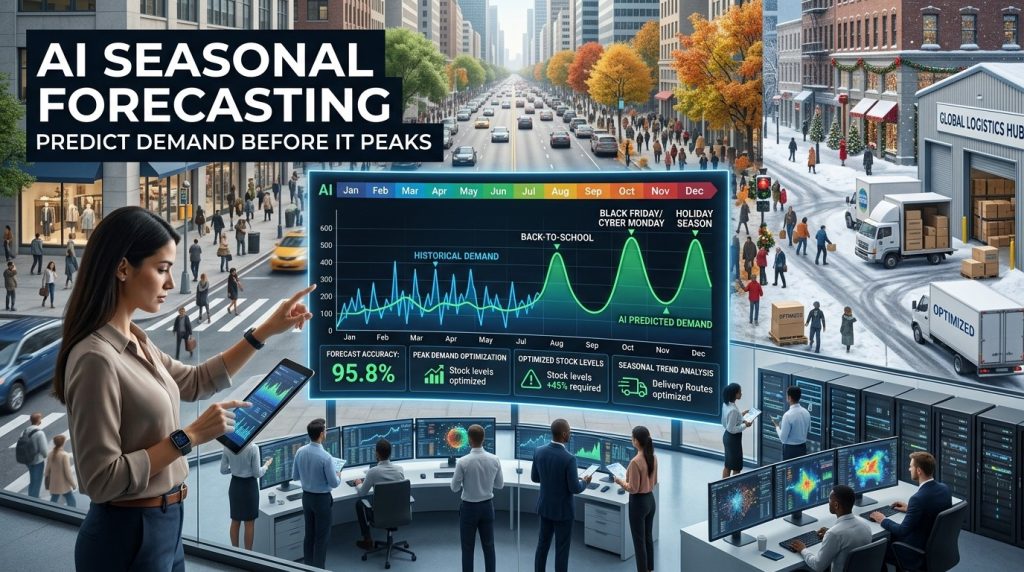
AI Seasonal Forecasting helps brands anticipate seasonal demand, prepare inventory, time campaigns, optimize pricing, and reduce uncertainty before customer interest reaches its peak.
AI Seasonal Forecasting is becoming an important planning approach for businesses that experience sharp changes in customer demand throughout the year. Seasonal peaks can create extraordinary opportunities, but they can also expose weaknesses in inventory planning, advertising budgets, staffing, fulfillment, and product availability. When demand rises faster than expected, businesses can lose revenue through stockouts. When demand is overestimated, they can be left with excess inventory and expensive markdowns.
The advantage of AI Seasonal Forecasting is not simply predicting that demand will increase during a familiar period. The real value comes from identifying how much demand may change, when that change may occur, which products are likely to benefit, and what external signals could alter the expected pattern. AI Seasonal Forecasting can combine historical sales, search behavior, campaign performance, product trends, customer behavior, regional patterns, promotions, and other business signals to create a more informed planning process.
Traditional seasonal planning often relies heavily on the previous year’s performance. That can be useful, but customer preferences, competitors, economic conditions, product availability, and marketing channels can change quickly. AI Seasonal Forecasting gives teams a way to examine multiple signals instead of treating last year’s numbers as a complete answer.
Another advantage is speed. Forecasting once per quarter may not be enough when seasonal demand can change within days or weeks. AI Seasonal Forecasting can support more frequent analysis, allowing teams to adjust assumptions when new information emerges.
The most effective approach is not to treat AI Seasonal Forecasting as a crystal ball. Forecasts are estimates built from data and assumptions. Their purpose is to improve decisions by reducing avoidable uncertainty, identifying potential scenarios, and helping teams prepare before demand becomes difficult to manage.
Understanding the Core Value of AI Seasonal Forecasting
The first step toward effective AI Seasonal Forecasting is understanding what the forecast is actually trying to predict. A business may want to estimate total seasonal sales, product-level demand, regional demand, expected order volume, advertising response, or customer interest before a peak.
AI Seasonal Forecasting becomes more useful when the forecasting target is clearly defined. Predicting overall holiday sales is different from predicting how many units of a particular product will sell during the final seven days before a holiday. The second problem requires more granular data and often produces more actionable decisions.
A useful forecast should answer practical questions. How much inventory should be prepared? When should replenishment begin? Which products deserve more promotional exposure? Which regions may require additional stock? How much advertising capacity should be reserved? When should a seasonal campaign begin?
AI Seasonal Forecasting can help connect those questions to measurable business outcomes. Instead of producing a number that sits inside a dashboard, the forecast can support procurement, merchandising, media planning, pricing, logistics, and customer service.
Businesses should also define the level of confidence required. A company selling inexpensive products with short replenishment cycles may tolerate greater forecasting uncertainty. A business importing expensive seasonal merchandise months in advance may need more conservative planning.
The value of AI Seasonal Forecasting therefore depends not only on model sophistication but on decision quality. A moderately accurate forecast connected to a strong operational process can be more useful than a highly complex forecast that nobody knows how to act upon.
Data Signals That Strengthen Seasonal Forecasts
Reliable AI Seasonal Forecasting starts with reliable inputs. Historical sales data remains important, but it should be treated as one signal among many. A product that sold exceptionally well last year may not repeat the same performance if customer interests have changed or if a competitor has introduced a stronger alternative.
Businesses can combine sales history with website traffic, search activity, click-through rates, conversion rates, cart behavior, email engagement, social interactions, promotional response, geographic demand, inventory levels, and product availability. Each signal provides a different view of customer intent.
AI Seasonal Forecasting can become particularly valuable when demand is being shaped by early interest. Search activity may increase before actual purchases rise. Product-page visits may accelerate before customers commit. Email engagement may reveal growing interest in a seasonal category even before transaction volume changes.
Marketing teams can also use content trends as an early indicator. When seasonal articles, guides, and product education pages start attracting more engagement, they may indicate that consumers are entering the research stage. Teams can support this layer by monitoring Fresh Content Signals and connecting content momentum with broader demand planning.
External variables can matter as well. Weather, public events, competitor promotions, product launches, supply constraints, and regional holidays can alter demand patterns. The more relevant signals a company can connect without introducing excessive noise, the more context the forecast can incorporate.
Data quality must remain a priority. Duplicate transactions, incorrect product mappings, missing dates, inconsistent category names, and inventory-related sales suppression can distort a model. AI Seasonal Forecasting cannot correct every data-quality problem automatically.
Detecting Seasonal Patterns Beyond Simple Year-on-Year Trends
Seasonality is more complicated than repeating the same curve every year. Customer demand may begin earlier, peak later, or become concentrated around a shorter period. AI Seasonal Forecasting can help identify these changes by comparing multiple historical patterns rather than relying on a single calendar assumption.
For example, consumers may begin holiday research several weeks before they actually purchase. A forecast that only examines transaction history could miss this early intent. AI Seasonal Forecasting can use leading indicators to identify rising interest before revenue appears in the same magnitude.
Different products can also have different seasonal curves. One category may peak at the beginning of a campaign, while another grows gradually and reaches maximum demand immediately before the event. Treating every product with one seasonal multiplier can lead to poor planning.
Regional variation creates another challenge. A national campaign might produce very different demand patterns across markets because of climate, local holidays, cultural preferences, income patterns, delivery availability, or promotional timing. AI Seasonal Forecasting can support more granular regional analysis when sufficient data exists.
Businesses should also watch for seasonality that is moving rather than disappearing. If demand previously peaked over four weeks but now concentrates within ten days, the operational risk may increase even if total seasonal revenue stays similar.
The objective is to identify patterns that matter operationally. AI Seasonal Forecasting is most useful when it reveals not only whether demand is seasonal, but how the timing, intensity, and composition of that season are changing.
Choosing the Right Forecasting Horizon
Forecasting horizon determines what decisions the model can support. Long-range AI Seasonal Forecasting is useful for procurement, supplier negotiations, workforce preparation, budgeting, and broader campaign planning. Short-range forecasts are more useful for daily inventory decisions, media adjustments, staffing, fulfillment, and last-minute promotions.
Long-range predictions naturally involve greater uncertainty because more variables can change before the target period arrives. A forecast made six months ahead may need to be revised repeatedly as customer behavior becomes clearer.
AI Seasonal Forecasting can work through rolling forecasts to address this issue. Instead of creating one fixed prediction and ignoring it, teams can update the outlook as new demand signals arrive. This allows planning to become progressively more precise as the seasonal event approaches.
A useful forecasting structure may involve three horizons: strategic, tactical, and operational. Strategic forecasts help the company decide how much capacity may be required. Tactical forecasts influence campaign timing and product allocation. Operational forecasts help teams manage the immediate sales period.
The horizon should match the cost of being wrong. If inventory needs to be ordered internationally several months in advance, the forecast should prioritize scenario planning and risk ranges. If products can be replenished locally within days, a more flexible approach may be appropriate.
AI Seasonal Forecasting becomes more practical when each horizon has defined users, actions, and review cycles. Forecasting should not become an isolated analytics project. It should become a recurring input into specific business decisions.
Building Demand Scenarios Instead of One “Perfect” Number
No forecast can know exactly what customers will do. That is why strong AI Seasonal Forecasting should often produce scenarios rather than one unquestionable outcome. Businesses can prepare for conservative, expected, and high-demand situations.
A conservative scenario might assume weaker traffic, lower conversion, or reduced promotional response. The expected scenario could reflect the most likely combination of current signals. A high-demand scenario might account for stronger campaign performance, viral attention, competitor stockouts, or unexpected customer interest.
AI Seasonal Forecasting becomes more actionable when these scenarios are connected to decisions. If demand reaches the high scenario, which supplier should be contacted? If demand falls below expectations, when should paid media be reduced? If one product underperforms while another grows rapidly, how should inventory be reallocated?
Scenario planning also helps internal communication. Finance teams can understand potential revenue ranges. Operations teams can prepare capacity plans. Marketing teams can establish budget flexibility. Leadership can see which assumptions create the largest risks.
The goal is not to create dozens of complicated possibilities. Too many scenarios can create analysis paralysis. Three or four well-defined cases are often easier to communicate and act upon.
AI Seasonal Forecasting should therefore be treated as a decision-support system. A good forecast does not eliminate uncertainty; it makes uncertainty visible enough to manage.
Using Forecasts to Improve Inventory Planning
Inventory is one of the clearest applications of AI Seasonal Forecasting because seasonal demand can create costly imbalances. Too little inventory can result in stockouts, missed sales, disappointed customers, and reduced advertising efficiency. Too much inventory can create storage costs, markdown pressure, and working-capital problems.
AI Seasonal Forecasting can help businesses estimate expected demand by product, category, location, and time period. This provides a stronger foundation for purchase orders and replenishment decisions.
Inventory planning should also account for lead times. If a supplier requires six weeks to deliver a product, an increase in demand expected next week cannot be solved through normal replenishment. The forecast must therefore be connected to supply timelines.
Another consideration is stock visibility. A product may appear to have demand weakness when it was actually unavailable for part of the period. Forecasting models should distinguish between low customer interest and sales lost because inventory was insufficient.
Seasonal bundles can introduce additional complexity. If several products are promoted together, demand for one item may influence demand for another. AI Seasonal Forecasting can help model these relationships when sufficient historical information exists.
Operational teams can also use forecasts to prioritize inventory transfers. If one location is expected to experience stronger demand while another has excess stock, moving inventory may reduce the chance of regional stockouts.
The best results come when AI Seasonal Forecasting is integrated with actual inventory constraints rather than treated as a standalone sales prediction.
Connecting Forecasting With Pricing and Promotions
Pricing can significantly influence seasonal demand. A strong promotion may increase volume, while an overly aggressive discount can reduce profitability without producing enough incremental sales. AI Seasonal Forecasting can help businesses estimate how demand may respond under different promotional conditions.
Historical promotion data is especially valuable. If a product previously received a 15% discount during a comparable period, the business may analyze changes in traffic, conversion, order volume, margin, and customer behavior. The model can then incorporate those patterns into planning.
AI Seasonal Forecasting can support price experimentation when combined with proper controls. Instead of assuming that the largest discount will produce the highest commercial value, teams can compare different promotional structures and consider both volume and profitability.
Bundling is another useful lever. A seasonal bundle can increase average order value while giving customers a clearer purchasing decision. Forecasting can estimate the demand relationship between the primary product and complementary items.
Promotions should also account for inventory. A forecast may show high expected demand, but that does not automatically justify a larger discount if inventory is already constrained. Conversely, excess inventory may justify a more aggressive campaign if the margin economics support it.
AI Seasonal Forecasting can therefore help shift pricing discussions from intuition alone toward evidence-based planning. It does not decide the optimal price automatically; it helps the team understand possible demand responses.
Predicting the Right Time to Launch Seasonal Campaigns
Campaign timing has a direct relationship with seasonal demand. Launching too early may waste budget while customer intent is still weak. Launching too late may leave insufficient time to capture consideration and convert demand.
AI Seasonal Forecasting can help identify when interest is likely to transition from research into stronger purchase behavior. Search activity, website engagement, product views, email behavior, and previous conversion timing can all contribute to the analysis.
Seasonal marketing can become more coordinated when forecasting is linked with broader strategic planning. For example, AI Seasonal Marketing can support campaign personalization and timing, while forecasting helps estimate the expected demand window. Together, the two processes can create a more informed seasonal plan.
AI Seasonal Forecasting can also support budget pacing. Instead of spending the same amount every day, marketers can prepare flexible allocations around expected shifts in demand. Strong early signals may justify accelerating spend, while weak signals may indicate that creative, targeting, or timing needs adjustment before additional budget is deployed.
Another advantage is coordination across channels. Search, social, email, influencers, affiliates, and display campaigns may each have different response windows. Forecasting can help teams anticipate when each channel is most relevant.
The objective is to match promotional pressure with genuine customer readiness rather than simply starting campaigns because the calendar says the season has begun.
Forecasting Product-Level and Category-Level Demand
Not all products benefit equally from seasonal attention. Some are highly seasonal, some experience moderate changes, and others remain relatively stable. AI Seasonal Forecasting can help identify these differences so businesses do not allocate resources uniformly.
Product-level forecasting is particularly useful for large catalogs. A category may show strong seasonal growth while individual products within that category move in different directions. One product may become a trend leader while another loses relevance.
AI Seasonal Forecasting can identify products with accelerating demand, stable demand, declining interest, or unusual volatility. These classifications can support merchandising decisions, product placement, advertising priorities, and inventory allocation.
New products create a special challenge because they lack historical seasonal data. In such cases, forecasting can use comparable products, category behavior, early engagement signals, and launch performance. The result is still uncertain, but the business has more evidence than a simple guess.
Product relationships are important as well. Substitute products may compete with each other, while complementary products may move together. A strong forecast should consider these relationships when enough data is available.
The outcome should be a more intelligent assortment strategy. Products expected to experience high demand may need stronger stock coverage and greater visibility. Products with weak seasonal potential may receive different promotional treatment.
Turning Forecasts Into Better Content and Search Planning
Demand forecasting should not remain inside the analytics department. Content teams can use seasonal demand signals to prioritize topics, guides, product comparisons, FAQs, and educational pages that customers are likely to need.
AI Seasonal Forecasting can reveal what categories may receive increased attention before transactions peak. Content teams can then prepare supporting materials before customers become highly competitive searchers.
A well-timed content strategy can also reduce the pressure on paid media. When useful resources begin attracting organic discovery early, customers can become familiar with the brand before they reach the transactional stage.
Search trends may reveal changing questions. A customer might shift from “ideas” to “best products” and finally to “where to buy.” Recognizing this progression helps businesses create content for different stages of intent.
AI Seasonal Forecasting can connect these changes to editorial planning. Instead of publishing seasonal content only when demand is already obvious, brands can prepare resources around leading indicators.
Content should still prioritize genuine usefulness. Forecasting should guide topic selection, not encourage keyword stuffing or low-value pages. Search visibility depends on relevance, clarity, trust, and a satisfying user experience.
The most effective seasonal content plans combine demand intelligence with audience understanding. Forecasts indicate where interest may be moving; content determines how the brand can become useful within that movement.
Applying Forecasting Across Marketing Channels
Different channels may reflect different stages of seasonal intent. Search can capture active demand. Social media can generate discovery. Email can reactivate existing customers. Affiliates can expand reach. Paid advertising can amplify relevant products when intent is strong.
AI Seasonal Forecasting can help allocate attention across these channels based on expected demand conditions. It can also help teams distinguish between channels that create awareness and channels that capture existing demand.
For example, social engagement may rise early while search conversions remain modest. Later, transactional search activity may accelerate. That does not necessarily mean social is ineffective; it may indicate that its role occurs earlier in the customer journey.
AI Seasonal Forecasting can help marketers interpret these patterns without judging every channel only by immediate last-click sales. Attribution still requires careful analysis, but forecasting can provide context for channel timing.
Email campaigns can also be sequenced around expected demand windows. An early educational message may support planning, while later messages can emphasize product availability, bundles, or deadline information.
Paid media teams can use forecasts to establish flexible rules. Budgets can expand when demand quality and conversion signals align, while weak conditions can trigger creative reviews or controlled spending.
The important principle is coordination. Forecasting works best when every channel receives a shared view of the expected seasonal environment rather than optimizing independently.
Building an AI Seasonal Forecasting Workflow
A repeatable forecasting workflow begins with a clear business question. “What will sales be?” is too broad. “How many units of each priority product may be required during the final two weeks of the seasonal campaign?” is much more actionable.
AI Seasonal Forecasting should then collect and prepare the relevant data. Historical transactions, promotional periods, inventory status, traffic, conversion behavior, search trends, regional differences, and campaign activity may all be relevant depending on the use case.
The next stage is feature selection and model development. Teams should choose variables that have a logical relationship with the outcome instead of adding every available dataset. More data is not automatically better if it introduces noise or unreliable patterns.
AI Seasonal Forecasting should then be evaluated against historical periods or holdout data. The purpose is to understand how well the approach would have performed when actual outcomes were known.
After validation, the forecast should be translated into actions. A dashboard that displays predicted demand without operational responses does not create much value. Teams need explicit rules for inventory, campaigns, staffing, pricing, and escalation.
Finally, forecasts should be monitored after launch. Actual demand should be compared with expected demand, major deviations should be investigated, and future forecasting assumptions should be updated.
A strong workflow is iterative. The model improves not only through technical refinement but through better data, better business rules, and better understanding of customer behavior.
Using Human Psychology to Interpret Demand Signals
Numbers alone do not explain why customers act. Human psychology plays a major role in seasonal demand because urgency, social expectations, perceived scarcity, gifting pressure, identity, and convenience can influence decisions.
AI Seasonal Forecasting can identify unusual demand changes, but teams should investigate the behavioral reasons behind those changes. A sudden increase may reflect a viral trend, a competitor stockout, a cultural event, or a campaign that unexpectedly resonated.
Customers also react to deadlines. Shipping cutoffs, event dates, and limited promotional windows can compress decision-making. Forecasting can help businesses anticipate these compressed periods so fulfillment and customer support are prepared.
Choice overload matters too. During seasonal campaigns, customers may encounter hundreds of offers. Better demand planning can support curated assortments that make decision-making easier.
AI Seasonal Forecasting can be particularly useful when combined with customer feedback. Reviews, support conversations, survey responses, and search questions can reveal emotional concerns behind demand patterns.
Trust also affects conversion. If customers do not believe an offer, delivery promise, product claim, or availability statement, demand may not convert as expected. Forecasting should therefore be interpreted alongside customer experience signals.
The best forecasting teams connect quantitative patterns with qualitative understanding. Data tells the business what is changing; customer behavior helps explain why it may be changing.
Managing Uncertainty, Bias, and Forecasting Limits
AI Seasonal Forecasting is only as reliable as the assumptions and information supporting it. Unexpected events can create conditions that historical data has never seen. New competitors, supply disruptions, economic shifts, platform changes, and sudden trends can invalidate previous assumptions.
Forecast bias is another concern. If historical data contains systematic overprediction or underprediction, an AI model may reproduce those tendencies. Businesses should review errors by product, location, period, and campaign type rather than looking only at one overall accuracy number.
AI Seasonal Forecasting should also distinguish correlation from causation. If sales increased during a previous season when advertising spend increased, that does not automatically mean advertising caused the entire growth. Other factors may have contributed.
Outliers require careful treatment. Removing every unusual event can make the model less realistic, but allowing one extraordinary event to dominate the forecast can distort future expectations.
Businesses should maintain human oversight for high-impact decisions. Forecast outputs should be reviewed against current operational realities, especially when the consequences of error are substantial.
Uncertainty should be communicated clearly. Instead of presenting every prediction as certain, teams can use ranges, scenarios, confidence measures, and assumptions. This creates more realistic planning conversations.
Ultimately, AI Seasonal Forecasting should improve preparedness, not create false confidence. The goal is better decision-making under uncertainty, not the illusion that uncertainty has disappeared.
Implementing Forecasting Without Overcomplicating the Business
A company does not need an enormous technology stack to begin using AI Seasonal Forecasting. A focused pilot can provide useful evidence before a larger investment is made.
Choose one seasonal category with enough historical data and a clear business decision attached to the forecast. Define the forecasting horizon, target metric, primary data sources, and success criteria.
AI Seasonal Forecasting should be integrated into existing planning meetings rather than becoming a separate analytics ritual. If operations already reviews inventory every Monday, forecast updates can become part of that process.
Data ownership should also be clear. Someone needs responsibility for maintaining product mappings, historical data quality, promotional calendars, and inventory information.
Teams should establish an exception process. If actual demand moves substantially outside the forecast range, the business should know who reviews the cause and what action may follow.
Technology should support this process, not dominate it. A highly complex system is unnecessary if teams cannot understand the outputs or apply them to real decisions.
An effective implementation typically moves through four stages: pilot, validation, operational integration, and continuous improvement. Each stage should demonstrate practical value before the next level of complexity is added.
Real-World Applications Across Seasonal Businesses
An online fashion retailer can use AI Seasonal Forecasting to estimate demand for event clothing before a major celebration. The business can combine previous sales, search behavior, regional demand, size distribution, product engagement, and campaign performance to improve stock decisions.
A consumer electronics retailer can use AI Seasonal Forecasting to anticipate demand during major gifting periods. Forecasts can inform inventory purchases, bundle creation, paid media budgets, and fulfillment preparation.
A cosmetics business can apply AI Seasonal Forecasting to gifting collections and limited seasonal sets. Because product combinations may matter as much as individual products, the business can estimate demand at both product and bundle levels.
A grocery business may use forecasting to prepare for holiday-specific products with short shelf lives. The cost of overstock can be substantial, so the forecast should incorporate timing, perishability, local demand, and replenishment constraints.
A travel accessories brand can forecast demand around vacation seasons. Search activity and geographic trends may provide early indicators while order data provides confirmation closer to the peak.
B2B businesses can also benefit. Seasonal demand does not belong only to consumer ecommerce. Companies supplying event materials, hospitality products, corporate gifts, or specialized equipment may experience predictable annual demand cycles.
Across these cases, AI Seasonal Forecasting works best when the forecast is tied to an operational decision. The model becomes valuable when it changes how the business purchases, markets, prices, staffs, or fulfills products.
Measuring Forecast Quality and Business Impact
Forecast accuracy matters, but it should not be the only measurement. AI Seasonal Forecasting should ultimately be evaluated according to whether it improves business decisions and reduces avoidable costs.
Useful technical metrics can include mean absolute error, mean absolute percentage error, weighted errors, forecast bias, and error by product or time period. No single metric is perfect for every business, so measurement should reflect the forecasting use case.
AI Seasonal Forecasting should also be evaluated against commercial outcomes. Did stockouts decline? Did excess inventory decrease? Did advertising become more efficient? Did campaign timing improve? Did fulfillment become more predictable?
A simple measurement framework can include:
| Measurement Area | What to Review | Why It Matters |
|---|---|---|
| Forecast accuracy | Predicted vs. actual demand | Shows model performance |
| Forecast bias | Persistent over- or underprediction | Reveals systematic issues |
| Stock availability | In-stock rate during peaks | Connects forecasting with revenue |
| Inventory efficiency | Excess and shortage levels | Measures operational impact |
| Campaign efficiency | Spend and conversion by period | Tests timing decisions |
| Revenue performance | Sales against plan | Links forecasts to business results |
| Margin performance | Profit after promotions | Prevents volume-only optimization |
Teams should compare outcomes against appropriate baselines. If sales improved, the business should investigate whether forecasting contributed or whether the result came mainly from a larger audience, stronger products, or market-wide demand growth.
Post-season analysis is essential. Review what the model expected, what actually happened, where it missed, and what new signals appeared. That learning should feed the next forecasting cycle.
Common Mistakes That Weaken Seasonal Forecasting
One frequent mistake is assuming that last year’s sales automatically predict this year’s demand. AI Seasonal Forecasting should use historical data as evidence, not as an unquestionable template.
Another mistake is ignoring stockouts. If a product was unavailable, recorded sales may understate customer demand. The forecast can become biased if the model interprets constrained sales as weak interest.
Businesses may also focus too heavily on model accuracy while ignoring decision speed. A forecast that is technically strong but updated too slowly may have limited operational value during a rapidly changing seasonal campaign.
AI Seasonal Forecasting can also fail when teams overload models with irrelevant variables. More inputs do not guarantee better predictions. Signal quality, consistency, and business relevance matter more.
Finally, forecasts can lose value when no one owns the response. A prediction that says demand may rise by 25% is meaningless unless someone knows whether to order inventory, increase staffing, adjust advertising, or monitor the situation more closely.
The best forecasting culture combines disciplined data analysis with practical business ownership.
Conclusion
AI Seasonal Forecasting gives businesses a structured way to anticipate changing demand before seasonal pressure reaches its highest point. By combining historical sales with search behavior, customer signals, inventory data, campaign performance, regional trends, and scenario planning, teams can make more informed decisions about stock, pricing, content, advertising, and fulfillment. The process should never be treated as a guarantee of what customers will do. Instead, it should create a clearer view of possible demand and the actions required for each situation. When forecasts are reviewed continuously and connected to real operational decisions, seasonal planning becomes more proactive, flexible, and capable of handling uncertainty.
Frequently Asked Questions (FAQ)
What Is AI Seasonal Forecasting?
AI Seasonal Forecasting is a data-driven approach that uses artificial intelligence and historical or real-time signals to estimate how customer demand may change during seasonal periods.
Why is AI Seasonal Forecasting important for ecommerce?
AI Seasonal Forecasting helps ecommerce businesses prepare inventory, marketing budgets, product assortments, staffing, and fulfillment capacity before seasonal demand reaches its highest level.
What data is needed for AI Seasonal Forecasting?
Common inputs include historical sales, product availability, search trends, website traffic, conversion rates, promotions, customer behavior, geographic demand, and campaign performance.
Can AI Seasonal Forecasting predict new product demand?
It can estimate new product demand by using comparable products, category patterns, early engagement signals, and related historical information, although uncertainty is generally higher than with established products.
How far ahead should businesses forecast seasonal demand?
The appropriate horizon depends on the business. Long-range forecasts support purchasing and capacity decisions, while short-range forecasts are more useful for campaign optimization, replenishment, and operational adjustments.
Is AI Seasonal Forecasting always accurate?
No. Forecasts are estimates and can be affected by incomplete data, unexpected events, changing customer behavior, supply disruptions, or unusual market conditions. Scenario planning helps businesses manage this uncertainty.
How does AI Seasonal Forecasting improve inventory management?
It can help estimate product-level and regional demand, identify potential stockout periods, support replenishment planning, and reduce the risk of carrying too much or too little seasonal inventory.
Can AI Seasonal Forecasting improve marketing campaigns?
Yes. It can help marketers anticipate demand windows, adjust campaign timing, allocate budgets, prioritize products, and coordinate promotional activity across multiple channels.
What is the biggest mistake businesses make with AI Seasonal Forecasting?
One major mistake is treating the forecast as a final answer instead of decision-support information. Forecasts need context, human review, and clear operational actions.
How can a business start using AI Seasonal Forecasting?
A business can begin with one seasonal category, one measurable forecasting goal, reliable historical data, and a defined operational decision. The pilot can then be validated and expanded gradually.