Event Based Marketing: Complete Guide & Best Practices
Geoffrey Davis
Modern consumers expect brands to communicate with extreme relevance and perfect timing. Event Based Marketing empowers organizations to deliver automated, highly tailored messages precisely when customer interactions occur. By transforming real-time behavioral signals into actionable opportunities, Event Based Marketing radically improves engagement, accelerates conversion cycles, and drives scalable revenue growth across channels.
Understanding Event Based Marketing: Core Concepts and Architecture
Event Based Marketing represents a fundamental paradigm shift in how modern enterprises communicate with prospects and existing customers. Unlike traditional batch-and-blast campaigns that push pre-scheduled marketing blasts to massive static email lists, Event Based Marketing operates on an event-driven architecture that responds dynamically to specific individual actions, milestones, or environmental conditions. In the context of contemporary Data-Driven Marketing, an event is defined as any discrete, measurable interaction or occurrence recorded within a digital ecosystem—such as downloading a whitepaper, abandoning a shopping cart, reaching a subscription anniversary, or triggering a custom API signal.
The mechanics of an effective Event Based Marketing framework rely on a continuous, closed-loop feedback mechanism between customer touchpoints and internal analytics systems. When a user executes a specific action, an event listener captures the event log and transmits it directly to a centralized engine or enterprise Customer Relationship Management database. This engine instantly evaluates the event payload against pre-configured business rules, segmentation parameters, and logical conditions. If the criteria are fulfilled, the system immediately initiates a pre-designed automated campaign delivered across the most effective communication channel for that specific context.
Strategic Benefits of Event Based Marketing for Enterprise Growth
Implementing a robust Event Based Marketing capability delivers transformative commercial advantages across the entire revenue funnel. The primary catalyst for these results is the unmatched relevance that event-driven triggers provide. When an automated communication directly references a user’s recent action, response rates, click-through rates, and conversion metrics skyrocket compared to generic promotional broadcasts. Organizations that transition to Event Based Marketing consistently report significant improvements in customer acquisition efficiency and total campaign effectiveness.
One of the most immediate financial gains realized through Event Based Marketing is the dramatic acceleration of conversion rates during Lead Nurturing workflows. Standard time-delayed email sequences often deliver follow-up messages days after a lead has moved on or researched competing vendors. By leveraging Event Based Marketing, sales and marketing teams can instantly engage high-intent prospects within seconds of a key milestone—such as viewing a pricing page three times in a single afternoon or requesting an enterprise software demonstration. This rapid, automated responsiveness captures prospect attention at peak intent, directly compressing sales cycle length and expanding pipeline velocity.
Beyond acquisition metrics, Event Based Marketing plays a crucial role in modern Customer Lifecycle Management and customer retention strategies. Churn rarely happens without warning; customers routinely display subtle behavioral indicators before canceling a subscription or migrating to a competitor. By setting up monitoring rules inside an Event Based Marketing system, retention teams can automatically flag drop-offs in platform usage, failed login attempts, or declining transaction frequencies. The system can then initiate targeted win-back campaigns, deliver proactive customer support resources, or alert account managers to intervene before churn becomes finalized.
Key Event Based Marketing Triggers and Operational Categories
To build a high-performing Event Based Marketing architecture, organizations must systematically categorize and define the specific triggers that unleash automated outreach. Triggers serve as the operational catalysts for Event Based Marketing, transforming raw customer activity into meaningful engagement opportunities. Categorizing triggers logically allows cross-functional teams to design targeted messaging matrices tailored to distinct customer states. The primary operational trigger categories utilized in enterprise Event Based Marketing include:
Behavioral Triggers: Initiated by direct user actions across digital properties, including website page visits, form submissions, mobile app feature usage, video views, product cart additions, and resource downloads. Behavioral triggers represent the highest intent signals in Event Based Marketing because they mirror active user consideration and interest.
Transactional and Financial Triggers: Generated by monetary transactions or account status updates, such as successful order placement, subscription renewals, failed payment processing, credit limit adjustments, or refund requests. Transactional Event Based Marketing triggers deliver exceptional open and engagement rates due to their direct relevance to user finances.
Demographic and Lifecycle Triggers: Sparked by temporal milestones connected to an individual user profile, such as customer onboarding anniversaries, birthdays, account creation dates, or progression into a new loyalty program tier. Lifecycle Event Based Marketing fosters deep brand affinity and emotional connection.
Contextual and Environmental Triggers: Triggered by external conditions external to the specific user profile, including localized weather updates, macroeconomic changes, regional sport achievements, geo-location proximity, or real-time inventory level changes. Contextual Event Based Marketing establishes extreme contextual relevance by tapping into immediate real-world surroundings.
Understanding how Event Based Marketing compares to traditional campaign marketing highlights why top-performing enterprises are rapidly reallocating their budgets toward event-driven methodologies.
Strategic Feature
Traditional Campaign Marketing
Event Based Marketing
Execution Trigger
Pre-set calendar schedule (e.g., weekly blast)
Real-time user action, milestone, or signal
Relevance Level
Low to moderate (generic segment messaging)
Exceptionally high (context-aware & individualized)
Data Reliance
Historical static demographic profiles
Real-time behavioral, transactional & stream data
Response Latency
Hours, days, or scheduled weekly windows
Immediate (milliseconds to real-time minutes)
Primary Goal
Broad brand awareness and reach
Conversion, retention & intent satisfaction
Customer Experience
Frequently intrusive or repetitive
Helpful, timely, value-adding & seamless
Scalability
Manual effort scales with campaign volume
Automated infrastructure scales infinitely
By uniting these diverse trigger categories within a unified Omnichannel Marketing Strategy, modern organizations guarantee that whether a customer interacts via mobile app, desktop web browser, SMS, or email, the underlying Event Based Marketing engine receives the signal and delivers a perfectly synchronized response.
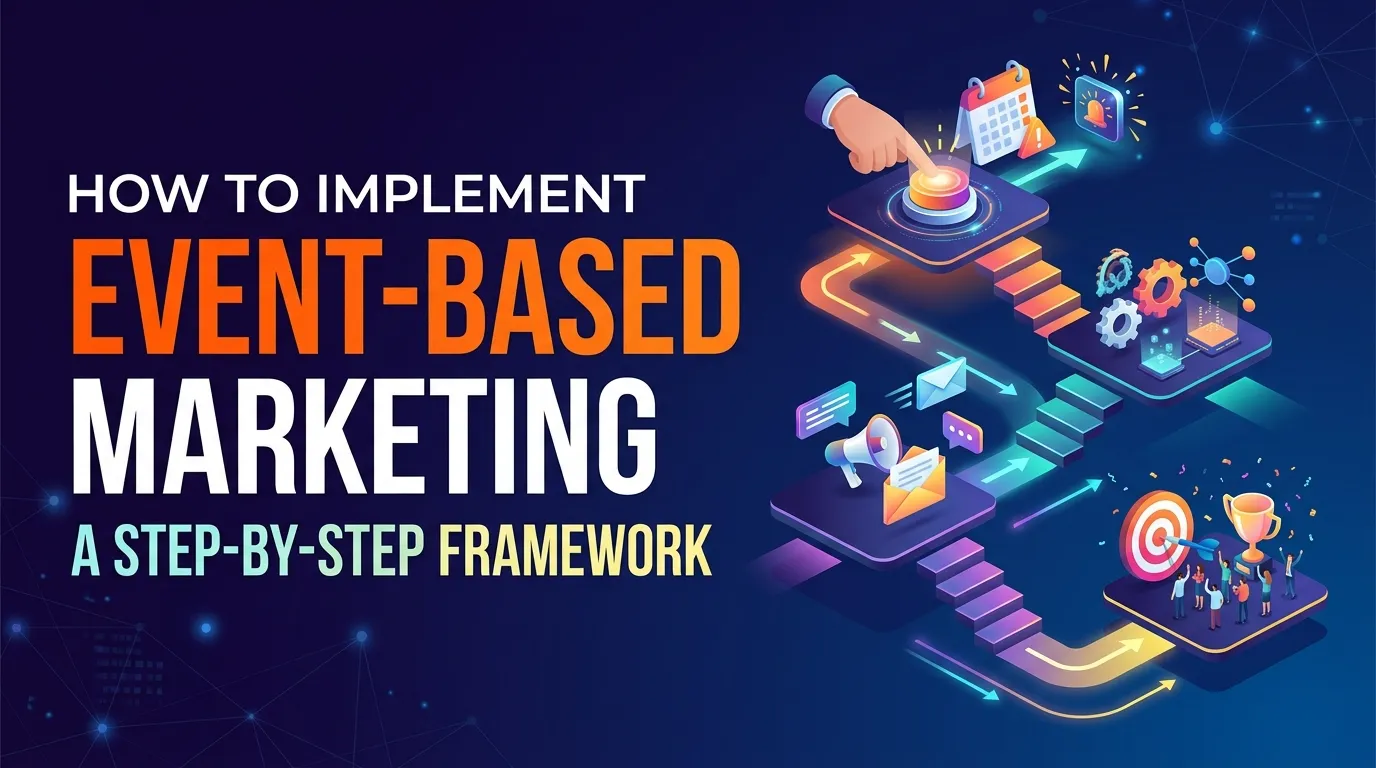
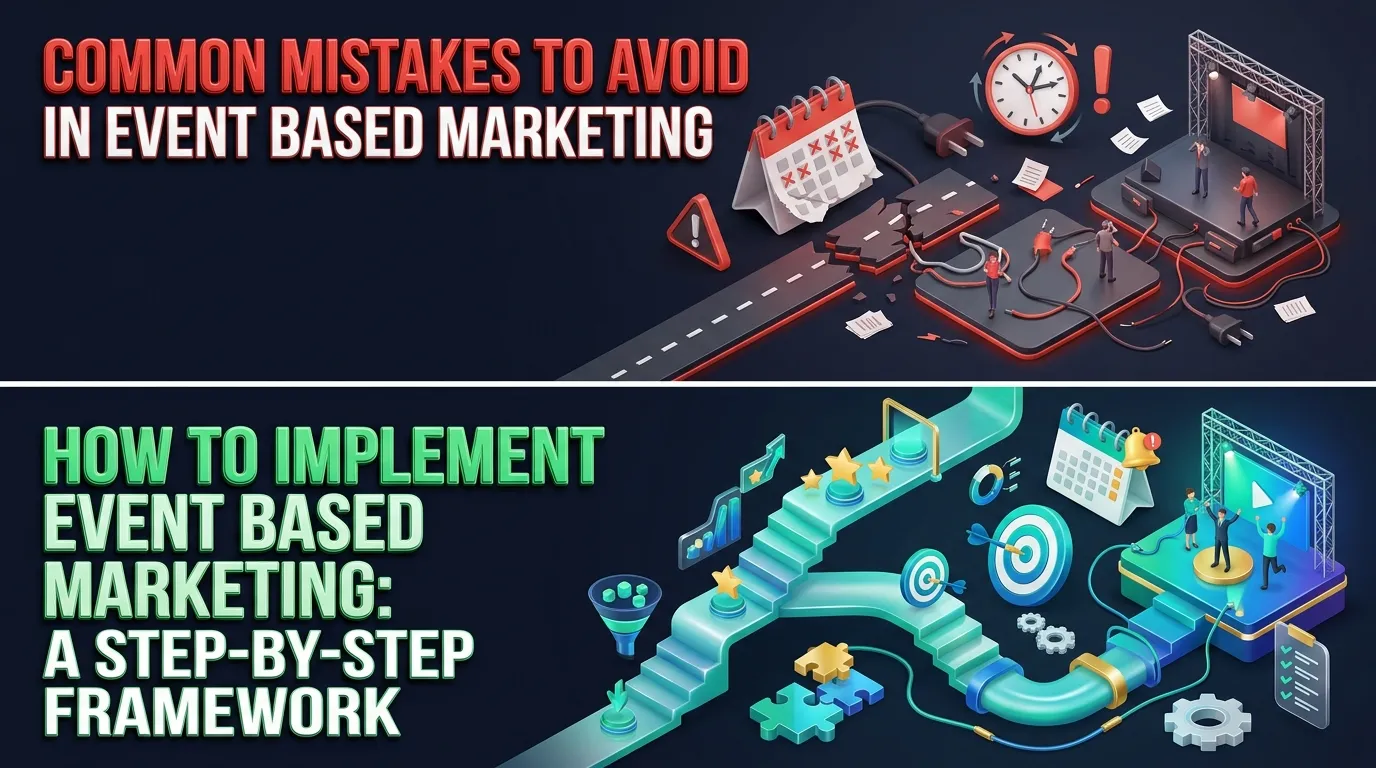
How to Implement Event Based Marketing: A Step-by-Step Framework
Executing a successful Event Based Marketing program requires a disciplined, structured approach that spans data architecture, journey mapping, content creation, and cross-channel system integrations. Without a clear step-by-step roadmap, organizations risk building disjointed workflows that create message clutter and frustrate prospects. The following framework outlines the essential steps to construct an enterprise-grade Event Based Marketing engine.
Mapping the Customer Journey and Defining High-Intent Events
The foundation of every high-converting Event Based Marketing program begins with comprehensive mapping of the target audience lifecycle. Marketing teams must analyze historic analytics data, consult sales representatives, and review customer support logs to identify pivotal inflection points where automated intervention yields maximum impact. Rather than attempting to track every conceivable digital click, focus initial Event Based Marketing deployment on high-intent conversion bottlenecks—such as cart abandonment, trial signup completion, or feature adoption drops. Define explicit event definitions, including exact event names, associated metadata properties, and required trigger parameters.
Integrating Data Pipelines and CDP Infrastructure
An Event Based Marketing strategy is only as powerful as the data pipeline supporting it. Organizations must break down departmental data silos by unifying customer records across transactional databases, web analytics, mobile apps, and customer service platforms. Deploying a centralized Customer Data Platform (CDP) or real-time event streaming pipeline ensures that event logs are collected, cleaned, and standardized instantly. This infrastructure allows the Event Based Marketing decision engine to access a single, authoritative customer profile enriched with historical context, purchase history, and behavioral attributes.
Designing Automated Triggers and Workflow Logic
Once data connections are validated, marketers must design logical branching workflows inside their chosen Marketing Automation Platforms. Effective Event Based Marketing workflows must incorporate clear business rules, eligibility criteria, suppression parameters, and frequency capping rules to prevent customer communication fatigue. Define the exact delay thresholds, multi-channel fallback rules, and dynamic content variations required for each scenario. For example, an abandoned browse trigger might initiate an immediate soft push notification, followed by a personalized email twelve hours later if no transaction occurred, and capped to execute no more than once per user every thirty days.
Testing, Dynamic Personalization, and Omnichannel Orchestration
Before setting Event Based Marketing campaigns live across production environments, rigorous end-to-end QA testing must be conducted. Test all data payload triggers, user profile syncs, rendering variations, and link tracking paths across devices and platforms. Integrate Real-Time Analytics solutions to measure workflow execution speed, deliverability success, conversion attribution, and user drop-off points. Continuously perform multivariate testing on message copy, subject lines, send channels, and time delays to iteratively optimize the overall performance of your Event Based Marketing ecosystem.
Common Mistakes to Avoid in Event Based Marketing
While Event Based Marketing provides unmatched conversion potential, poor execution can alienate customers, damage brand reputation, and waste technical resources. Identifying and mitigating operational traps early ensures long-term program stability and customer satisfaction.
Key pitfalls to avoid when deploying Event Based Marketing include:
Over-Triggering and Lack of Frequency Capping: Bombarding users with automated emails, push notifications, and SMS messages every single time they click a button causes instant message fatigue and skyrockets unsubscribe rates. Enterprise Event Based Marketing systems must enforce strict global frequency rules that limit total touchpoints across all active workflows.
Data Latency and Stale Event Processing: Delivering an event-driven abandoned cart email three days after the user already completed the purchase creates a terrible customer experience. Event Based Marketing demands real-time data pipelines that process event streams in milliseconds, backed by immediate suppression logic the moment a goal action is completed.
Generic Content Lacking True Personalization: Triggering a communication based on a specific action but delivering generic, unpersonalized copy defeats the core value proposition of Event Based Marketing. Messages should dynamically reference the exact product viewed, topic researched, or milestone achieved to maximize conversion intent.
Siloed Channel Communication: Running independent Event Based Marketing triggers across isolated email, mobile push, and direct sales systems leads to conflicting messaging. Modern execution requires centralized orchestration so that engagement on one channel instantly updates or pauses communications across all other channels.
By maintaining rigorous data hygiene, enforcing strict governance rules, and viewing every trigger from the perspective of the customer, organizations can bypass these execution landmines and run highly effective Event Based Marketing initiatives.
Pro Tips and Advanced Strategies for Event Based Marketing Excellence
To achieve true industry dominance, forward-thinking organizations are pushing beyond basic reactive triggers and adopting advanced strategies that elevate Event Based Marketing to new heights of precision and revenue generation. Advanced techniques for scaling Event Based Marketing include:
Predictive Event Triggering with Artificial Intelligence: Shift from purely reactive Event Based Marketing to proactive, predictive engagement. By training machine learning models on vast historical customer datasets, algorithms can predict high-probability future events—such as churn likelihood, propensity to upgrade, or imminent product depletion—allowing systems to fire Event Based Marketing campaigns before the customer even initiates the action.
Synergizing Event Based Marketing with B2B ABM Strategies: Combine event triggers with Account-Based Marketing frameworks to transform enterprise business development. When multiple stakeholders from a key target account visit specific solution pages, attend webinars, or review pricing documentation simultaneously, an integrated Event Based Marketing platform can instantly alert assigned account executives, deploy targeted LinkedIn advertising, and initiate tailored executive outreach sequences.
Dynamic Omnichannel Orchestration and Next-Best-Action Decisioning: Implement advanced decision engines that evaluate user preferences, channel responsiveness history, and margin profitability to select the absolute “Next Best Action.” Rather than relying on rigid, pre-scripted workflow paths, AI-powered Event Based Marketing dynamically determines whether to send a discount offer via SMS, deliver an educational guide via email, or present an in-app interactive modal.
Micro-Moment Event Optimization: Capitalize on fleeting consumer intent windows by optimizing Event Based Marketing for micro-moments—such as immediate post-purchase enthusiasm or instant location-based context. Delivering instant value within these small timeframes establishes unmatched brand authority and customer delight.
Consistently testing these advanced strategies enables ambitious marketing teams to build a resilient, future-proof Event Based Marketing engine that outpaces competitors and consistently drives top-line business growth.
Conclusion
Mastering Event Based Marketing allows modern enterprises to move beyond generic broadcasts and connect with customers at peak intent. By unifying real-time behavioral data with automated execution, your organization can increase conversions, reduce churn, and scale long-term revenue. Ready to transform your customer journeys? Upgrade your marketing automation stack today to launch high-converting campaigns.
FAQ
1. What is Event Based Marketing and how does it differ from traditional marketing?
Event Based Marketing sends personalized messages based on customer actions in real time, unlike traditional marketing, which uses scheduled campaigns.
2. Why is Event Based Marketing important for modern digital campaigns?
It reaches customers at the right moment, improving engagement, conversions, and marketing ROI.
3. What are the most common triggers used in Event Based Marketing?
Common triggers include cart abandonment, product views, purchases, downloads, renewals, and account milestones.
4. How does Event Based Marketing improve customer retention?
It detects customer inactivity or risk signals and automatically sends re-engagement messages or offers.
5. What software tools are required for Event Based Marketing?
Businesses typically use a CDP, CRM, marketing automation platform, event-tracking tools, and analytics software.
6. How do you measure the ROI of Event Based Marketing?
Measure conversions, revenue, customer acquisition costs, customer lifetime value, and results from automated campaigns.
7. What is the difference between Event Based Marketing and event marketing?
Event Based Marketing uses customer actions as digital triggers, while event marketing focuses on conferences, webinars, trade shows, and similar events.
8. How does real-time data processing impact success?
Real-time data helps businesses respond immediately to customer actions, increasing engagement and conversion opportunities.
9. What are the biggest technical challenges?
Key challenges include data integration, data accuracy, low latency, frequency control, and cross-platform connectivity.
10. How can B2B companies use Event Based Marketing?
B2B companies can track actions like pricing-page visits, downloads, and webinar attendance to trigger sales alerts and personalized campaigns.