


The future of digital marketing will be shaped by artificial intelligence, automation, personalization, evolving search behavior, and data-driven decision-making. Between 2026 and 2030, businesses will need to create more relevant customer experiences, adapt to changing search engines, and use emerging technologies to remain competitive. From AI-powered campaigns to voice search and social media innovation, the future of digital marketing will depend on combining technology with creativity, trust, and customer-focused strategies.
Future Digital Marketing Trends 2026
Digital marketing is entering a new phase in which technology and customer expectations are changing how businesses attract and retain audiences. In 2026, brands will increasingly focus on delivering relevant experiences across search engines, social media platforms, websites, email, and other digital channels. The future of digital marketing will emphasize meaningful engagement rather than simply generating impressions, clicks, or website traffic.
One important trend is the growing use of AI-powered tools to understand customer behavior and improve campaign performance. Businesses can analyze audience preferences, identify emerging interests, and develop content that addresses specific customer needs. Short-form videos, interactive content, creator partnerships, and conversational experiences will also remain important for capturing attention in crowded digital spaces.
However, technology alone will not guarantee success. Businesses must combine innovation with authentic communication, useful content, and consistent branding. Understanding the benefits of digital marketing can help businesses identify opportunities to increase visibility, reach targeted audiences, and measure their marketing performance more effectively. Companies that adapt their strategies while maintaining customer trust will be better positioned to benefit from the future of digital marketing.
Digital Marketing Predictions 2030
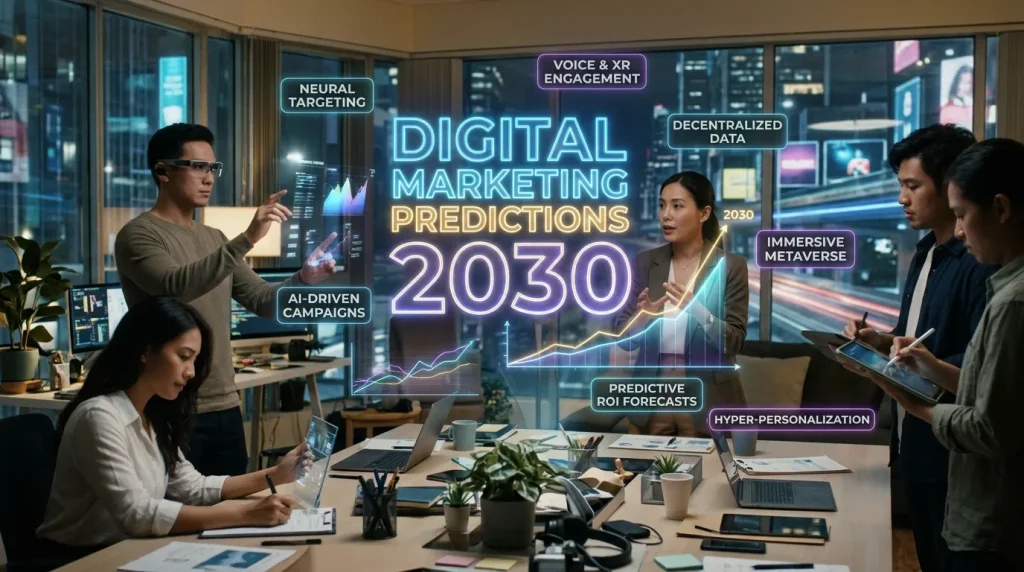

The future of digital marketing will also involve a closer connection between online and offline customer experiences. Customers may discover a product through an AI-powered search, explore reviews on social media, receive a personalized email, and complete their purchase through a mobile application. Businesses will need to provide consistent information and experiences throughout this journey.
Privacy and transparency will become even more important as consumers become more aware of how their information is collected and used. Companies that rely on clear consent, responsible data practices, and honest communication can build stronger relationships with their audiences.
Another major development will be the increased importance of measurable business outcomes. Marketing teams will need to demonstrate how their activities contribute to customer acquisition, retention, revenue, and long-term growth. The future of digital marketing will reward businesses that combine innovation with practical strategy, responsible data management, and continuous improvement.
AI in Digital Marketing
Artificial intelligence is becoming a central part of modern marketing operations. AI tools can assist with content research, customer segmentation, campaign analysis, advertising optimization, and customer support. These capabilities help marketing teams reduce repetitive work and devote more time to strategy, creativity, and relationship building.
In the future of digital marketing, generative AI will make it easier to develop initial content drafts, generate campaign ideas, analyze audience feedback, and adapt messaging for different customer segments. Predictive AI may also help businesses estimate purchasing intent, identify customers who need additional support, and determine which marketing activities deserve closer attention.
Nevertheless, AI-generated content requires human review. Automated systems can produce inaccurate information, repetitive messaging, or content that lacks originality. Businesses should verify facts, protect confidential information, and ensure that their communications reflect their brand identity.
Human creativity will remain essential because effective marketing depends on understanding emotions, cultural context, customer motivations, and complex business challenges. AI should support these abilities rather than replace thoughtful decision-making. Companies that balance automation with human expertise will be better prepared for the future of digital marketing.
Digital Marketing Automation Trends
Marketing automation helps businesses manage repetitive activities such as email campaigns, lead nurturing, customer segmentation, follow-up messages, and reporting. As automation technology improves, businesses will be able to create more coordinated campaigns that respond to customer behavior and changing interests.
For example, a company can send educational content to a new subscriber, provide additional product information when the subscriber visits a relevant page, and deliver a follow-up message after a purchase. These interactions can be organized into automated workflows that support the customer journey without requiring manual intervention at every stage.
The future of digital marketing will involve more intelligent automation that adapts to customer actions instead of relying exclusively on fixed schedules. However, automation should not make communication feel impersonal. Excessive messages, irrelevant recommendations, and poorly timed notifications can damage customer relationships.
Businesses should establish clear communication preferences, monitor campaign performance, and provide opportunities for customers to manage their subscriptions. Effective automation combines efficiency with relevance, ensuring that every message has a meaningful purpose.
Future of SEO and Content Marketing
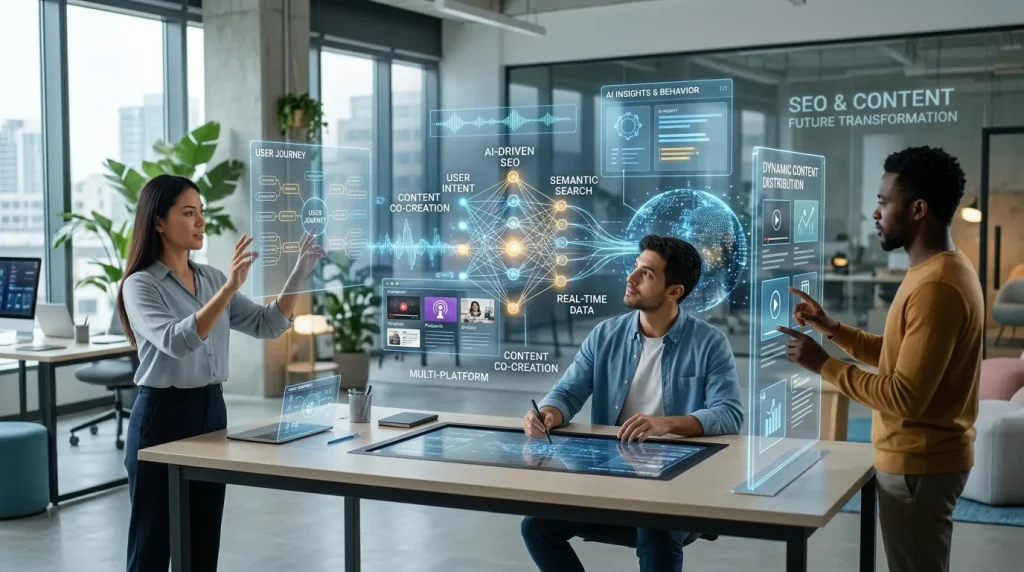
The future of digital marketing will require a broader approach to search visibility. Businesses should organize their websites logically, use descriptive headings, improve page speed, optimize for mobile devices, and provide accurate information. Original research, practical examples, expert insights, and regularly updated resources can also help content stand out.
AI-generated search summaries may change how people interact with search results. Consequently, brands should aim to become reliable sources of information while continuing to build recognition through multiple channels. Helpful content should be written for people first, with relevant keywords incorporated naturally.
Content marketing will also become more connected to video, podcasts, interactive tools, and social media discussions. A comprehensive article can support several related content formats, allowing businesses to reach audiences with different preferences. In the future of digital marketing, sustainable SEO success will depend on relevance, credibility, accessibility, and a consistently useful user experience.
Personalized Marketing Strategies
Personalization involves adapting marketing messages, recommendations, and experiences to customers’ interests and needs. Instead of sending the same communication to every person, businesses can use relevant information to make their content more useful and timely.
For example, an online retailer may recommend products based on a customer’s browsing preferences, while a software company may send educational resources suited to a subscriber’s business requirements. Personalized landing pages, segmented email campaigns, and tailored offers can help customers find information that matters to them.
The future of digital marketing will make personalization more sophisticated through AI-assisted analysis and improved audience segmentation. However, effective personalization requires responsible data collection and respect for customer privacy. Businesses should explain how personal information is used and avoid making customers uncomfortable through overly intrusive targeting.
Personalization also depends on understanding the customer’s stage in the buying journey. Someone researching a problem may need educational information, while a customer comparing solutions may benefit from product demonstrations or transparent pricing. By delivering relevant information at the right time, businesses can improve engagement and strengthen customer relationships.
Voice Search Optimization Trends
Voice search allows people to find information by speaking to smartphones, smart speakers, vehicles, and other connected devices. As conversational interfaces continue to develop, businesses will need to consider how people phrase questions naturally rather than focusing exclusively on short search terms.
Voice search queries often resemble everyday conversations. Users may ask where a service is available, how a product works, or which solution best addresses a specific problem. Businesses can respond by creating clear FAQ sections, answering common questions directly, and using natural language throughout their content.
The future of digital marketing will also involve optimization for conversational AI experiences. Accurate business information, relevant local content, structured website data, and useful answers can help search systems interpret a company’s services and expertise.
Mobile usability and local search optimization will remain important for businesses serving specific geographic areas. Keeping contact information, service descriptions, and business details consistent can improve the customer experience. Although voice search technology will continue to evolve, the underlying principle remains straightforward: provide accurate, accessible, and helpful information that matches the user’s intent.
Social Media Marketing Trends 2026
Social media platforms continue to influence product discovery, customer communication, brand awareness, and purchasing decisions. In 2026, businesses will increasingly combine short-form video, creator collaborations, community engagement, live content, and social commerce to connect with their audiences.
The future of digital marketing will require brands to understand the strengths of individual platforms instead of publishing identical content everywhere. A professional network may support industry expertise, while a video-focused platform may be better suited to demonstrations, storytelling, and behind-the-scenes content.
Businesses should establish clear objectives before investing in social media. These objectives may include increasing brand awareness, generating qualified leads, building a community, or driving online sales. Performance measurement should reflect those goals rather than relying exclusively on follower counts.
A well-developed social media marketing strategy guide can help businesses plan their content, understand their audiences, and maintain a consistent publishing approach. Brands can also improve engagement by responding to questions, encouraging genuine conversations, and collaborating with relevant creators.
For events and promotional campaigns, effective messaging can make a meaningful difference. Businesses can explore event marketing messaging that drives engagement to understand how clear communication can attract audiences and encourage participation.
Data-Driven Digital Marketing Strategies

Important metrics may include conversion rates, customer acquisition costs, qualified leads, engagement, retention, and revenue. These indicators help marketers understand whether their activities are contributing to meaningful business outcomes. The most useful metrics depend on campaign objectives, so businesses should avoid treating every measurement as equally important.
The future of digital marketing will place greater emphasis on first-party data collected directly through appropriate customer interactions, such as website engagement, subscriptions, and purchases. Businesses should collect only information they need, respect consent requirements, and maintain suitable security practices.
Marketing budgets must also reflect performance and strategic priorities. Companies can use marketing budgeting, planning, and optimizing spend to support better financial decisions and allocate resources more effectively. Regular campaign reviews can reveal where adjustments may improve results.
When data analysis is combined with experimentation and sound judgment, businesses can make more informed decisions. The future of digital marketing will favor organizations that use evidence responsibly while recognizing that numbers must be interpreted within the broader customer and business context.
Emerging Digital Marketing Technologies
Emerging technologies will continue to expand the ways businesses communicate with customers. Augmented reality can help shoppers visualize products, while virtual experiences can support product demonstrations, training, and interactive brand engagement. Conversational AI can also provide assistance and answer routine customer questions across digital channels.
Other developments include predictive analytics, advanced recommendation systems, connected devices, and improved marketing measurement tools. These technologies can help companies understand customer needs, streamline operations, and create more engaging experiences.
The future of digital marketing will not depend on adopting every new technology immediately. Businesses should assess whether a technology solves a real customer problem, supports their objectives, and offers measurable value. Small experiments can help teams evaluate benefits and limitations before making substantial investments.
Referral marketing and customer advocacy will also remain valuable alongside technological innovation. For businesses introducing new products, a well-planned product launch referral strategy can encourage satisfied customers to recommend an offer to others. This approach combines digital communication with the credibility of genuine customer recommendations.
Ultimately, emerging technologies work best when they support a clear strategy. Organizations that prioritize customer needs, responsible innovation, and continuous learning will be better prepared to navigate the future of digital marketing through 2030.
Conclusion
The future of digital marketing will be shaped by continuous technological innovation, changing customer expectations, and the growing importance of personalized experiences. From artificial intelligence and marketing automation to SEO, voice search, social media, and data-driven strategies, businesses must be prepared to adapt to new opportunities between 2026 and 2030.
FAQ
1. What is the future of digital marketing?
The future of digital marketing involves greater use of AI, automation, personalization, conversational search, and data-driven strategies. Businesses will focus on creating relevant customer experiences while improving campaign efficiency and maintaining trust.
2. What are the biggest digital marketing trends in 2026?
Major trends include AI-assisted marketing, short-form video, marketing automation, personalized customer experiences, social commerce, conversational search, and privacy-conscious data strategies.
3. How will AI change digital marketing by 2030?
AI is expected to support content development, predictive analytics, audience segmentation, customer service, and campaign optimization. Human oversight will remain important for accuracy, originality, and responsible decision-making.
4. Will SEO still be important in 2030?
Yes. SEO will remain valuable as businesses compete to provide useful, trustworthy, and accessible information across traditional search engines and emerging AI-powered search experiences.
5. How can small businesses prepare for future digital marketing trends?
Small businesses can start by improving their websites, creating helpful content, building a consistent social media presence, using basic automation, and measuring campaign results before investing in more advanced tools.
6. Why is personalization important in digital marketing?
Personalization helps businesses provide relevant information, recommendations, and offers based on customer interests. When implemented responsibly, it can improve engagement and support stronger customer relationships.
7. What role will marketing automation play in the future?
Marketing automation will help businesses manage repetitive tasks, coordinate customer communications, nurture leads, and respond to customer behavior more efficiently.
8. How will voice search affect digital marketing?
Voice search will encourage businesses to create conversational content, answer common questions clearly, improve local search information, and make websites accessible across devices.
9. How can businesses measure digital marketing success?
Businesses can track metrics such as qualified leads, conversion rates, customer acquisition costs, revenue, engagement, and customer retention. Measurements should align with specific campaign and business objectives.
10. How can companies stay competitive in digital marketing through 2030?
Companies can stay competitive by monitoring relevant trends, testing new technologies carefully, creating valuable content, respecting customer privacy, and continually improving their strategies using reliable performance data.