


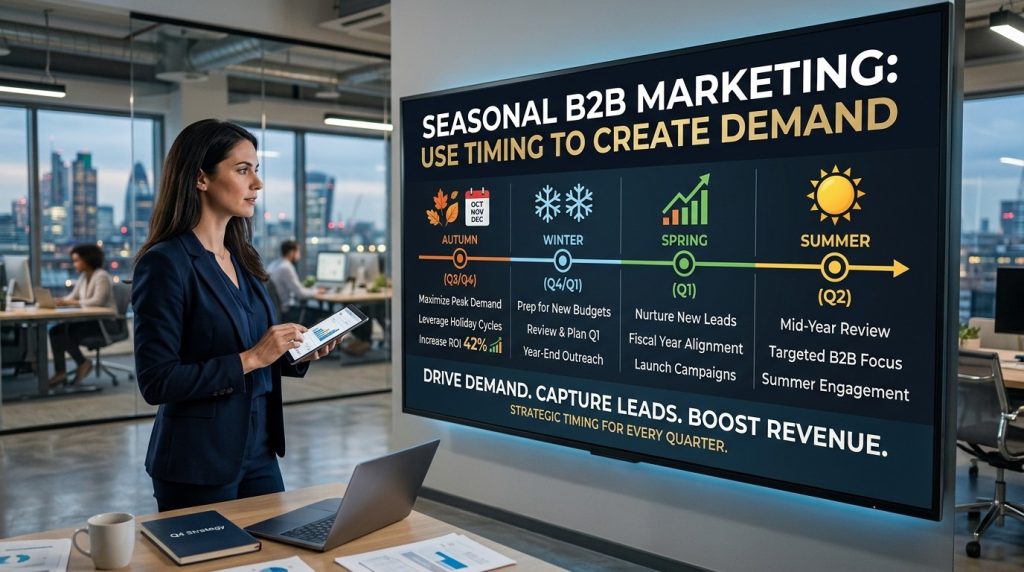
Seasonal B2B Marketing helps companies align demand generation with predictable business cycles, budget periods, industry events, customer priorities, and timely buying opportunities.
Business-to-business demand rarely appears at random.
Organizations move through planning cycles, budgeting periods, procurement windows, product launches, hiring phases, compliance deadlines, conferences, industry events, financial reporting periods, and operational changes. Decision-makers may have very different priorities in January compared with June, even when they are purchasing the same solution from the same vendor.
That changing context creates a major opportunity for marketers.
Seasonal B2B Marketing is the practice of aligning B2B campaigns, content, offers, sales activity, messaging, and lead-generation efforts with predictable or emerging periods when business needs become more important, urgent, or commercially actionable.
The concept goes far beyond holiday promotions.
For B2B organizations, a season can be any recurring or temporary period that changes buying behavior.
A software company may experience demand before annual planning. An accounting firm may become highly relevant before reporting deadlines. A logistics provider may see demand before peak shipping periods. A cybersecurity company may gain attention during budget planning or compliance cycles. A manufacturer may experience procurement activity before a production season.
Seasonal B2B Marketing helps marketers stop treating the calendar as a list of dates and start treating time as a demand signal.
When businesses understand when their customers become more motivated to solve a problem, they can enter the conversation earlier, create stronger relevance, prepare sales teams more effectively, and capture opportunities that generic year-round campaigns often miss.
What Is Seasonal B2B Marketing?
Seasonal B2B Marketing is a strategy that coordinates marketing activity with recurring or temporary changes in business priorities and buyer behavior.
In consumer marketing, seasonality often refers to holidays, weather, school periods, or shopping events.
In B2B, seasonality can be more complex.
It can emerge from:
- Fiscal years
- Budget approvals
- Procurement schedules
- Industry conferences
- Regulatory deadlines
- Contract renewals
- Hiring cycles
- Product launches
- Annual planning
- Quarterly reporting
- Supply-chain cycles
- Peak operating periods
- Business closures
- Executive planning periods
The common factor is timing.
Seasonal B2B Marketing recognizes that the same prospect can have different levels of urgency throughout the year. A company might ignore a software platform in one quarter and actively evaluate it three months later because its annual planning process has started.
That change creates a window.
The marketer’s job is to recognize it.
Why Timing Matters So Much in B2B
B2B purchases are often complicated.
They can involve multiple stakeholders, significant budgets, technical evaluation, procurement, legal review, implementation planning, and executive approval.
Because the process is complex, timing can influence when a problem receives internal attention.
A decision-maker may know that a business problem exists but still postpone action because another priority is more urgent.
Then a trigger appears.
A budget becomes available.
A contract approaches renewal.
A compliance deadline becomes closer.
An executive establishes a new strategic objective.
A new business cycle begins.
Suddenly, an existing problem becomes a buying priority.
Seasonal B2B Marketing is designed to anticipate those moments.
Instead of waiting until a buyer actively searches for a solution, marketers can build familiarity before the decision becomes urgent.
The Psychology Behind B2B Seasonality
B2B buyers are not purely rational machines.
They are professionals making decisions under pressure, uncertainty, incentives, deadlines, organizational politics, and resource limitations.
A seasonal trigger can change their mental state.
Before a planning cycle, they may be exploratory.
During budget allocation, they may be financially focused.
Before a compliance deadline, they may become risk-sensitive.
Before peak demand, they may prioritize reliability and capacity.
During annual reviews, they may focus on performance and measurable results.
This means Seasonal B2B Marketing should change not only its timing but also its psychological framing.
A message about efficiency may work during cost-planning periods.
A message about risk reduction may be stronger before an audit.
A message about scalability may resonate before a predictable growth cycle.
Timing influences what buyers care about.
The Difference Between B2B Seasonality and Consumer Seasonality
B2B marketers sometimes assume that seasonality is mostly a consumer concept.
That is a mistake.
The difference is that B2B seasonality is often driven by organizational systems rather than purely cultural holidays.
| Consumer Seasonality | B2B Seasonality |
|---|---|
| Holidays | Budget cycles |
| Weather | Procurement cycles |
| School calendars | Fiscal calendars |
| Shopping periods | Contract renewals |
| Cultural events | Industry events |
| Personal needs | Organizational priorities |
| Emotional purchases | Business-case decisions |
| Short purchase journeys | Longer buying journeys |
Seasonal B2B Marketing therefore needs deeper customer research.
A B2B marketer should understand how the target organization operates throughout the year.
Finding the Seasonal Patterns in Your Market
The first step is to discover when demand changes.
Begin with historical business data.
Review sales by month, quarter, industry, product, region, lead source, and customer segment.
Then look for recurring patterns.
Ask:
When do leads increase?
When do deals close?
When do prospects request proposals?
When do customers renew?
When do sales cycles accelerate?
When does website traffic change?
When do specific industries become more active?
When do customers ask particular questions?
These patterns can reveal hidden seasonal cycles.
Seasonal B2B Marketing becomes much stronger when the strategy is built from actual evidence instead of assumptions.
Sales Data Is Often the Best Starting Point
Marketing teams sometimes search for trends in external market reports before examining their own CRM.
Internal data can be more valuable.
Your CRM may reveal that enterprise opportunities consistently accelerate in the final month of a fiscal quarter.
It may show that specific industries begin evaluating services several months before their peak season.
It may reveal that renewals cluster around the same periods every year.
It may show that leads generated during one seasonal window convert faster than those generated during ordinary periods.
These insights can transform planning.
Seasonal B2B Marketing can then be built around moments already proven to influence revenue.
Building a B2B Seasonal Demand Map
A useful seasonal demand map organizes the year around customer needs rather than holidays.
For example:
| Time Period | Buyer Trigger | Likely Concern | Marketing Opportunity |
|---|---|---|---|
| Early Q1 | New-year planning | Strategy | Educational content |
| Mid-year | Budget reviews | Efficiency | ROI messaging |
| Pre-peak season | Capacity pressure | Reliability | Solution campaigns |
| Pre-renewal | Contract review | Value | Retention messaging |
| Pre-compliance deadline | Risk | Compliance | Risk-reduction content |
| Year-end | Budget utilization | Investment | Decision-support campaigns |
The exact pattern varies by company.
The framework is what matters.
Seasonal B2B Marketing should map commercial behavior to a timeline that the marketing and sales teams can actually use.
Fiscal Cycles and Budget Windows
Budget timing is one of the strongest B2B seasonal signals.
Organizations allocate money according to internal financial calendars.
Some businesses finalize budgets near the end of a calendar year.
Others operate on different fiscal years.
The timing of budget approval can influence whether buyers are willing to explore new solutions.
Early in the cycle, a buyer may want strategic justification.
Closer to approval, they may need ROI evidence.
After allocation, they may need implementation information.
Later, remaining budget can create another buying window.
Seasonal B2B Marketing should therefore align messaging with the buyer’s financial mindset rather than simply increasing advertising during a predefined month.
Procurement Cycles
Procurement can create predictable demand patterns.
Large organizations may conduct vendor evaluations at specific times.
Contracts may expire annually.
Supplier reviews may happen during planned periods.
Procurement teams may also impose deadlines for submitting proposals.
A marketer who understands these patterns can create content that answers procurement questions before the evaluation begins.
This can include:
- Vendor comparison guides
- ROI calculators
- Implementation documentation
- Security information
- Case studies
- Procurement checklists
- Technical specifications
Timing matters because procurement teams often need information before sales conversations become active.
Contract Renewal Seasons
Renewal periods are another important opportunity.
When customers approach renewal, they reassess value.
They ask:
Did the solution deliver results?
Should we expand?
Should we negotiate?
Should we replace the provider?
Seasonal B2B Marketing can support retention by increasing communication before the renewal decision becomes urgent.
This should not be limited to upselling.
The campaign should reinforce value, document outcomes, and address unresolved concerns.
That creates a stronger foundation for retention.
Industry Events as Demand Triggers
Industry events create temporary concentrations of attention.
Conferences, trade shows, exhibitions, association meetings, workshops, and professional gatherings can change what buyers are researching.
A B2B company can create pre-event content, event-focused landing pages, meeting campaigns, post-event resources, and follow-up sequences.
Event Marketing becomes especially powerful when connected to an existing business need.
The event itself should not be the entire reason for the campaign.
Instead, marketers should ask what buyers are trying to accomplish around the event.
Are they evaluating vendors?
Learning about new technology?
Networking?
Planning purchases?
Looking for partners?
Solving operational problems?
Seasonal B2B Marketing can use those questions to develop messages that remain useful after the event ends.
Weather Can Influence B2B Demand Too
Weather is not only relevant to consumer behavior.
Certain B2B sectors are strongly affected by environmental conditions.
Construction, logistics, agriculture, energy, hospitality, facilities management, outdoor services, transportation, and many other industries can experience demand changes based on weather.
A logistics company might need to prepare clients for severe conditions.
A facilities company may promote preventative services before a seasonal weather shift.
A supplier may anticipate changes in inventory requirements.
This creates opportunities for Weather-Based Marketing in industries where environmental conditions directly affect operations.
The marketing message should connect the weather signal to business impact.
Creating Seasonal Content That Supports Buyers
B2B buyers rarely want a sales pitch when they first recognize a seasonal problem.
They want clarity.
Useful seasonal content can include:
- Planning guides
- Industry checklists
- Forecast reports
- Budget templates
- Trend analysis
- Risk assessments
- Operational frameworks
- Benchmark reports
- ROI examples
- Procurement guides
- Implementation roadmaps
This content creates an information bridge between awareness and purchase.
Seasonal B2B Marketing should therefore include different content for different stages of the buying journey.
Early-Season Content
Early in the cycle, buyers may not be ready to purchase.
Educational content works well here.
The goal is to help them understand the upcoming challenge.
Examples include:
“How to Prepare for Next Quarter’s Capacity Increase”
“What Operations Leaders Should Review Before Peak Season”
“Budget Planning Questions for Technology Investments”
This content creates awareness before the buying process becomes urgent.
Mid-Season Content
As urgency increases, content should become more practical.
Buyers may want:
- Comparisons
- Case studies
- Product demonstrations
- Cost analysis
- Implementation details
- Vendor evaluation criteria
Seasonal B2B Marketing should shift from “why this matters” toward “how to solve it.”
Late-Season Content
Near a deadline, decision-makers often want speed and risk reduction.
Messages can emphasize:
- Implementation timelines
- Support
- Availability
- Quick-start solutions
- Cost certainty
- Deployment confidence
At this stage, the marketing goal is often to reduce friction.
Aligning Marketing and Sales
Seasonal strategies fail when marketing and sales operate separately.
Sales teams know where the market is becoming active.
They hear objections.
They understand procurement timing.
They know which accounts are preparing to buy.
Marketing teams can turn that knowledge into scalable content and campaigns.
Seasonal B2B Marketing should therefore be built collaboratively.
A simple weekly or monthly feedback process can uncover valuable signals.
Marketing can ask sales:
Which industries are becoming more active?
What questions are prospects asking?
Which deals are accelerating?
Which objections are appearing?
What deadlines are prospects mentioning?
The answers can influence campaign timing.
Account-Based Seasonal Marketing
Account-based marketing becomes even more powerful when combined with seasonality.
Instead of targeting an entire market with one message, a company can identify accounts approaching a relevant business trigger.
For example:
A retailer preparing for peak demand may need logistics support.
A manufacturer entering a production cycle may need automation.
A financial institution approaching a reporting period may need compliance technology.
An enterprise renewing contracts may evaluate alternatives.
Seasonal B2B Marketing can prioritize these accounts when their likelihood of engagement increases.
Account Signals and Intent
Useful account signals may include:
- Website visits
- Content downloads
- Product research
- Hiring activity
- New executive appointments
- Funding events
- Expansion announcements
- Technology changes
- Contract timing
- Industry events
These signals can indicate that an account’s internal priorities are changing.
Combining them with historical seasonality can improve targeting.
Building a Seasonal Lead-Nurture Journey
Not every lead will be ready at the same moment.
Seasonal campaigns should therefore include nurture paths.
A prospect might first download a planning guide.
Then receive an industry benchmark.
Then see a case study.
Then receive implementation information.
Finally, they may receive a consultation offer.
This progression supports the psychology of gradual commitment.
The buyer receives increasing levels of information as intent develops.
Email Campaigns for Seasonal Demand
Email is particularly effective for existing B2B audiences.
A seasonal sequence can include:
Email One: Why the upcoming period matters.
Email Two: Common risks or challenges.
Email Three: Planning checklist.
Email Four: Evidence and case study.
Email Five: Solution options.
Email Six: Consultation or assessment.
The exact sequence should reflect the complexity of the product and buying cycle.
Seasonal B2B Marketing works best when emails feel like useful guidance rather than repetitive promotion.
Search Marketing and Seasonal B2B Intent
Search behavior can reveal when business needs become urgent.
A B2B buyer may search for a solution months before making a purchase.
The exact pattern varies by industry.
That means marketers should identify both early-research keywords and high-intent commercial searches.
For example:
Early intent might involve “how to prepare for peak demand.”
Later intent might involve “enterprise demand planning software.”
The content and advertising strategy should cover the entire journey.
SEO for Seasonal B2B Demand
Seasonal SEO can be challenging because search patterns may fluctuate.
A good strategy often begins months before the peak period.
Create evergreen pages that can be updated annually.
Develop supporting articles around recurring questions.
Build internal links around a seasonal topic cluster.
Refresh statistics and examples.
Update calls to action.
Check whether search intent has changed.
This makes the campaign more efficient over time.
Paid Search Timing
Paid search budgets can also be adjusted around seasonal intent.
During low-intent periods, marketers may prioritize educational keywords.
As the buying window approaches, budget can shift toward high-commercial-intent terms.
This avoids treating every day as equally valuable.
Seasonal B2B Marketing can therefore become a budget-allocation strategy as much as a messaging strategy.
Paid Social in B2B Seasonality
Paid social can help create awareness before buyers actively search.
LinkedIn and other professional platforms can be particularly useful for industry-targeted campaigns.
The creative can focus on:
- Upcoming deadlines
- Industry risks
- Seasonal planning
- Benchmark data
- Event participation
- Strategic priorities
This helps establish awareness before search intent becomes obvious.
Retargeting Seasonal Visitors
Some prospects will interact early but delay action.
Retargeting allows marketers to continue the conversation.
A person who reads a seasonal planning guide can later see:
- A case study
- A benchmark
- A webinar
- A product demonstration
- A calculator
- A consultation invitation
This creates continuity.
The important thing is to avoid showing the same generic advertisement repeatedly.
The message should evolve as buyer intent develops.
Seasonal Webinars
Webinars can become powerful demand-generation assets during predictable planning windows.
Examples include:
“Preparing Your Business for Peak Season”
“Budget Planning for Next Year’s Technology Investments”
“Reducing Operational Risk Before a Seasonal Surge”
“How Procurement Teams Can Evaluate Vendors Faster”
The strongest webinars solve a timely problem.
They give buyers a reason to attend now rather than sometime later.
Seasonal Reports and Benchmarks
Data-driven content can create authority.
An industry benchmark published before a planning period can help executives understand where they stand.
The report might examine:
- Costs
- Productivity
- Industry adoption
- Customer expectations
- Operational risk
- Technology usage
- Seasonal performance
The content becomes a planning tool, not merely marketing collateral.
This improves perceived value.
Offer Strategy
B2B seasonal offers should not always be discounts.
A discount can sometimes reduce perceived value for premium services.
Alternative offers include:
- Free assessment
- Strategy workshop
- Consultation
- Benchmark report
- Audit
- Planning session
- Pilot program
- Implementation review
- Executive briefing
The offer should reduce the buyer’s perceived risk or effort.
Using Urgency Responsibly
Seasonal campaigns naturally involve deadlines.
That creates legitimate urgency.
But B2B buyers are often sophisticated.
Artificial urgency can damage credibility.
Instead of inventing a deadline, marketers should connect urgency to real business conditions.
For example:
“Prepare before peak fulfillment begins.”
“Plan before annual budget approvals.”
“Review your contracts before renewal.”
“Complete implementation before the seasonal surge.”
The urgency comes from the business environment.
Seasonal B2B Marketing and Pricing
Pricing strategy can also change with demand.
A company may offer incentives before a major demand period to secure commitments early.
Another company may bundle implementation and support during a planning window.
Some businesses can use seasonal capacity pricing.
Others may offer longer-term commitments around predictable purchase periods.
The correct strategy depends on the economics of the industry.
Marketing should communicate price in the context of business value.
Understanding Buyer Risk
B2B buyers carry professional risk.
A poor purchase can affect their performance, reputation, budget, or career.
Seasonality can increase that risk perception.
Before a major operating period, buyers may become less tolerant of implementation problems.
Therefore, Seasonal B2B Marketing should emphasize trust.
Useful proof includes:
- Customer case studies
- Reviews
- Certifications
- Security information
- Implementation timelines
- Service-level commitments
- Customer success data
- Industry experience
The stronger the evidence, the easier it becomes for a buyer to defend a purchasing decision internally.
Internal Selling and Seasonal Campaigns
A B2B purchase rarely depends on one person.
Champions often need to persuade managers, finance teams, technical stakeholders, procurement teams, or executives.
This is why marketing should create material that can travel internally.
For example:
- One-page business cases
- ROI summaries
- Technical briefs
- Executive presentations
- Risk assessments
- Comparison sheets
Seasonal B2B Marketing should help the internal champion build consensus.
Common Seasonal B2B Marketing Mistakes
Many companies make the strategy more complicated than necessary.
Mistake One: Treating Holidays as the Only Seasons
Business cycles are often more commercially meaningful.
Mistake Two: Starting Too Late
Demand generation needs lead time.
Mistake Three: Creating One Message for the Entire Cycle
Buyer psychology changes as urgency increases.
Mistake Four: Ignoring Historical Data
Past performance can reveal predictable patterns.
Mistake Five: Disconnecting Marketing From Sales
Sales teams often know seasonal changes first.
Mistake Six: Overusing Discounts
B2B buyers may value proof more than price.
Mistake Seven: Ignoring Procurement
The person interested in the solution may not be the person who controls the process.
Mistake Eight: Forgetting Measurement
A seasonal campaign should produce learning that improves future campaigns.
Avoiding these mistakes can dramatically improve efficiency.
Measuring Seasonal Campaign Performance
Seasonal campaigns should use a combination of marketing and revenue metrics.
| Metric | Purpose |
|---|---|
| Qualified leads | Measures demand quality |
| Meeting rate | Measures sales interest |
| Opportunity creation | Measures pipeline impact |
| Win rate | Measures commercial effectiveness |
| Sales-cycle length | Measures timing impact |
| Revenue | Measures direct business value |
| Customer acquisition cost | Measures efficiency |
| Pipeline velocity | Measures momentum |
| Renewal rate | Measures retention |
| Engagement by account | Measures account interest |
Comparing these metrics with non-seasonal periods can reveal whether the seasonal strategy genuinely improved performance.
Measuring the Timing Effect
One important question is whether seasonal campaigns actually improve timing.
For example:
Do leads convert faster?
Do sales conversations begin earlier?
Does pipeline accumulate before the peak period?
Do prospects require fewer touchpoints?
Does win rate increase?
If the answer is yes, timing is producing strategic value.
This is one of the most important reasons to invest in Seasonal B2B Marketing.
Attribution Should Include Delayed Conversions
B2B deals often take weeks or months to close.
A campaign launched before a seasonal buying window may generate a lead that converts much later.
Judging that campaign only by immediate revenue can create misleading conclusions.
Use longer attribution windows.
Track the customer journey from initial interaction to opportunity and final revenue.
This provides a more accurate picture of seasonal campaign impact.
Creating a Repeatable Seasonal Campaign System
Once a seasonal opportunity is proven, document it.
Record:
- Launch date
- Audience
- Trigger
- Message
- Offer
- Channel
- Budget
- Lead volume
- Conversion rate
- Pipeline
- Revenue
- Lessons learned
The next year, the team should not start from zero.
It should begin with the previous year’s learning.
This creates compound advantage.
Each cycle becomes easier to forecast and execute.
The Role of Automation
Automation can make seasonal execution more efficient.
Marketing systems can trigger campaigns based on dates, customer behavior, account activity, or predefined conditions.
Automated sequences can support:
- Lead nurturing
- Event reminders
- Renewal communication
- Content distribution
- Retargeting
- Sales alerts
- Internal notifications
But automation should not mean sending the same campaign every year without reassessing the market.
Buyer behavior changes.
The strategy should evolve.
AI and Seasonal Demand Forecasting
AI can assist B2B teams in analyzing historical patterns and identifying relationships between different variables.
A model might detect that a particular industry begins researching a service several months before a known operating peak.
Another system could identify which account segments respond most strongly during specific periods.
AI can also help analyze:
- Search trends
- CRM activity
- Content engagement
- Sales notes
- Industry news
- Website behavior
The strategic value comes from turning those signals into better decisions.
Human expertise remains important because not every statistical pattern represents a real commercial opportunity.
Seasonal B2B Marketing Across Industries
Almost every B2B sector can have some form of seasonality.
Technology
Budget cycles, product launches, cybersecurity planning, and infrastructure upgrades can create recurring demand windows.
Manufacturing
Production schedules, procurement periods, maintenance cycles, and inventory requirements can shape buying behavior.
Logistics
Peak shipping periods, holiday fulfillment, weather disruptions, and inventory movements influence demand.
Professional Services
Reporting deadlines, fiscal planning, tax cycles, and business reviews create opportunities.
Healthcare
Budget periods, staffing requirements, compliance cycles, and operational planning influence demand.
Construction
Weather patterns, project schedules, permitting timelines, and material procurement can affect purchase timing.
Financial Services
Reporting periods, budgeting, regulatory requirements, and strategic planning can create predictable activity.
The exact trigger changes, but the principle remains.
Understand when the business problem becomes important.
Creating an Annual Seasonal B2B Strategy
A complete annual strategy can be divided into several stages.
Research Phase
Analyze historical performance and identify recurring triggers.
Forecasting Phase
Estimate upcoming demand windows.
Preparation Phase
Create content, landing pages, sales tools, offers, and campaign assets.
Activation Phase
Launch campaigns before the buying window reaches its peak.
Acceleration Phase
Increase sales alignment and high-intent messaging as demand rises.
Conversion Phase
Remove friction and support decision-making.
Review Phase
Measure performance and document learning.
This framework turns seasonality into a repeatable process.
How Far Ahead Should B2B Marketers Plan?
There is no universal answer.
The right lead time depends on sales-cycle length.
A transactional B2B product may need weeks.
An enterprise platform may require months.
A consulting engagement may depend on annual planning.
The campaign should begin early enough for awareness to develop before the buying decision becomes urgent.
The longer the sales cycle, the earlier the marketer needs to enter the conversation.
Lead Time Should Match Buyer Complexity
A common planning mistake is using the same campaign schedule for every product.
That does not make sense.
A low-cost service may require little consideration.
An enterprise transformation project may involve multiple departments and months of evaluation.
Therefore, Seasonal B2B Marketing should match content lead time to decision complexity.
The harder the decision, the earlier education should begin.
Seasonal Personalization
Personalization can improve relevance when used carefully.
Instead of saying:
“Our seasonal campaign is now live.”
A company might communicate:
“As your annual planning period approaches, here are three ways operations teams are reducing capacity risk.”
This message is more relevant because it reflects the recipient’s likely business context.
Personalization should be based on meaningful information, not superficial details.
Geographic and Regional Seasonality
B2B seasonality can vary by geography.
Different markets may have different fiscal cycles, weather conditions, holidays, industry structures, or procurement patterns.
A global campaign should therefore avoid assuming that one seasonal calendar fits every region.
Regional versions may require:
- Different launch dates
- Different examples
- Different offers
- Different content
- Different regulations
- Different cultural context
Localization can significantly improve relevance.
Seasonal Demand and Thought Leadership
Thought leadership can be especially useful before high-value planning periods.
A business can publish an industry forecast, executive briefing, market outlook, or strategic analysis before buyers finalize plans.
This positions the company as a useful source of perspective rather than simply another vendor.
The goal is to influence the buyer’s thinking before they define the vendor shortlist.
That is often where the highest strategic value lies.
Seasonal Case Studies
Case studies can provide proof at exactly the right moment.
A logistics provider can publish a peak-season case study before another peak season.
A software company can publish a planning-cycle case study before budget season.
A compliance provider can release a deadline-readiness case study before an audit period.
The content becomes immediately relevant because the prospect can imagine themselves facing a similar situation.
Creating Seasonal Landing Pages
Landing pages should align tightly with the campaign.
A seasonal landing page might contain:
- Problem
- Seasonal trigger
- Business impact
- Solution
- Evidence
- Implementation details
- FAQ
- Call to action
Avoid creating pages that are only promotional.
Useful information increases trust.
Repurposing Seasonal Assets
One strong seasonal asset can become many content formats.
A report can become:
- Blog posts
- LinkedIn posts
- Email sequences
- Sales slides
- Webinar topics
- Short videos
- Infographics
- Executive summaries
This improves efficiency.
The central insight remains consistent while the format changes according to channel.
Seasonal B2B Marketing and Customer Retention
Seasonality is not only for acquisition.
Existing customers may have predictable moments when they need additional support.
A company can offer:
- Seasonal checkups
- Optimization reviews
- Training
- Upgrades
- Capacity planning
- Renewal support
- Performance reports
These activities deepen the relationship.
The same seasonal insight that generates new demand can strengthen customer retention.
The Competitive Advantage of Better Timing
Many B2B companies compete on product features.
Others compete on pricing.
Timing provides another competitive dimension.
The company that reaches a buyer while the problem is becoming important can establish an advantage before competitors become visible.
This does not require being the first company in the market.
It requires being relevant at the right moment.
That distinction is crucial.
From Calendar Marketing to Demand Intelligence
The future of B2B seasonality is likely to become more data-driven.
Instead of creating a static calendar once a year, companies can maintain dynamic demand maps that combine:
- Historical sales
- CRM activity
- Search behavior
- Market changes
- Industry events
- Economic signals
- Customer engagement
- Account intent
- Operational indicators
This transforms the calendar into a decision system.
Seasonal B2B Marketing becomes less about dates and more about signals.
Why Timing Can Create Demand
Some marketers assume marketing only captures demand that already exists.
Good timing can do more.
When a business shows a customer an upcoming risk, explains the cost of delay, provides a practical plan, and introduces a credible solution before urgency peaks, the marketing campaign can actively increase the importance of the problem.
That is how timing can create demand.
The marketer is not inventing the business problem.
The marketer is helping the buyer recognize its relevance sooner.
A Practical Checklist
Before launching a seasonal B2B campaign, ask:
Demand
Is there evidence that buyer behavior changes during this period?
Timing
When does research begin?
When does urgency increase?
When does the decision typically happen?
Audience
Which industries, accounts, or roles are most affected?
Message
What problem becomes more important?
Proof
What evidence reduces buyer risk?
Offer
What makes taking the next step easier?
Sales
Is the sales team prepared?
Operations
Can the company deliver what the campaign promises?
Measurement
How will pipeline, revenue, and timing impact be evaluated?
If these questions have clear answers, the campaign has a much stronger foundation.
What the Best Seasonal B2B Marketers Do Differently
The strongest marketers do not merely ask what happens every season.
They ask why demand changes.
That question reveals the underlying mechanism.
Maybe budgets reset.
Maybe capacity becomes constrained.
Maybe risk increases.
Maybe customers enter a planning period.
Maybe procurement activity rises.
Maybe an external event changes priorities.
Once the mechanism is understood, the marketer can identify adjacent opportunities.
This allows Seasonal B2B Marketing to evolve beyond repetitive campaigns into a strategic demand-generation discipline.
Final Strategic Perspective
B2B markets are dynamic because businesses operate according to cycles.
Those cycles affect budgets.
Budgets affect priorities.
Priorities affect research.
Research affects vendor conversations.
Vendor conversations affect pipeline.
Pipeline affects revenue.
Timing connects all of these stages.
Seasonal B2B Marketing gives marketers a structured way to recognize those connections and act before competitors do.
The objective is not to fill a calendar with campaigns.
The objective is to understand when a customer is most likely to care.
That requires research, data, psychology, sales collaboration, content planning, and operational discipline.
But the result can be powerful.
A well-timed campaign can feel less like advertising and more like assistance.
It appears when the buyer has a reason to listen.
It addresses a problem that has become important.
It provides evidence when uncertainty matters.
It offers a path forward when action becomes necessary.
That is how timing becomes a competitive advantage.
Frequently Asked Questions (FAQ)
What is Seasonal B2B Marketing?
Seasonal B2B Marketing is the practice of aligning B2B campaigns and sales activity with recurring or temporary periods when business priorities, budgets, customer needs, or buying behavior change.
Is B2B marketing really seasonal?
Yes. B2B demand can fluctuate because of fiscal calendars, procurement cycles, contract renewals, industry events, compliance deadlines, operational peaks, and annual planning periods.
How can a company identify its B2B seasonal patterns?
Start by analyzing CRM data, historical revenue, lead generation, proposal requests, deal-closing dates, customer renewals, website behavior, and industry-specific events to identify recurring demand changes.
How early should a seasonal B2B campaign start?
The appropriate lead time depends on the product’s sales cycle. Complex enterprise purchases may require months of education, while simpler B2B purchases may require considerably less preparation.
Can Seasonal B2B Marketing work for SaaS companies?
Yes. SaaS companies can align campaigns with budget planning, software renewal periods, annual planning, operational peaks, product launches, compliance requirements, and technology review cycles.
Does seasonal B2B marketing require discounts?
No. Offers can include assessments, consultations, planning workshops, reports, demonstrations, pilots, implementation reviews, or other ways of reducing buyer risk and effort.
How does weather affect B2B marketing?
Weather can influence industries such as logistics, construction, agriculture, transportation, energy, hospitality, and facilities management by changing operational conditions and customer demand.
How can sales and marketing work together on seasonal campaigns?
Marketing can use sales insights about buyer timing, objections, account activity, and upcoming opportunities to improve messaging, content, campaign timing, and account prioritization.
What metrics should be used to measure seasonal B2B campaigns?
Useful metrics include qualified leads, meetings, opportunities, pipeline, win rate, sales-cycle duration, revenue, acquisition cost, pipeline velocity, renewal rate, and engagement by target account.
What is the biggest advantage of Seasonal B2B Marketing?
Its biggest advantage is timing. By reaching prospects when a business problem becomes more relevant or urgent, companies can improve relevance, accelerate conversations, support sales teams, and capture demand before competitors.
Conclusion
Seasonal B2B Marketing turns business timing into a strategic demand-generation advantage. By understanding fiscal cycles, procurement windows, renewals, industry events, operational peaks, customer planning periods, and temporary market triggers, companies can reach buyers when their priorities are changing. The most effective approach combines historical data, buyer psychology, sales collaboration, targeted content, timely offers, and accurate measurement. Rather than creating campaigns simply because a date appears on a calendar, marketers should identify the business reason behind each demand window. When the right message reaches the right buyer before urgency peaks, marketing becomes more useful, sales conversations become easier, and seasonal demand can become a repeatable source of sustainable pipeline and revenue.