
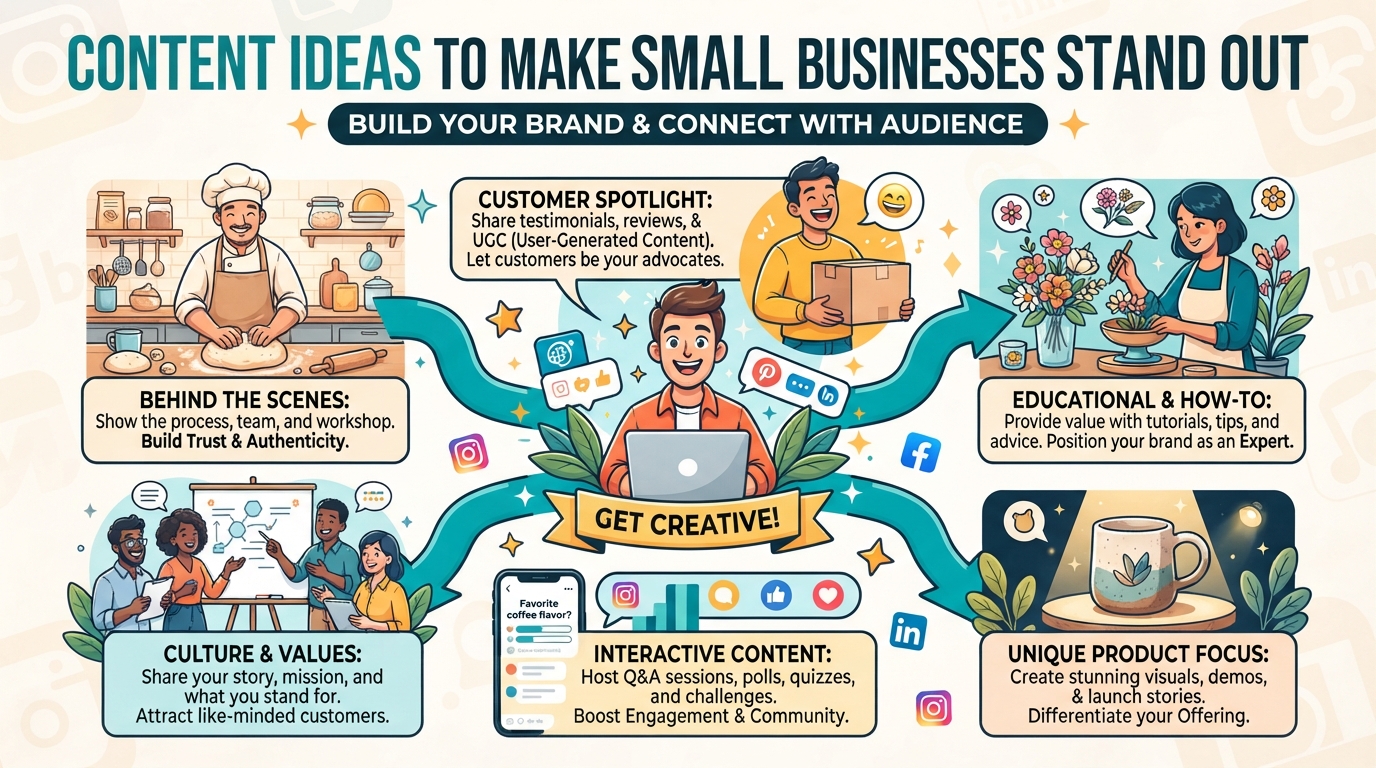
For small businesses creating useful content is a simple way to connect with customers, build trust, and grow online. You don’t need a big budget—just your smartphone, ideas, and customer insights.
Easy Content Ideas for Small Businesses
You do not need complicated ideas to create good content. Some of the best content can come from the simple things you already do every day.
Here are some practical ideas you can start using today.
1. Introduce Your Products or Services
One of the easiest content ideas is to introduce your products or services.
Instead of simply saying, “Our new product is available,” explain what the product does and why customers may find it useful.
For example, if you sell clothing, you can talk about:
- Fabric quality
- Available sizes
- Available colors
- How to choose the right size
- How to care for the product
- Where and when to use it
This type of content gives potential customers useful information before they make a purchase.
For small businesses, product education can also reduce repetitive customer questions.
2. Share Behind-the-Scenes Content
People are often interested in what happens behind a business.
Show customers how your products are made, packed, prepared, or delivered.
For example, a bakery can show how a cake is decorated. A clothing business can show the packaging process. A handmade business can show how a product is created.
You can record these moments with your smartphone.
Behind-the-scenes content makes your business feel more personal and authentic.
3. Answer Common Customer Questions
Your customers are already giving you content ideas every day.
Think about the questions they ask repeatedly.
For example:
- How long does delivery take?
- How can I place an order?
- Do you accept returns?
- Which size should I choose?
- What payment methods are available?
- How should I use the product?
Each question can become a separate social media post, short video, or blog topic.
This is one of the most practical Content ideas for small businesses because you do not have to spend hours researching new topics.
4. Create How-To Content
Educational content can help your business become a useful source of information.
Create simple tutorials related to your industry.
For example, a skincare business could share basic skincare tips. A plant shop could explain how to take care of indoor plants. A computer repair business could share tips for keeping a laptop running smoothly.
The goal is to solve a small problem for your audience.
You can provide useful information without directly promoting a product in every post.
5. Share Customer Reviews
Customer reviews can be turned into useful content.
With permission, you can share a customer’s feedback as a social media graphic, short video, or testimonial post.
You can also explain the customer’s problem and how your product or service helped them.
Always ask for permission before publishing personal information, photos, or private conversations.
6. Create Before-and-After Content
Before-and-after content can be very effective when your business involves visible changes.
Examples include:
- Room decoration before and after
- Website redesign before and after
- Graphic design projects
- Product packaging changes
- Food presentation
- Home organization
Make sure your claims are accurate and that the images represent real results.
7. Create an FAQ Series
Instead of publishing one large FAQ post, turn your most common questions into a series.
For example, every week you can answer one customer question.
Over time, you can build a large collection of helpful content without constantly searching for new topics.
Social Media Content Ideas

Social media can be an affordable way for businesses to connect with existing and potential customers.
However, you do not need to be active on every platform.
Choose the platforms where your target audience spends time and focus on creating useful content there.
8. Create Short Videos
Short-form videos are a simple way to demonstrate products, answer questions, or share quick tips.
You can create videos showing:
- How your product works
- How to use a product
- Common mistakes
- Quick tips
- Behind-the-scenes activities
- Frequently asked questions
- You can start with a smartphone.
For small businesses, the most important thing is not expensive equipment. Clear information, good lighting, and useful content are often more important.
9. Create 3 Tips or 5 Tips Posts
List-based posts are easy to read and easy to create.
For example:
3 Things to Check Before Buying Online
Or:
5 Simple Ways to Improve Your Small Business Social Media Page
These posts can also be turned into carousel posts or short videos.
10. Ask Questions and Create Polls
Content should not always be one-way communication.
Ask your audience questions.
For example:
“Which color would you choose?”
“What product would you like us to introduce next?”
“What is your biggest challenge when buying online?”
Questions encourage people to interact with your business and can also provide useful customer insights.
11. Repurpose One Piece of Content
You do not need to create completely new content every day.
One topic can become several different pieces of content.
For example, a blog post can become:
- A Facebook post
- An Instagram carousel
- A short video
- A customer FAQ
- A newsletter
- A simple infographic
This process is called content repurposing.
It can save time and make content creation easier for busy business owners.
12. Create Seasonal Content
Use relevant holidays, seasons, events, and occasions as content opportunities.
For example, a clothing business can create a guide about choosing outfits for a holiday.
A food business can share seasonal recipes or special menu ideas.
A gift shop can create gift guides for special occasions.
The important thing is to make the content useful rather than simply posting a generic greeting.
Blog and Educational Content Ideas

Social media is useful, but long-form content such as blog posts can also help businesses answer detailed customer questions.
13. Create Beginner Guides
Write simple guides for people who are new to your industry.
For example:
- Beginner’s Guide to Choosing Skincare Products
- Beginner’s Guide to Indoor Plants
- Beginner’s Guide to Buying Office Furniture
- Beginner’s Guide to Choosing the Right Clothing Size
A good beginner guide should answer basic questions clearly and avoid unnecessary technical language.
14. Create Problem-Solution Content
Think about a common problem your customers experience.
Then create content that explains how to solve it.
For example, if you sell office furniture, you could write about how to organize a small office.
If you provide digital marketing services, you could explain how a small business can improve its online presence.
This type of content helps position your business as a useful source of information.
15. Share Industry Tips
Your experience can be a valuable source of content.
If you are a photographer, you could share product photography tips.
If you own a bakery, you could explain how to store different types of baked goods.
If you run a clothing store, you could share basic clothing care tips.
Your real-world experience can make your content more practical and relatable.
16. Create Case Studies
Case studies show how your product or service helped solve a real problem.
A simple case study can include three parts:
- The customer’s problem
- The solution you provided The result
- Always get permission before sharing customer information.
- You should also avoid making exaggerated claims.
17. Create Comparison Content
Customers often compare products before making a purchase.
You can create comparison content that explains the differences between two products, services, materials, or options.
For example:
Which Type of Packaging Is Right for Your Business?
Or:
Online vs. In-Store Shopping: What Should You Choose?
Keep comparison content factual and useful. Explain which option may be suitable for different needs rather than making unsupported claims.
Low Cost Content Creation Strategies

One of the biggest challenges for small businesses is limited time and budget.
Fortunately, content creation does not have to be expensive.
Use Your Smartphone
A modern smartphone can be enough to create photos and videos for your business.
Try to use natural light whenever possible.
Keep your camera lens clean and make sure your phone is stable when recording videos.
You do not need perfect production quality when you are starting.
Create a Content Calendar
A content calendar can make your marketing process much easier.
For example:
| Day | Content Type |
|---|---|
| Monday | Educational Tip |
| Tuesday | Product Photo |
| Wednesday | Customer Question |
| Thursday | Short Video |
| Friday | Customer Review |
| Saturday | Behind the Scenes |
| Sunday | Business Tip |
You can change this schedule according to your business and available time.
The goal is not to post every day. The goal is to create a schedule that you can maintain consistently.
Batch Your Content
Instead of creating one post every day, create several pieces of content when you have free time.
For example, you could record five short videos in one afternoon.
Then you can edit and publish them throughout the week.
This approach is particularly useful for busy business owners.
Update Old Content
Not every content idea has to be completely new.
If you have an old blog post or social media post that performed well, update it with new information and publish it again.
Make sure any outdated information is removed or corrected before republishing.
Important Tips for Creating Better Content
The success of small businesses on social media is often connected to consistency and relevance.
Here are some important things to remember.
1. Focus on Your Customer
Do not only talk about what you sell.
Think about what your customers need.
Before creating a post, ask:
“How will this content help my customer?”
If the answer is clear, you probably have a useful topic.
2. Avoid Selling in Every Post
If every post says “Buy Now,” people may lose interest.
Try to create a balance between promotional, educational, entertaining, and informative content.
Your audience should get value even when they are not ready to buy.
3. Use Simple Language
You do not need complicated words to sound professional.
Write the way your customers naturally communicate.
Use short paragraphs, clear headings, bullet points, and simple examples.
This makes your content easier to read on both mobile phones and computers.
4. Improve Your Visuals
Poor-quality photos can make even a good product look unattractive.
Pay attention to:
- Lighting
- Background
- Framing
- Image clarity
- Product placement
You do not need expensive equipment. A clean setup and good lighting can make a significant difference.
5. Add a Clear Call to Action
Tell your audience what they can do next.
For example:
- Tell us your opinion in the comments.
- Send us a message to learn more.
- Which option would you choose?
- Save this post for later.
A clear call to action can encourage useful interaction.
6. Track Your Results
Creating content is only one part of the process.
You should also monitor performance.
Look at which posts receive more engagement, which videos get more views, and which topics generate more questions.
Use these insights to improve future content.
7. Be Honest and Accurate
Avoid making claims that you cannot support.
Do not promise unrealistic results just to attract attention.
Trust is especially important for small businesses, because long-term customer relationships can be a major part of business growth.
Common Questions (FAQ)
What are the easiest content ideas for small businesses?
Some of the easiest options include product photos, FAQs, customer questions, educational tips, reviews, behind-the-scenes videos, and short tutorials.
Start with topics you already know well.
How often should a small business post content?
There is no single posting frequency that works for every business.
Your schedule should depend on your industry, audience, resources, and platform.
A realistic schedule that you can follow consistently is usually more practical than posting frequently for a short period and then stopping.
Do I need a professional camera to create business content?
No.
A smartphone can be enough when you are starting.
Good lighting, clear information, useful ideas, and consistent publishing are often more important than expensive equipment.
How can I find new content ideas?
Start with your customers.
Look at the questions they ask, the problems they experience, their reviews, and the feedback they provide.
You can also look at common topics in your industry and identify questions that businesses often fail to answer clearly.
Can I use the same content on different platforms?
Yes, but it is usually better to adjust the format for each platform.
For example, a long blog post can become a short video, a carousel, several social media posts, or an email.
Repurposing allows small businesses to get more value from the same research and ideas.
How long does content marketing take to produce results?
Results vary from one business to another.
They can depend on your industry, audience, platform, content quality, consistency, and overall marketing strategy.
Instead of judging your strategy after only a few posts, track performance over a longer period.
Is blogging still useful for small businesses?
Blogging can still be useful, especially when customers search online for answers to questions related to your products or services.
Helpful blog posts can explain topics in more detail than a short social media post.
How many times should I use a keyword in an article?
There is no need to force a keyword into a specific number of sentences.
Keywords should appear naturally where they make sense.
Using the same keyword repeatedly can make an article sound unnatural and reduce readability.
The main priority should be creating useful content for readers.
Conclusion
Creating content does not have to be complicated or expensive.
With the right approach, small businesses can create useful and engaging content using resources they already have.
Your customers’ questions, your daily business activities, your experience, your products, and your customer feedback can all become content ideas.
You can turn one product into several posts. One customer question can become a social media post, a short video, and a blog article. One blog article can also be repurposed into multiple social media formats.
The most important thing is to focus on value.
Do not make every piece of content a sales pitch. Instead, educate your audience, answer their questions, solve their problems, and show them the people and processes behind your business.
Start with a simple content calendar and choose a few content formats that you can manage consistently.
You do not need to create perfect content from day one.
Start small, learn from your audience, monitor your results, and improve over time.
With consistent effort and the right Content ideas for small businesses, content creation can become a natural part of your marketing strategy rather than another difficult task on your to-do list.
The best time to start is simple: choose your first ten customer questions, turn them into content topics, and start creating.