
Digital advertising strategies help businesses reach the right audience, increase conversions, and maximize ROI through channels like PPC, social media ads, programmatic advertising, and performance marketing. This guide explains how to create effective campaigns using audience targeting, creative optimization, data-driven decisions, and continuous testing to achieve long-term growth.
Effective digital advertising combines paid search, social media, programmatic buying, and continuous optimization to reach the right audience at the right time. The most successful campaigns align targeting methods with business goals, use data to refine performance, and diversify spend across multiple channels rather than relying on a single platform.
Digital advertising has never been more competitive—or more powerful. Brands now have access to targeting capabilities, creative formats, and measurement tools that were unimaginable just a decade ago. The challenge is no longer access; it’s execution.
Most businesses dive into paid advertising without a clear strategy. They boost a post here, run a search ad there, and then wonder why results are inconsistent. The brands that consistently outperform their competitors take a more deliberate approach—one that connects channel selection, audience targeting, creative strategy, and performance measurement into a unified system.
This guide breaks down the core digital advertising strategies you need to know: from paid search and social media to programmatic solutions and performance marketing. By the end, you’ll have a clear framework for building campaigns that deliver measurable ROI.
What Are the Core Online Advertising Strategies?
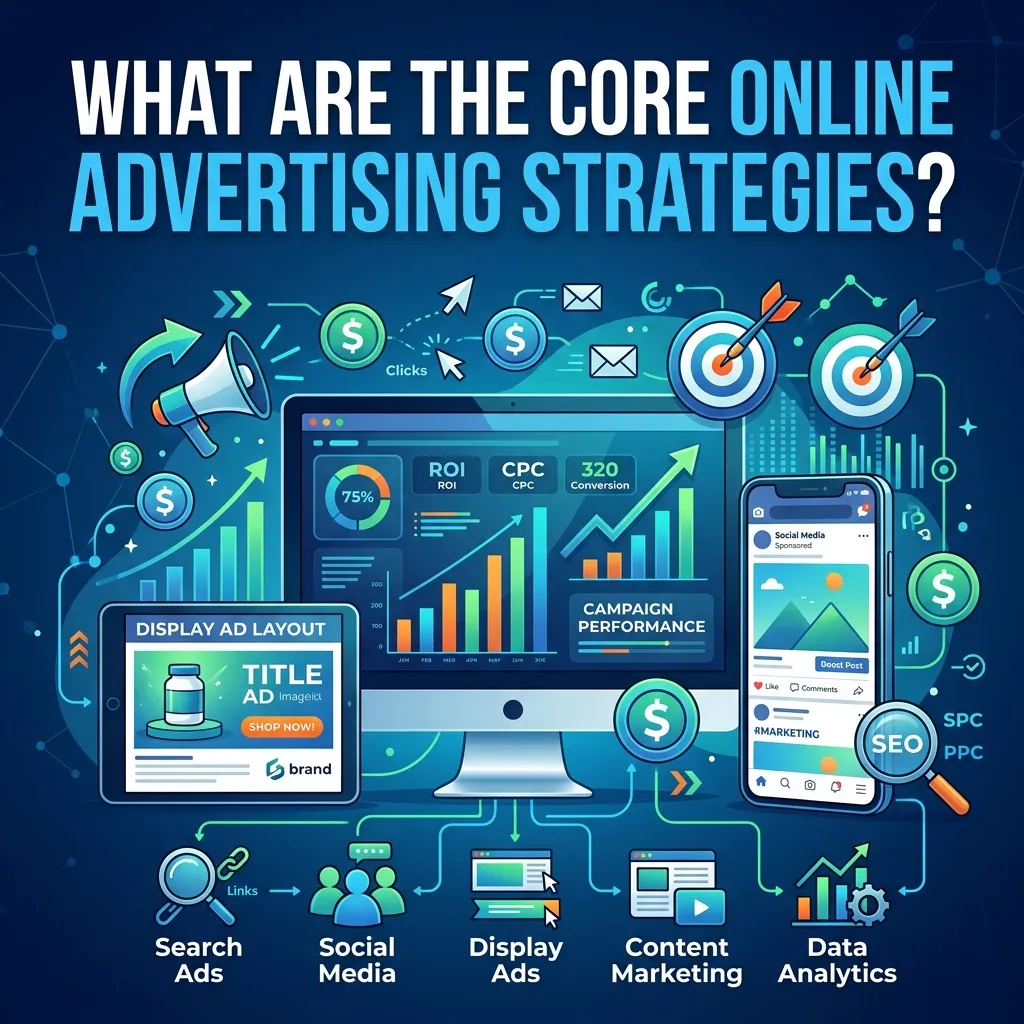
Before diving into tactics, it helps to understand the strategic layers that underpin every successful digital ad campaign.
Digital advertising strategies generally fall into three categories:
- Acquisition strategies — designed to reach new audiences and drive first-time conversions
- Retention strategies — focused on re-engaging existing customers and increasing lifetime value
- Brand-building strategies — aimed at growing awareness and shaping perception over time
Most businesses need a mix of all three, weighted differently depending on their growth stage. An early-stage startup, for example, should lean heavily into acquisition. An established brand with strong market share might prioritize retention and brand reinforcement.
The mistake many advertisers make is treating all campaigns as acquisition campaigns. Running the same messaging to cold audiences and warm audiences—people who already know your brand—is one of the fastest ways to waste ad spend.
Businesses that focus on brand-building should also develop a clear identity and message. A strong brand positioning strategy helps advertisers create campaigns that connect with the right audience and communicate a consistent value proposition.
Which Digital Marketing Advertising Techniques Deliver the Highest ROI?
ROI depends heavily on your industry, margins, and customer acquisition cost. That said, certain techniques consistently outperform others across verticals.
Retargeting remains one of the highest-ROI techniques available. Because retargeted audiences have already interacted with your brand—by visiting your website, watching a video, or engaging with a previous ad—they convert at significantly higher rates than cold audiences. The cost-per-click tends to be lower too, since you’re targeting a smaller, more defined pool.
Lookalike audiences extend this logic to new users. Platforms like Meta and TikTok allow advertisers to build audiences that mirror their best existing customers, using behavioral and demographic signals to find people with similar profiles. This is a particularly effective acquisition technique for businesses that have enough first-party data to build a meaningful seed audience.
Dynamic creative optimization (DCO) automates the process of testing ad variations at scale. Rather than manually A/B testing headlines and images, DCO tools serve different combinations to different users and automatically prioritize the best performers. This reduces both manual effort and creative waste.
What Are the Most Effective Paid Advertising Strategies?
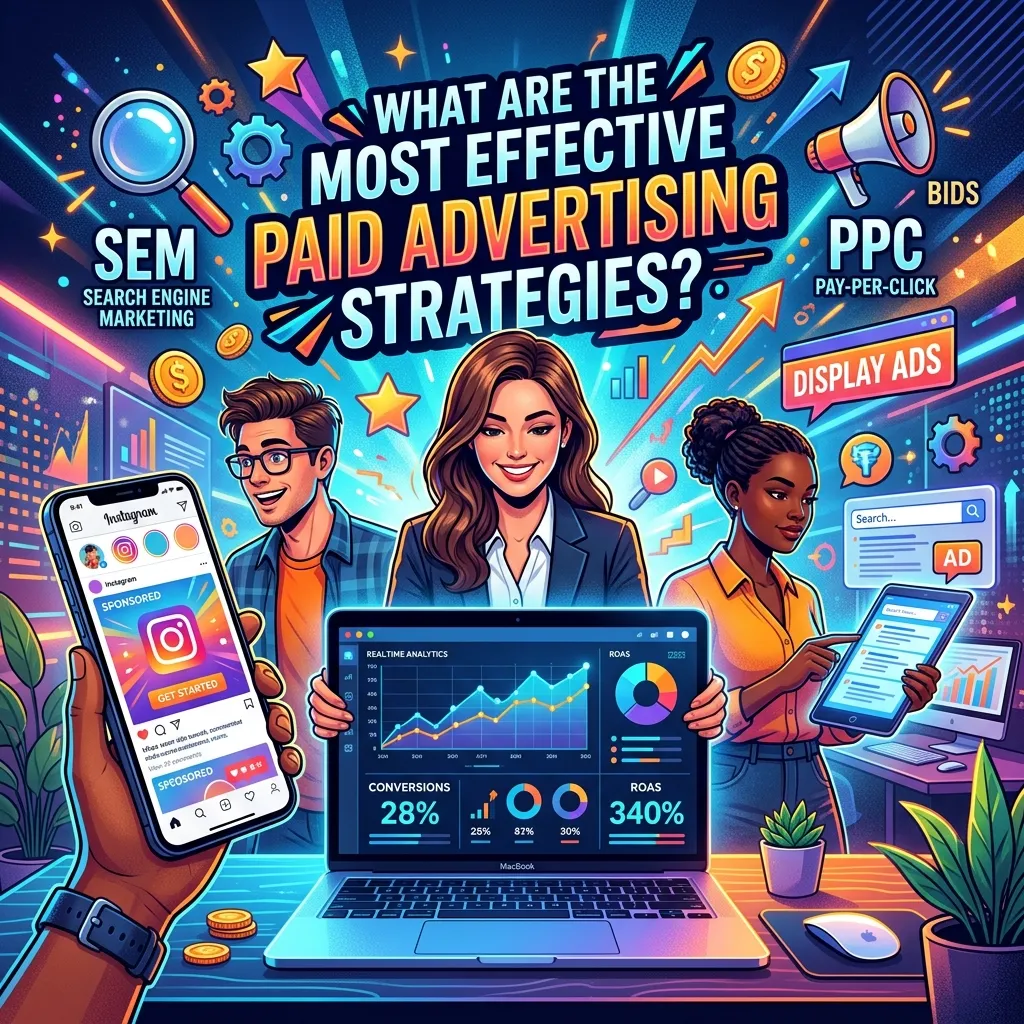
Paid advertising covers a wide spectrum—from pay-per-click (PPC) search ads to display, video, and native formats. The right mix depends on where your audience spends their time and what action you want them to take.
Businesses often combine paid advertising with other promotional methods, including seasonal marketing ideas, to create timely campaigns that attract customers during important buying periods.
How does pay-per-click (PPC) advertising work, and when should you use it?
PPC advertising, most commonly associated with Google Ads, charges advertisers only when a user clicks on their ad. It’s a performance-driven model that works particularly well for capturing demand that already exists. If someone types “best project management software” into Google, they’re actively looking for a solution—PPC puts your product directly in front of them at that moment of intent.
The key to effective PPC is match type selection and negative keywords. Broad match keywords generate volume but can attract irrelevant traffic. Exact match keywords are more precise but limit reach. A well-structured campaign uses a combination, refined over time with negative keyword lists that prevent spend on irrelevant searches.
What role does display advertising play in a digital ad strategy?
Display advertising—banner ads served across websites, apps, and news platforms—excels at building awareness and supporting retargeting. Unlike search ads, display doesn’t capture existing demand; it creates it. This makes display better suited for upper-funnel campaigns where the goal is visibility rather than immediate conversion.
Google’s Display Network reaches over 90% of internet users globally, making it a scalable channel for broad awareness campaigns. For more premium placements, programmatic platforms offer access to curated inventory across high-quality publishers.
Display advertising is also valuable when combined with broader campaigns designed to increase brand awareness through digital marketing, helping businesses stay visible throughout the customer journey.
How Do You Optimize a Digital Ad Campaign for Better Performance?
Campaign optimization is where most of the real work happens. Launching a campaign is straightforward—keeping it performing at a high level requires ongoing attention.
Conversion tracking is the foundation. Without it, you’re flying blind. Every campaign should have clearly defined conversion events—form submissions, purchases, phone calls, app installs—tracked accurately before any budget is committed.
Once tracking is in place, focus on these four optimization levers:
- Bid strategy — Automated bidding (Target CPA, Target ROAS) works well once a campaign has enough conversion data. In the early stages, manual bidding gives you more control.
- Audience segmentation — Break campaigns into tighter audience segments rather than running one broad campaign. Different audiences respond to different messages.
- Creative refresh cadence — Ad fatigue is real. Monitor frequency metrics and refresh creative before performance starts to drop, rather than after.
- Landing page alignment — Ad relevance doesn’t end at the click. A high-converting ad pointed at a weak landing page will always underperform. Ensure your landing pages match the promise of your ads.
What Are the Best Targeted Advertising Methods for Reaching the Right Audience?
Targeting precision is one of digital advertising’s greatest strengths. The challenge is using it effectively without over-narrowing your audience to the point where reach becomes a bottleneck.
Interest-based targeting lets you reach users based on their browsing behavior and stated preferences. It’s broad enough to deliver meaningful reach while still filtering for relevance.
Behavioral targeting goes a step further, using real-time data to serve ads based on recent actions—pages visited, products browsed, content consumed. This is the mechanism behind retargeting and is particularly powerful in e-commerce.
Contextual targeting matches ads to the content of the page being viewed, rather than relying on user data. With growing privacy regulations limiting cookie-based tracking, contextual targeting has seen a significant resurgence as a privacy-compliant alternative.
Geotargeting allows advertisers to focus spend on specific locations—countries, cities, or even a radius around a physical address. For local businesses, this is essential. For national brands, geotargeting enables regional testing and budget efficiency.
How Does Performance Marketing Differ from Traditional Digital Advertising?
Performance marketing is an umbrella term for advertising models where you only pay for a specific outcome—a lead, a sale, an app install. It’s distinct from brand advertising, where payment is based on impressions or reach regardless of user action.
Affiliate marketing is the most established performance marketing channel. Advertisers partner with publishers who promote their products in exchange for a commission on conversions. When managed well, affiliate programs are highly cost-efficient because spend is tied directly to revenue.
Cost-per-acquisition (CPA) campaigns on platforms like Google and Meta operate on a similar principle—you set a target cost per conversion, and the platform’s algorithm adjusts bids to hit that target. This model works best for advertisers with clear unit economics who know how much a customer is worth.
Performance marketing demands robust attribution. When multiple channels contribute to a conversion, how do you allocate credit? Last-click attribution—still the default for many platforms—overvalues the final touchpoint and undervalues earlier interactions. Moving to data-driven attribution models gives a more accurate picture of what’s actually driving results.
What Social Media Advertising Tactics Work Best?
Social media advertising encompasses a wide range of platforms—Meta (Facebook and Instagram), TikTok, LinkedIn, Pinterest, X (formerly Twitter), and Snapchat—each with distinct audience characteristics and creative formats.
Meta Ads remain the dominant social advertising platform for most consumer brands, combining unmatched scale with sophisticated audience targeting. The platform’s Advantage+ campaigns use machine learning to automate audience selection and creative delivery, reducing manual management while improving performance.
TikTok Ads have emerged as a serious performance channel, particularly for consumer products targeting younger demographics. The platform’s native, entertainment-first format rewards authentic creative over polished production—a meaningful shift from traditional ad aesthetics.
LinkedIn Ads are the go-to for B2B advertisers. The platform allows targeting by job title, company size, industry, and seniority—making it highly effective for reaching decision-makers, despite its relatively high cost-per-click compared to other social platforms.
Across all social platforms, video consistently outperforms static formats. Short-form video—particularly in the 15- to 30-second range—generates higher engagement and better completion rates than longer formats.
What Are Programmatic Advertising Solutions and How Do They Work?
Programmatic advertising automates the buying and selling of digital ad inventory through real-time bidding (RTB). Rather than negotiating directly with publishers, advertisers use demand-side platforms (DSPs) to bid on individual ad impressions as they become available.
The key advantages of programmatic advertising are scale, efficiency, and targeting granularity. Advertisers can serve ads across thousands of websites and apps simultaneously, applying audience data to serve the right ad to the right user without manual placement.
Private marketplace (PMP) deals offer a middle ground between open programmatic auctions and direct publisher buys. Advertisers gain access to premium, brand-safe inventory at negotiated rates, with more control over where their ads appear.
Programmatic is increasingly extending beyond display into connected TV (CTV), digital out-of-home (DOOH), and audio advertising—channels that were previously harder to access programmatically.
Digital Advertising Best Practices That Separate Good Campaigns from Great Ones
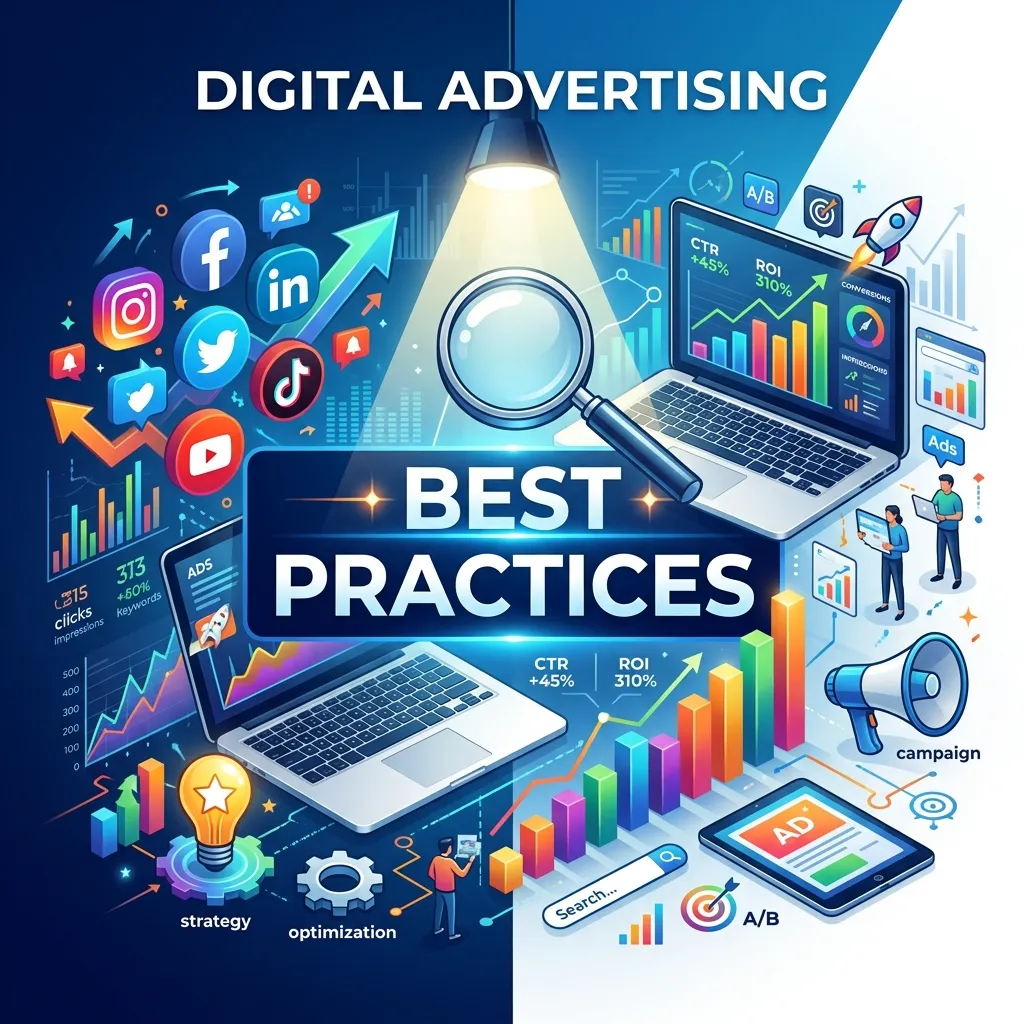
Regardless of channel or format, certain principles apply universally to high-performing digital advertising.
Diversify your channel mix. Over-reliance on a single platform is a significant risk. Algorithm changes, privacy updates, and rising CPMs can erode performance quickly. Spreading budget across multiple channels builds resilience.
Test continuously, but structure your tests properly. Change one variable at a time—headline, image, audience, bid strategy—and give tests enough time and budget to generate statistically meaningful results before drawing conclusions.
Align creative to the funnel stage. Awareness-stage ads should educate and intrigue. Consideration-stage ads should differentiate. Conversion-stage ads should reduce friction and reinforce trust with social proof, guarantees, or urgency.
First-party data is your competitive advantage. As third-party cookie deprecation continues, advertisers with strong first-party data—email lists, CRM data, loyalty program members—will maintain targeting capabilities others lose. Invest in building and activating this asset now.
Measure what matters. Clicks and impressions are easy to report on but rarely the metrics that matter. Tie advertising performance back to business outcomes—revenue, customer acquisition cost, return on ad spend—and optimize toward those numbers.
Build a Digital Advertising Strategy That Scales
Digital advertising rewards consistency and iteration. The brands that win long-term aren’t necessarily the ones with the biggest budgets—they’re the ones that test systematically, learn faster, and reallocate resources toward what works.
Start by auditing your current channel mix. Are you capturing existing demand through search? Building awareness through social and display? Re-engaging past visitors through retargeting? If any of these layers are missing, that’s where your next opportunity likely sits.
From there, prioritize measurement infrastructure. Clean conversion tracking, thoughtful attribution modeling, and regular performance reviews create the feedback loops that turn good campaigns into great ones.
Digital advertising is not a set-and-forget discipline. The strategies covered in this guide—paid search, social media advertising, programmatic solutions, performance marketing, and targeted audience methods—are most powerful when they work together, informed by data and refined over time.
Frequently Asked Questions
What is the most effective digital advertising strategy for small businesses?
For small businesses with limited budgets, paid search (PPC) and social media retargeting tend to deliver the highest ROI. PPC captures users actively searching for your product or service, while retargeting re-engages visitors who didn’t convert on their first visit. Both are cost-efficient because they target high-intent audiences rather than broad populations.
How much should a business spend on digital advertising?
Budget allocation varies by industry and business goals, but a common starting point is spending 5–10% of revenue on marketing, with digital advertising making up a significant portion of that. For growth-stage businesses focused on rapid customer acquisition, that figure can climb to 20% or higher. The key is tying spend to measurable return on ad spend (ROAS) targets rather than arbitrary budget caps.
What is programmatic advertising, and is it suitable for small advertisers?
Programmatic advertising automates the buying of digital ad inventory through real-time bidding. Historically, it required large minimum budgets and was better suited to enterprise advertisers. Today, many demand-side platforms (DSPs) and managed programmatic services have lowered the barrier to entry, making it accessible for mid-market and even smaller advertisers with monthly budgets starting around $5,000.
How do you measure the success of a digital advertising campaign?
Success metrics depend on campaign objectives. For awareness campaigns, reach, impressions, and video completion rates are relevant. For conversion campaigns, track cost-per-acquisition (CPA), return on ad spend (ROAS), and conversion rate. Regardless of channel, all campaigns should connect to business-level outcomes—revenue, leads, or customer lifetime value—rather than vanity metrics like clicks or likes.
What is the difference between performance marketing and brand advertising?
Performance marketing ties ad spend directly to measurable outcomes—sales, leads, or installs—and payment is often structured around those results (cost-per-click, cost-per-acquisition). Brand advertising focuses on building awareness and perception, with payment typically based on impressions or reach. Both serve important roles: brand advertising builds the audience that performance marketing later converts.
How is digital advertising changing due to privacy regulations?
Regulations like GDPR and CCPA, combined with the phaseout of third-party cookies, are shifting digital advertising toward privacy-compliant alternatives. Contextual targeting, first-party data activation, and privacy-preserving audience modeling (such as Google’s Privacy Sandbox) are growing in importance. Advertisers who build robust first-party data assets now will be better positioned as cookie-based targeting becomes less reliable.
What is digital advertising?
Digital advertising is the practice of promoting products or services through online channels such as search engines, social media platforms, websites, apps, and digital networks.
What are the main types of digital advertising strategies?
The main strategies include paid search advertising, social media advertising, display advertising, programmatic advertising, retargeting, and performance marketing.
Which digital advertising method provides the best ROI?
The best ROI depends on business goals and industry, but PPC, retargeting, and targeted social media campaigns often deliver strong results because they focus on high-intent audiences.
How does PPC advertising work?
PPC advertising allows businesses to pay only when users click their ads. Platforms like Google Ads help brands reach people actively searching for relevant products or services.
Why is audience targeting important in digital advertising?
Audience targeting helps businesses show ads to the most relevant users based on interests, behaviors, location, demographics, and online activity, improving campaign efficiency.
What is programmatic advertising?
Programmatic advertising uses automated technology and real-time bidding to purchase digital ad placements and deliver ads to specific audiences at scale.
How can businesses improve digital ad campaign performance?
Businesses can improve results by tracking conversions, testing creatives, refining audiences, optimizing landing pages, and adjusting budgets based on performance data.
What is the difference between brand advertising and performance marketing?
Brand advertising focuses on increasing awareness and building brand perception, while performance marketing focuses on measurable actions like leads, sales, or app installs.
How important is social media advertising for businesses?
Social media advertising helps businesses reach targeted audiences, build brand awareness, generate leads, and drive conversions through platforms like Facebook, Instagram, TikTok, and LinkedIn.
What metrics should be tracked in digital advertising campaigns?
Important metrics include click-through rate (CTR), conversion rate, cost per acquisition (CPA), return on ad spend (ROAS), impressions, engagement, and customer lifetime value (CLV).