Holiday Marketing: Strategies to Boost Sales & Engagement
Geoffrey Davis
Preparing for the festive rush requires actionable Holiday Marketing Tips to stand out. Businesses face fierce competition, making strategic planning essential. By leveraging data-driven insights, you can capture attention, increase conversions, and maximize revenue during the most profitable season. This comprehensive guide explores proven Holiday Marketing Tips designed to elevate your seasonal campaigns. We cover everything from early foundation building and omnichannel execution to advanced conversion tactics and post-season retention. Discover expert strategies, avoid common pitfalls, and utilize detailed frameworks that guarantee your brand maximizes engagement and sales throughout the festive shopping period.
Foundational Holiday Marketing Tips for Early Preparation
The most successful seasonal campaigns are never built at the last minute. To truly dominate the festive season, marketers must establish a robust foundation months in advance. Implementing effective Holiday Marketing Tips starts with a deep dive into historical data, market trends, and internal capabilities. Brands that wait until November to plan their Black Friday strategy often find themselves outbid on ad networks and struggling with supply chain bottlenecks. By starting early, you give your team the bandwidth to create compelling narratives, test landing pages, and secure inventory.
A critical first step is conducting a thorough post-mortem of your previous holiday season. What were your best-selling products? Which traffic sources yielded the highest conversion rates? Did your website handle the traffic surges smoothly? By answering these questions, you form a baseline for the current year. Your Holiday Marketing Tips must be rooted in reality, avoiding the trap of chasing shiny new tactics without securing your core conversion paths.
Furthermore, early preparation involves aligning your marketing goals with your inventory and fulfillment capabilities. It is a disaster to launch a highly successful marketing campaign only to run out of stock on day one. Cross-departmental synergy between marketing, sales, customer service, and logistics ensures that when your Holiday Marketing Tips generate massive traffic, your infrastructure can handle the load. Establishing clear Key Performance Indicators (KPIs) such as Return on Ad Spend (ROAS), Customer Acquisition Cost (CAC), and Average Order Value (AOV) allows you to track success accurately and make real-time adjustments as the season progresses.
Analyzing Historical Data and Consumer Trends
To leverage the best Holiday Marketing Tips, you must act like a data scientist. Dive into Google Analytics and review user flow, bounce rates, and conversion funnels from the previous Q4. Identify where potential buyers dropped off. If a significant portion of users abandoned their carts at the shipping calculation stage, your strategy this year should address that friction point—perhaps by offering unconditional free shipping or clearly displaying shipping costs upfront. Integrating e-commerce optimization techniques based on hard data prevents you from repeating past mistakes and guarantees a higher baseline conversion rate.
Establishing Clear Targets and Resource Allocation
Your budget dictates the scale of your Holiday Marketing Tips. Divide your budget intelligently across awareness, consideration, and conversion phases. Top-of-funnel activities require funding early in the season to build an audience pool, which you will subsequently retarget during peak sales days. Allocate a specific contingency budget as well. Advertising costs invariably spike during November and December; having a reserve allows you to aggressively scale campaigns that are outperforming expectations without needing emergency executive approval.
Strategic Audience Segmentation and Holiday Marketing Tips
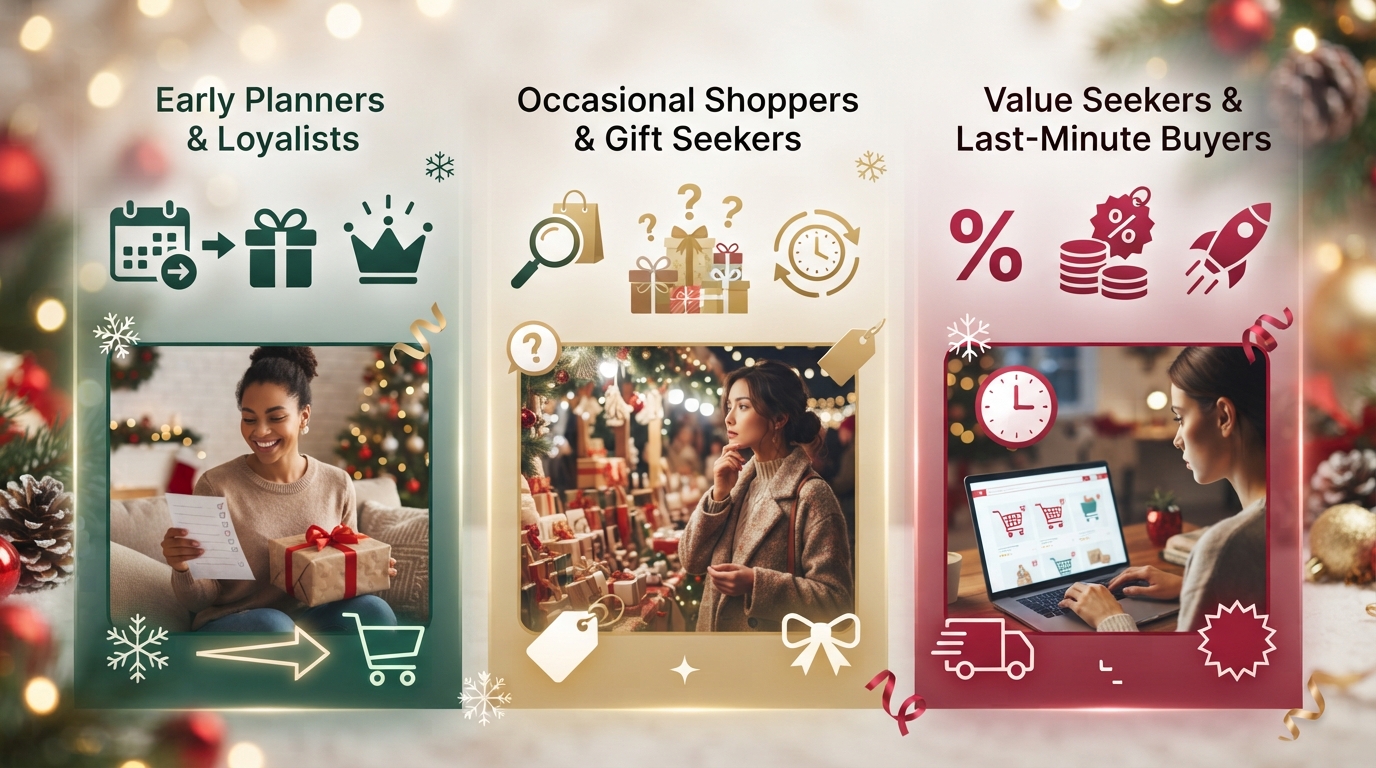
Treating your entire customer base as a monolith is a fast track to mediocre results. The most impactful Holiday Marketing Tips revolve around precise audience segmentation. During the holidays, consumers are bombarded with generic marketing messages. To cut through the noise, your communications must feel tailor-made for the recipient. By leveraging customer data, you can deliver highly relevant offers that resonate with specific buyer psychographics and historical purchasing behaviors.
Segmentation begins with your existing customer database. Implementing email marketing automation allows you to categorize subscribers based on their engagement levels, purchase history, and average order value. A VIP customer who regularly spends hundreds of dollars requires a completely different messaging approach than a one-time buyer who only purchases discounted items. The VIP might respond best to an exclusive, early-access shopping event, whereas the discount shopper might need a flash sale countdown timer to trigger a purchase. Customizing these approaches forms the bedrock of advanced Holiday Marketing Tips.
Beyond internal data, utilizing zero-party data—information that a customer intentionally and proactively shares with your brand—supercharges your Holiday Marketing Tips. Interactive quizzes, preference centers, and conversational SMS marketing can help you gather specific insights about what your customers are looking to buy this season. Are they shopping for themselves, a spouse, or children? Knowing this allows you to dynamically populate your marketing materials with the exact product categories they care about, drastically increasing the likelihood of a conversion.
Regency, Frequency, Monetary (RFM) Analysis
Implementing RFM analysis is one of the most technical yet rewarding Holiday Marketing Tips you can deploy. Regency looks at how recently a customer made a purchase, Frequency measures how often they buy, and Monetary evaluates how much they spend. By scoring your database using these three metrics, you can identify your “Champions” (high in all three), your “At-Risk” customers (used to buy frequently but haven’t recently), and your “New Customers.” Crafting bespoke messaging for each RFM segment ensures maximum relevance and drastically improves email open rates and click-through rates.
Building Lookalike Audiences for Scaling
Once you have segmented your most profitable customers, you can use these profiles to acquire new buyers. Upload your VIP customer lists to platforms like Meta and Google to create Lookalike Audiences. These advertising algorithms will find new users who share similar online behaviors and demographic profiles with your best customers. This strategy reduces your Customer Acquisition Cost and ensures that your social media ad campaigns are reaching individuals with a high propensity to purchase your specific products during the holiday rush.
Modern consumers do not interact with a brand in a vacuum. They might discover a product via an Instagram reel, research it on your website via their desktop, receive a promotional SMS, and finally complete the purchase on their mobile phone while commuting. Therefore, your Holiday Marketing Tips must encompass a unified omnichannel strategy. An omnichannel approach ensures that the customer experiences a seamless, consistent brand narrative regardless of the platform they are currently using.
Executing omnichannel Holiday Marketing Tips requires breaking down silos within your marketing department. Your email team, social media managers, and paid ad specialists must work from the same promotional calendar and utilize consistent visual assets and copywriting tones. If a customer receives an email promoting a 30% off sitewide sale, they should see the exact same offer reinforced on your homepage banner, your Facebook ads, and your SMS broadcasts. This repetition builds trust and urgency, guiding the consumer smoothly down the purchasing funnel.
Furthermore, omnichannel strategies must account for the physical retail space if your brand possesses brick-and-mortar locations. Integrating online and offline experiences is a goldmine for Holiday Marketing Tips. Features like Buy Online, Pick Up In-Store (BOPIS) have surged in popularity because they offer the convenience of digital shopping with the immediate gratification of physical retail. Ensuring your inventory systems are synced in real-time between your website and your physical stores prevents double-selling and customer frustration, solidifying a positive brand perception.
Synchronizing SMS and Email Campaigns
One of the most potent Holiday Marketing Tips involves pairing your email and SMS efforts. While email is excellent for long-form storytelling and product catalogs, SMS boasts an incredibly high open rate (often exceeding 90%) and is perfect for urgent, time-sensitive alerts. A cohesive strategy might involve sending an email detailing a weekend sale on Thursday evening, followed by a short SMS reminder on Saturday morning to those who opened the email but did not purchase. This orchestrated touchpoint strategy maximizes visibility without overwhelming the subscriber.
Leveraging Social Commerce and In-App Purchasing
Social media is no longer just an awareness tool; it is a primary sales channel. Integrating seasonal promotional ideas directly into platforms like Instagram Shops, TikTok Shop, and Pinterest allows consumers to purchase without ever leaving their preferred app. By reducing the friction of the checkout process, you capture impulse buyers who might otherwise abandon the transaction if forced to navigate to a separate external website. Ensuring your product catalogs are correctly synced and optimized with high-quality images and clear pricing is vital for social commerce success.
Content Creation and Festive Storytelling
Amidst the heavy discounting and aggressive sales pitches of the season, brands that tell compelling stories capture the most loyal customers. Applying Holiday Marketing Tips to your content strategy means moving beyond simple transactional messaging and tapping into the emotional resonance of the season. Consumers buy based on emotion and justify with logic. Your content must evoke the feelings associated with the holidays—joy, generosity, connection, and nostalgia.
Effective Holiday Marketing Tips dictate that your content should solve a problem for the consumer. The holidays are stressful; people are pressed for time and anxious about finding the perfect gift. Creating comprehensive, highly curated gift guides is an exceptional way to alleviate this stress. Instead of just listing products, categorize your guides by persona: “Gifts for the Tech-Obsessed,” “Gifts for the Home Chef,” or “Last-Minute Gifts Under $50.” This structure immediately guides the user to the most relevant items, significantly reducing bounce rates and increasing time-on-site.
Furthermore, integrating user-generated content (UGC) into your strategy provides unparalleled social proof. Consumers trust the experiences of their peers far more than polished corporate advertisements. Encouraging your existing customers to share photos of themselves using your products, perhaps through a branded festive hashtag contest, creates a repository of authentic content. Repurposing this UGC in your emails, landing pages, and ads is one of the most cost-effective Holiday Marketing Tips to build trust and drive conversions.
Craft emotionally resonant video campaigns highlighting family, giving, and joy.
Develop interactive content like “Gift Finder Quizzes” to actively engage users.
Collaborate with micro-influencers to produce authentic, relatable product reviews.
Optimize all blog content and gift guides for long-tail seasonal search queries.
Create unboxing videos to showcase the physical premium experience of your products.
Optimizing Landing Pages for Seasonal Relevance
Your website should visually reflect the season without compromising usability. Applying Holiday Marketing Tips to web design involves subtle festive overlays, specialized holiday navigation menus, and dedicated landing pages for specific sales events. A dedicated Black Friday landing page, built and indexed months in advance, captures early search traffic and provides a centralized hub for your best offers. Ensure these pages prominently display trust badges, clear return policies, and secure checkout icons to reassure hesitant buyers.
Utilizing Video Marketing for Maximum Engagement
Video content consistently yields higher engagement rates than static images. Throughout the festive season, utilize short-form video on TikTok, Instagram Reels, and YouTube Shorts to demonstrate products, share behind-the-scenes office culture, or highlight customer testimonials. Educational videos explaining how to use a complex product can dramatically reduce return rates, while emotive, cinematic videos build long-term brand affinity. Integrating these video assets into your overall strategy ensures your Holiday Marketing Tips resonate across all multimedia formats.
Maximizing Conversions with Data-Driven Paid Campaigns
Organic reach is rarely sufficient to hit aggressive Q4 revenue targets. Therefore, executing data-driven paid advertising is a cornerstone of effective Holiday Marketing Tips. The advertising landscape becomes incredibly saturated and expensive during November and December. To maintain a profitable ROAS, your paid strategies must be highly targeted, dynamically optimized, and continuously monitored. The days of simply boosting a post and hoping for sales are gone; today’s environment requires sophisticated bidding algorithms and granular audience targeting.
A pivotal aspect of paid Holiday Marketing Tips is deploying a robust retargeting infrastructure. According to the National Retail Federation, consumer shopping behavior becomes erratic during the holidays, with users comparing multiple sites before purchasing. A robust retargeting pixel allows you to follow these users across the web, serving them dynamic product ads featuring the exact items they viewed but did not purchase. Combining retargeting with a compelling urgency trigger—such as a declining discount or low stock warning—is highly effective at recovering lost sales.
Moreover, diversifying your ad spend across multiple platforms mitigates risk. While Meta (Facebook/Instagram) and Google Ads remain dominant, exploring Pinterest for visual discovery, TikTok for viral engagement, or even connected TV (CTV) for broader brand awareness can yield exceptional results. Each platform requires a distinct creative approach. What works as a Google Search text ad will fail spectacularly as an Instagram Story. Tailoring your creative assets to the specific platform’s native format is one of the most vital Holiday Marketing Tips for paid media success.
Platform Comparison: Where to Allocate Your Holiday Budget
Advertising Platform
Primary Strength
Best Use Case for Holiday Marketing Tips
Target Audience
Average Cost Expectation
Google Search Ads
High Intent Capture
Capturing users actively searching for “buy [product] near me”
High-intent, ready-to-buy consumers
High CPC, but excellent ROI
Meta Ads (Facebook/IG)
Visual Retargeting & Lookalikes
Showcasing lifestyle imagery, gift guides, and dynamic product catalogs
Broad demographic, impulse buyers
Moderate CPM, highly scalable
Pinterest Ads
Early Discovery & Planning
Sponsoring gift guides and aesthetic product pins months in advance
Planners, design-conscious shoppers
Lower CPC, requires longer lead time
TikTok Ads
Viral Reach & Authenticity
Leveraging creator content and trending audio for flash sales
Gen Z and Millennials
Volatile, high potential for organic crossover
Google Shopping
Visual Search Intent
Displaying price, image, and reviews directly in search results
Comparison shoppers
Highly competitive during peak weeks
Implementing Dynamic Search and Performance Max
To truly harness automated Holiday Marketing Tips, lean into AI-driven campaign types like Google’s Performance Max (PMax). PMax campaigns utilize machine learning to distribute your budget across all of Google’s channels (Search, Display, YouTube, Discover) based on where the algorithm predicts the highest conversion probability. While you sacrifice some granular control, feeding the system high-quality creative assets and precise audience signals allows the AI to discover profitable pockets of traffic that manual bidding might miss.
Crucial Holiday Marketing Tips: Common Mistakes to Avoid
Even the most brilliant marketing strategies can be undermined by fundamental execution errors. Analyzing failed campaigns reveals that ignoring basic operational Holiday Marketing Tips often leads to disastrous results. The festive season magnifies every weakness in your business model. A slow website might be a minor annoyance in May, but in November, it translates to thousands of dollars in lost revenue as impatient shoppers bounce to your competitors.
One of the most catastrophic mistakes is neglecting mobile commerce trends. The majority of digital holiday traffic now originates from mobile devices. If your website features tiny buttons, a convoluted checkout process, or pop-ups that are impossible to close on a smartphone screen, your conversion rate will plummet. Applying effective Holiday Marketing Tips requires a mobile-first design philosophy. Test your site rigorously on various devices and network speeds to ensure a frictionless experience for mobile shoppers.
Another frequent error is poor inventory management and lack of transparency. There is nothing more frustrating for a consumer than completing a purchase, only to receive an email days later stating the item is backordered. Your inventory systems must sync with your frontend in real-time. If stock is running low, use that as a psychological trigger (“Only 3 left in stock!”) rather than hiding the information. Transparent communication regarding shipping deadlines is equally critical; if a product cannot be delivered by Christmas, state it clearly on the product page to avoid a customer service nightmare.
Failing to stress-test website server capacity before major traffic spikes.
Running overly complex promotions that confuse the customer at checkout.
Ignoring current customers in favor of acquiring new, expensive leads.
Using generic, uninspired ad copy that blends in with competitor messaging.
Forgetting to update shipping cut-off dates prominently across the website.
The Danger of Deep Discount Dependency
While sales are expected, training your customers to only purchase when items are heavily discounted erodes your brand equity and profit margins. Smart Holiday Marketing Tips involve offering value adds instead of just slashing prices. Consider bundling related products together for a perceived discount, offering an exclusive gift with purchase, or providing complimentary premium packaging. These tactics maintain the perceived value of your core products while still providing the holiday incentive consumers expect.
Overlooking Customer Service Preparedness
Your marketing team can drive incredible traffic, but if your customer service infrastructure is weak, you will lose those customers forever. The holidays bring an influx of inquiries regarding sizing, shipping, and returns. Implementing Holiday Marketing Tips extends to support: deploy AI chatbots to handle basic FAQs, hire seasonal support staff, and ensure your team is empowered to resolve issues quickly. A positive customer service interaction during a stressful holiday shopping experience often transforms a one-time buyer into a lifelong brand advocate.
Expert Insights and Pro Tactics for Unprecedented Growth
To elevate your campaigns from good to extraordinary, you must look beyond the standard playbook. Elite marketers employ advanced Holiday Marketing Tips that focus on psychological triggers, micro-commitments, and long-term lifetime value (LTV). The goal is not just to secure a single holiday sale, but to acquire a customer who will return in January, spring, and beyond. This requires a shift in mindset from transactional marketing to experiential marketing.
One powerful expert tactic is the utilization of VIP Early Access. Instead of launching your Black Friday sale to the general public on Friday morning, open the sale on Wednesday exclusively for your email subscribers and SMS list. This accomplishes several Holiday Marketing Tips simultaneously: it rewards loyalty, guarantees server stability by staggering traffic, and creates an artificial sense of scarcity. When the public sale finally launches, the “sold out” badges on popular items act as massive social proof, driving urgency for the remaining inventory.
Another high-level strategy involves optimizing the post-purchase experience. The moment after a customer buys is when they are most excited about your brand. Don’t waste the confirmation page with a simple “Thank You.” Utilize customer retention strategies right then and there. Offer a one-time, time-sensitive discount on a complementary item, or invite them to join your loyalty program to earn double points on their recent purchase. Turning a single-item buyer into a multi-item buyer before they even receive their first package is a hallmark of masterful Holiday Marketing Tips.
Implement dynamic countdown timers in both emails and landing pages to enforce true scarcity.
Use heatmapping tools during the first week of November to identify and fix UX bottlenecks immediately.
Launch “12 Days of Gifting” campaigns to encourage daily website visits and habit formation.
Partner with non-competing brands for joint giveaways to cross-pollinate high-quality audience lists.
Offer tiered promotions (Spend $50 get 10% off, Spend $100 get 20% off) to directly increase Average Order Value.
Post-Holiday Nurturing and Retention
The biggest mistake marketers make is going silent on December 26th. The post-holiday period is crucial for retention. Implementing Holiday Marketing Tips for Q1 involves sending personalized “How are you enjoying your product?” emails, offering replenishment subscriptions, and launching targeted campaigns for those who received gift cards. A customer acquired during the holidays is often expensive; maximizing their LTV through dedicated retention workflows ensures the profitability of your Q4 marketing efforts extends well into the new year.
Crafting an Unforgettable Unboxing Experience
In the era of social media, the physical delivery of your product is a marketing channel in itself. Premium, thoughtful packaging generates organic UGC and reinforces brand quality. As part of your advanced Holiday Marketing Tips, consider including a handwritten note, a small unexpected freebie, or beautifully designed interior packaging. When a customer films their unboxing experience and shares it on TikTok, they are providing you with free, highly authentic advertising that influences their entire social network.
By methodically applying these strategies, integrating your data systems, and maintaining a relentless focus on the customer experience, you build a seasonal engine that not only survives the competitive holiday rush but thrives in it. The most successful brands understand that holiday marketing is not a sprint; it is the culmination of year-round relationship building, activated through precise, data-backed execution.
Implementing these comprehensive Holiday Marketing Tips will transform your seasonal campaigns into highly profitable revenue engines. By combining precise segmentation, emotional storytelling, and seamless omnichannel execution, you ensure sustainable business growth. Take action now to captivate your audience, drive massive sales, and build lasting customer loyalty this festive season.
1. What are the most important Holiday Marketing Tips for a small business with a limited budget?
Small businesses should focus on high-ROI organic strategies and hyper-targeted local advertising. The best Holiday Marketing Tips for limited budgets include leveraging zero-cost user-generated content, maximizing email marketing to existing warm leads, and utilizing Google My Business for local SEO visibility. Avoid broad, expensive awareness campaigns and focus entirely on converting high-intent users at the bottom of the funnel.
2. When should I start planning and implementing my Holiday Marketing Tips?
Preparation should ideally begin in late Q2 or early Q3 (July/August). This allows ample time to review past data, secure inventory, produce creative assets, and build anticipation. However, you should begin executing early-awareness Holiday Marketing Tips by late September or early October to capture early-bird shoppers before ad costs skyrocket in November.
3. How can I stand out if my competitors are offering much larger discounts?
If you cannot compete on price, you must compete on value and experience. Effective Holiday Marketing Tips in this scenario include offering exclusive product bundles, emphasizing superior customer service, providing lightning-fast shipping, or utilizing premium packaging. Highlight your brand’s unique story, ethical sourcing, or community involvement to attract buyers who value more than just a cheap price tag.
4. Are email newsletters still effective during the holidays despite inbox crowding?
Yes, email marketing remains one of the highest-converting channels. To cut through the noise, your Holiday Marketing Tips must focus on precise segmentation and compelling subject lines. Avoid sending generic blasts; instead, send personalized recommendations based on past purchase behavior. Utilize A/B testing on subject lines to maximize open rates during peak promotional days.
5. How do I prevent cart abandonment during the festive shopping season?
Cart abandonment spikes during the holidays as consumers comparison shop. Crucial Holiday Marketing Tips to combat this include being transparent about shipping costs upfront, offering guest checkout options to reduce friction, and implementing automated cart abandonment email and SMS sequences. Including a small, time-sensitive discount in your recovery emails can dramatically improve conversion rates.
6. What role does social media play in seasonal marketing strategies?
Social media is essential for both discovery and direct sales. Your Holiday Marketing Tips should utilize platforms like Instagram and TikTok to showcase visual gift guides, run influencer campaigns, and execute retargeting ads. Additionally, setting up in-app shopping features reduces friction, allowing users to purchase directly from their social feeds instantly.
7. How should I adjust my paid advertising budget for the holidays?
Ad costs (CPMs and CPCs) increase significantly during Q4. Effective Holiday Marketing Tips dictate shifting budget toward audience building in October when ads are cheaper. In November and December, shift the majority of your budget to aggressive retargeting and high-intent search terms. Ensure you have a contingency budget to scale campaigns that show exceptional ROAS.
8. What is the best way to handle post-holiday returns and customer service?
Treat returns as an opportunity for retention. Holiday Marketing Tips for post-season involve making the return process as frictionless as possible. Offer easy portal access, pre-printed labels, and quick refunds or store credit. A smooth return experience builds massive trust, making it highly likely that the consumer will purchase from your brand again in the future.
9. Should B2B companies also utilize Holiday Marketing Tips?
Absolutely. While B2B sales cycles are different, Q4 is when many companies finalize end-of-year budgets. B2B Holiday Marketing Tips should focus on end-of-year software discounts, client appreciation gifts, and content geared toward preparing for the upcoming year. It is also an excellent time to strengthen relationships through personalized outreach and milestone celebrations.
10. How do I measure the true success of my holiday marketing campaigns?
Move beyond vanity metrics like social media likes. The most vital Holiday Marketing Tips rely on tracking hard data: Return on Ad Spend (ROAS), Customer Acquisition Cost (CAC), Average Order Value (AOV), and overall conversion rate. Additionally, track the Lifetime Value (LTV) of customers acquired during the holidays over the next 6-12 months to determine the true profitability of your seasonal efforts.
Conclusion
Implementing these data-driven Holiday Marketing Tips will transform your seasonal campaigns into highly profitable revenue engines. By combining precise audience segmentation, emotional storytelling, and seamless omnichannel execution, you guarantee sustainable business growth during the festive rush. Take action today to captivate your audience, drive massive sales, and build lasting customer loyalty.
FAQ
1. How can I effectively integrate influencers into my holiday marketing strategy?
Partnering with niche creators is one of the most effective Holiday Marketing Tips for building authentic social proof. Instead of blowing your budget on a single mega-influencer, collaborate with several micro-influencers who boast highly engaged, targeted followings. Send them your products early so they can create authentic unboxing videos, gift guides, or tutorials. To maximize ROI, request the rights to repurpose their user-generated content in your own social media ad campaigns and email newsletters throughout the festive season.
2. What are the best last-minute strategies if I am behind on holiday preparations?
If you are late to the game, the most crucial Holiday Marketing Tips revolve around instantly deliverable products and warm audience targeting. Focus your entire remaining budget on retargeting past purchasers and website visitors, as they require less convincing than cold traffic. Push digital gift cards heavily in the final days before the holidays, as these eliminate shipping anxieties for last-minute shoppers. Additionally, utilize email marketing automation to trigger urgent flash sales that drive immediate, high-intent conversions.
3. How can artificial intelligence improve my seasonal marketing campaigns?
AI is fundamentally transforming how brands approach the festive rush. Advanced Holiday Marketing Tips now heavily feature AI for predictive analytics, allowing you to accurately forecast inventory needs based on historical trends. You can also deploy AI-driven chatbots to handle the massive influx of Q4 customer service inquiries regarding shipping and returns. Furthermore, utilizing machine learning algorithms for dynamic pricing and personalized product recommendations ensures your e-commerce optimization efforts operate at peak efficiency, maximizing the Average Order Value for every visitor.
4. How do I maintain sales momentum and avoid the post-holiday slump?
The key to preventing a severe revenue drop in January lies in robust customer retention strategies. Post-season Holiday Marketing Tips suggest treating every new Q4 buyer as a long-term investment rather than a one-off transaction. Launch a specialized “New Year, New You” campaign, offer exclusive replenishment discounts to holiday shoppers, or invite them into a VIP loyalty program. By consistently nurturing these new leads through valuable content and personalized offers, you transition them from seasonal impulse buyers into year-round brand advocates.
5. How can I accurately track the success of an omnichannel holiday campaign?
Measuring a fragmented customer journey requires moving beyond basic last-click attribution. Essential Holiday Marketing Tips for tracking include implementing unified marketing attribution models that assign value to every touchpoint—from the initial Pinterest ad to the final SMS alert. Utilize custom UTM parameters for all external links and ensure your tracking pixels are firing correctly across your entire Black Friday strategy. Consolidating this data into a centralized dashboard allows you to see exactly which channels are driving the highest Return on Ad Spend (ROAS) and adjust your budgets in real-time.