Seasonal Social Media Marketing: Strategies to Boost Engagement and Sales
Geoffrey Davis
Did you know that holidays and changing seasons trigger massive shifts in consumer spending? Mastering seasonal social media marketing is no longer optional for brands seeking serious growth. By aligning your message with the calendar, you capture attention instantly and drive urgency that turns passive followers into active buyers.
This comprehensive guide breaks down exactly how to leverage seasonal social media marketing for your business. We will explore platform-specific tactics, advanced content strategies, and analytics tracking. You will discover actionable frameworks to maximize ROI, avoid common pitfalls, and transform casual scrollers into loyal customers year-round.
The Power of Seasonal Social Media Marketing for Business Growth
Understanding the psychological triggers behind seasonal social media marketing is the first step toward unprecedented business growth. When you align your brand narrative with cultural moments, holidays, or weather changes, you tap into pre-existing consumer excitement. People naturally look for thematic content during specific times of the year. For instance, the transition into autumn brings a collective desire for cozy aesthetics, while the summer months evoke feelings of adventure and outdoor activity. By embedding your products into these seasonal narratives, you reduce consumer friction and make purchasing feel like a natural extension of their seasonal celebration.
Moreover, seasonal social media marketing creates an organic sense of urgency. Holidays have hard deadlines. A consumer knows they cannot delay a Mother’s Day purchase or miss a Black Friday discount window. This built-in ticking clock is a marketer’s dream. It compels users to act immediately rather than bookmarking an item for later. When you combine this urgency with visually compelling, emotionally resonant content, your conversion rates skyrocket. Brands that actively participate in these cultural conversations also humanize themselves. They show audiences that they share the same joyful, festive, or reflective moments, which builds profound long-term brand loyalty.
Data consistently backs up the necessity of these calendar-driven pushes. According to insights from the National Retail Federation, holiday sales represent a massive percentage of annual retail revenue. Ignoring the digital aspect of this shopping frenzy means leaving money on the table. Effective seasonal social media marketing allows businesses of all sizes to compete on a global stage, utilizing targeted ads and viral organic reach to capture market share. Ultimately, treating the calendar as a strategic roadmap ensures your brand remains relevant, visible, and highly profitable 365 days a year.
How to Build a Winning Seasonal Social Media Marketing Strategy
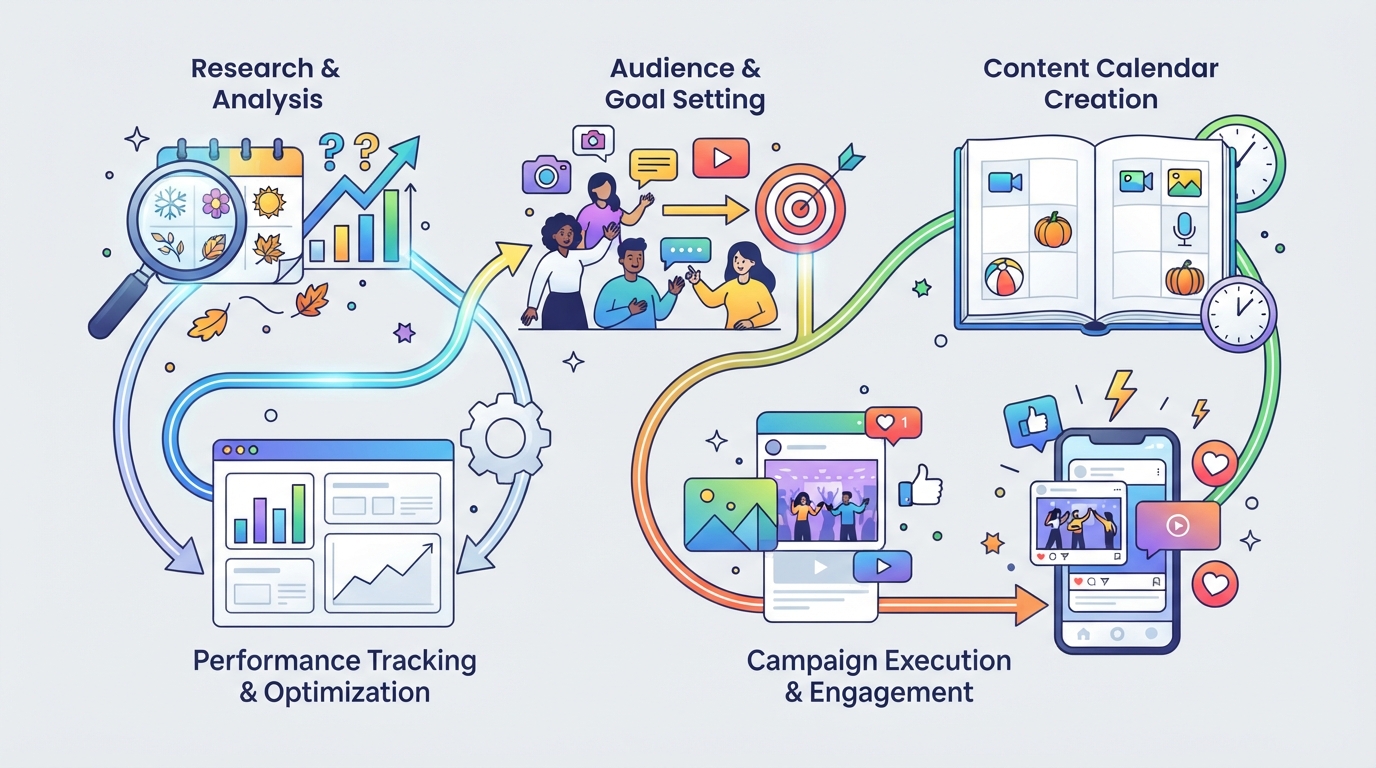
Creating a high-converting seasonal social media marketing campaign requires meticulous planning long before the holiday actually arrives. The foundation of any successful initiative is a robust social media content calendar. This calendar should map out every major holiday, micro-holiday, and seasonal shift relevant to your specific target audience. You must work backward from the event date to schedule teaser campaigns, early-bird promotions, the main launch, and last-minute urgency reminders. If you wait until December to plan your winter holiday content, you have already lost to competitors who began their strategic mapping in August.
A winning strategy also demands precise audience segmentation. Seasonal social media marketing is not a one-size-fits-all endeavor. Different demographics celebrate different events in varying ways. You need to analyze your audience data to understand which holidays resonate most deeply with them. For example, a younger demographic might engage heavily with socially driven micro-holidays like National Coffee Day or Earth Day, while an older demographic might respond better to traditional major holidays. Tailoring your messaging, imagery, and product recommendations to fit these specific audience segments drastically improves your engagement rates and return on ad spend.
Furthermore, integrating your digital efforts across all marketing channels amplifies your seasonal social media marketing impact. Your social channels should seamlessly connect with your email marketing, website banners, and paid search campaigns. When a customer sees a cohesive aesthetic and unified promotional message across multiple touchpoints, it reinforces brand recall. Building holiday marketing campaigns that encompass omnichannel synchronization ensures that even if a user scrolls past an Instagram post, they are retargeted effectively through a Facebook ad or an email newsletter. This holistic approach captures the consumer at various stages of the buying journey, funneling them toward the ultimate goal of making a purchase.
Mini-Conclusion: Strategic foresight transforms chaotic holiday rushes into highly orchestrated revenue-generating machines. By planning early and segmenting smartly, you secure a massive competitive advantage.
Top Platforms for Maximizing Seasonal Campaign ROI
Not all social networks serve the same purpose, and selecting the right platform is critical for your seasonal social media marketing success. Instagram remains a powerhouse for visual storytelling and aesthetic-driven product showcases. During the holidays, users flock to Instagram for inspiration, making it the perfect ecosystem for high-quality photography, Reels, and influencer collaborations. If your brand relies on visual appeal—such as fashion, food, or home décor—Instagram is your primary battleground. You can leverage countdown stickers in Stories to drive urgency for flash sales, or utilize Instagram Shopping features to create a frictionless checkout experience directly within the app.
TikTok has revolutionized how brands approach seasonal social media marketing through authentic, short-form video. The platform thrives on trends, sounds, and challenges, allowing brands to go viral organically without massive ad budgets. Creating a festive challenge or showcasing behind-the-scenes packing videos during a busy holiday rush humanizes your brand. TikTok users crave entertainment and authenticity over polished, corporate advertisements. Brands that successfully integrate their seasonal promotions into the native language of TikTok—using trending audio and relatable humor—often see unprecedented spikes in user engagement and impulse purchases.
For brands focused on long-term discovery and high commercial intent, Pinterest and Facebook offer incredible value. Pinterest acts as a visual search engine where users actively plan their holidays months in advance. Pinning your seasonal content early ensures it gains traction just as consumers begin their purchasing research. Meanwhile, Facebook’s sophisticated ad targeting capabilities make it indispensable for remarketing. You can run highly specific dynamic ads featuring products users previously viewed, framed with festive seasonal messaging. Understanding where your audience spends their time allows you to allocate your budget effectively.
Social Platform
Primary Target Audience
Best Seasonal Content Format
Commercial Intent Level
Instagram
Millennials, Gen Z
Reels, Shoppable Posts, Stories
High (Impulse and Discovery)
TikTok
Gen Z, Millennials
Trending Audio, Challenges, Unboxing
Medium to High (Trend-based)
Pinterest
Millennials, Gen X
High-Quality Pins, Idea Pins
Very High (Planning and Buying)
Facebook
Gen X, Boomers
Dynamic Ads, Video, Community Groups
High (Retargeting and Loyalty)
LinkedIn
B2B Professionals
Industry Insights, Year-in-Review
Low (Brand Awareness focus)
Mini-Conclusion: Platform diversification protects your strategy. By playing to the unique strengths of each network, you build a comprehensive web that captures consumers no matter how they choose to browse.
Content Ideas to Supercharge Your Seasonal Promotions
Generating fresh, exciting ideas for seasonal social media marketing can be exhausting, but relying on proven content frameworks guarantees higher engagement. One of the most effective strategies is leveraging user-generated content. Encourage your followers to share photos or videos using your product in their seasonal celebrations. You can incentivize this by running a themed contest or giveaway. When potential customers see real people enjoying your brand during the holidays, it serves as powerful social proof, bypassing the skepticism often associated with traditional advertising.
Interactive content also plays a massive role in successful seasonal social media marketing. People love sharing their opinions, especially regarding festive topics. You can host “This or That” polls on Instagram Stories asking users to choose between two seasonal flavors or styles. You can create engaging quizzes that help users find the perfect gift for their loved ones. Interactive content not only boosts algorithmic visibility through high engagement rates but also provides you with valuable first-party data regarding consumer preferences, which you can use to optimize future ecommerce seasonal sales.
To keep your audience engaged throughout the season without fatiguing them, you must diversify your content formats. A blend of educational, entertaining, and promotional content is essential.
Behind-the-Scenes Tours: Show your team preparing for the seasonal rush, decorating the office, or packing orders.
Gift Guides and Bundles: Curate specific product combinations tailored for distinct personas, making shopping effortless for your audience.
Exclusive Flash Sales: Utilize platforms with ephemeral content, like Snapchat or Instagram Stories, to offer 24-hour only discounts that drive immediate action.
Mini-Conclusion: Creativity drives conversion. By mixing community-driven content with interactive and promotional formats, you maintain high audience interest throughout the entire seasonal window.
Common Mistakes to Avoid in Seasonal Campaigns
Even seasoned marketers can stumble when executing seasonal social media marketing, often resulting in wasted ad spend and missed revenue opportunities. The most glaring error is starting the campaign too late. Consumers begin their holiday shopping earlier every single year. If you launch your Black Friday campaign on the week of Thanksgiving, you are already drowning in a sea of competitor noise. Successful brands tease their offers weeks in advance, building anticipation and capturing leads early. Procrastination in the planning phase inevitably leads to rushed execution, poor creative assets, and logistical nightmares.
Another critical mistake is adopting a generic, one-size-fits-all approach to seasonal social media marketing. Slapping a digitally rendered pumpkin or a snowflake on your standard advertisement does not constitute a compelling seasonal campaign. Modern consumers easily see through lazy marketing. Your content must resonate emotionally with the specific theme of the season. Furthermore, failing to align your inventory and customer service capabilities with your marketing efforts can be disastrous. If your marketing goes viral but your website crashes or your shipping delays stretch into weeks, you will generate severe brand resentment instead of loyalty.
Finally, neglecting mobile optimization is a fatal error in today’s digital landscape. The vast majority of consumers experience seasonal social media marketing on their smartphones. If your landing pages load slowly on cellular data, or if your checkout process requires too many taps, users will abandon their carts instantly.
Avoid complicated navigation paths; ensure the journey from social post to checkout is three clicks or less.
Do not ignore past campaign data; repeating the same strategic failures year over year stunts growth.
Never pause your community management; active engagement and rapid customer service responses are vital during high-stress shopping seasons.
Mini-Conclusion: Precision and preparation are your greatest shields. By avoiding these common pitfalls, you protect your brand reputation and ensure a frictionless customer experience that maximizes seasonal profitability.
Expert Insights and Pro Tips for Dominating the Season
Elevating your seasonal social media marketing from good to exceptional requires advanced tactics that go beyond standard posting. Industry leaders heavily rely on the strategic implementation of festive advertising strategies that leverage psychological pricing and perceived value. Instead of simply discounting items, successful brands create exclusive seasonal bundles. Bundling increases the average order value while making the consumer feel they are receiving a massive seasonal bargain. Additionally, creating limited-edition packaging specifically for a holiday campaign inherently drives FOMO (Fear Of Missing Out), pushing hesitant buyers to finalize their purchases before the unique items disappear.
Another expert tactic is cultivating robust influencer partnerships well before the season peaks. Influencers get booked incredibly fast during Q4 and major summer holidays. By securing partnerships months in advance, you lock in better rates and ensure your brand receives premium placement in their content schedules. Instruct your influencer partners to focus on storytelling rather than aggressive selling. A video showing an influencer authentically incorporating your product into their family holiday routine performs significantly better than a rigid, script-read endorsement. Authenticity remains the most potent currency in seasonal social media marketing.
You must also master the art of agile budget allocation. During major seasonal events, ad costs fluctuate wildly. Do not set your campaigns on autopilot. Monitor your ad performance daily and be prepared to shift your budget toward the creatives and platforms generating the highest return on ad spend (ROAS). If a particular TikTok video is gaining unprecedented organic traction, immediately put paid amplification behind it. Conversely, if an expensive Facebook ad set is underperforming, kill it quickly to preserve capital. Agility and responsiveness define the winners in seasonal marketing battles.
Mini-Conclusion: Advanced strategies separate industry leaders from the rest. By leveraging exclusivity, authentic partnerships, and agile budget management, you secure a dominant market position.
Measuring Success: Analytics for Seasonal Social Media Marketing
You cannot optimize what you do not measure. A rigorous analytical approach is mandatory to determine the true impact of your seasonal social media marketing efforts. Engagement metrics—such as likes, comments, shares, and saves—provide a surface-level understanding of content resonance. However, to truly measure business impact, you must look deeper into the funnel. Tracking click-through rates (CTR) from your social platforms to your website reveals how effective your call-to-action and creative hooks actually are. If your posts have high engagement but low CTR, your audience likes your content but feels no urgency to buy, indicating a flaw in your promotional framing.
Conversion tracking is the absolute core of evaluating seasonal social media marketing success. You must utilize tracking pixels, custom UTM parameters, and platform-specific analytics tools to trace every sale back to its originating social post. This closed-loop reporting allows you to calculate your exact return on ad spend and overall campaign profitability. It also highlights the differing purchasing behaviors across demographics. Perhaps you will discover that while Instagram drives the highest volume of traffic, Pinterest drives the highest average order value. These insights are invaluable for shaping your Q4 marketing tactics for the following year.
Beyond immediate sales, you must measure the long-term impact of your seasonal social media marketing. Did the campaign generate a surge in email subscribers? Did your brand awareness metrics, such as follower growth and brand mention volume, increase significantly?
Track the customer lifetime value (CLV) of users acquired during seasonal pushes to ensure they aren’t just one-time discount shoppers.
Monitor sentiment analysis in your comment sections to gauge the emotional reaction to your festive messaging.
Review cart abandonment rates to identify and fix friction points in your seasonal landing pages.
Mini-Conclusion: Data is the ultimate truth-teller. Comprehensive analytics empower you to refine your approach continuously, ensuring each subsequent seasonal campaign outperforms the last.
Scaling Your Strategy for Year-Round Impact
While major holidays like Christmas and Black Friday dominate the conversation, true mastery of seasonal social media marketing involves leveraging the entire calendar year. Spring brings opportunities for renewal, cleaning, and outdoor preparation. Summer opens doors for travel, fitness, and leisure campaigns. Autumn is perfect for back-to-school and home comfort promotions. By mapping out a comprehensive, 12-month strategy, you prevent your brand from experiencing the dreaded post-holiday revenue slump. You keep your audience engaged and accustomed to interacting with your brand across all seasons.
To scale effectively, you must build a repository of evergreen seasonal templates. Designing new graphics and video formats from scratch for every minor holiday is inefficient and costly. Create high-quality, adaptable templates for your social media channels that can be quickly customized with seasonal colors, text, and imagery. This allows your team to execute rapid-response campaigns for micro-holidays or sudden weather events—such as a surprise snowstorm promotion for a cozy apparel brand. Efficiency in production gives you the agility to capitalize on real-time cultural moments seamlessly.
Finally, post-campaign analysis must become a mandatory ritual within your organization. After every major seasonal push, gather your team for a comprehensive debrief. Analyze what creatives drove the highest engagement, which platforms delivered the best ROI, and where logistical bottlenecks occurred. Documenting these learnings meticulously ensures that your seasonal social media marketing evolves and improves continuously. By turning historical data into forward-looking strategy, you transform seasonal marketing from a stressful scramble into a predictable, highly profitable engine for sustained corporate growth.
Conclusion
Mastering seasonal social media marketing empowers your brand to connect with consumers exactly when their buying intent is highest. By carefully planning your calendar, optimizing platform-specific content, and relentlessly analyzing your data, you can achieve explosive business growth. Do not let another lucrative season pass you by. Start mapping out your upcoming holiday campaigns today, analyze your audience data, and launch a strategy that turns festive excitement into measurable, year-round sales success.
FAQ
1. What is the best time to start planning for seasonal social media marketing?
You should begin planning your campaigns at least two to three months before the target holiday or season. For major Q4 events like Black Friday and Christmas, planning should ideally commence in late summer (August). Early preparation allows for proper audience research, high-quality asset creation, and the ability to launch teaser campaigns that build anticipation and capture early shoppers.
2. How much of my budget should go toward seasonal campaigns?
The ideal budget allocation depends heavily on your industry. Retail and ecommerce brands often allocate 40% to 50% of their annual ad spend to Q4 seasonal social media marketing alone. Review your historical sales data; allocate the largest portions of your budget to the seasons that historically generate the highest revenue for your specific business model, while keeping a reserve for testing new micro-holidays.
3. Which social media platform is best for holiday marketing?
There is no single best platform, as it depends on your audience and product. Instagram and Pinterest are phenomenal for highly visual products and inspiration-driven shopping. TikTok excels at driving massive organic awareness and trend-based purchasing among younger demographics. Facebook remains incredibly powerful for targeted retargeting ads aimed at converting warm leads who have previously interacted with your brand.
4. Can B2B companies benefit from seasonal social media marketing?
Absolutely. While B2B companies might not run “Black Friday” flash sales, they can leverage seasonal social media marketing to humanize their brand, share end-of-year industry insights, or express gratitude to clients. Content highlighting company culture during the holidays, or sharing preparation tips for the upcoming business year, generates strong engagement and builds essential corporate trust.
5. What are the most effective types of content for seasonal promotions?
Video content, particularly short-form video on Reels and TikTok, currently drives the highest engagement. User-generated content, where real customers showcase your products in seasonal settings, is highly persuasive. Additionally, interactive content like polls, gift guides, and limited-time countdown stories perform exceptionally well because they encourage active participation and create a sense of urgency.
6. How do I maintain engagement after a major seasonal campaign ends?
To prevent a post-season slump, pivot your messaging smoothly. After Christmas, shift your seasonal social media marketing focus to themes of renewal, self-care, and New Year resolutions. Launch customer loyalty campaigns or exclusive “thank you” discounts for new buyers. Keep the momentum going by teasing the next upcoming micro-holiday or product launch, ensuring your brand stays top-of-mind.
7. Why is my seasonal ad campaign getting high clicks but low sales?
This usually indicates a disconnect between your ad creative and your landing page. If users click because of an exciting seasonal social media marketing hook but find a slow, confusing, or non-themed website, they will bounce. Ensure your landing page reflects the exact same festive aesthetic, pricing, and urgency as the ad, and verify that your checkout process is optimized for mobile devices.
8. What is the difference between macro and micro seasonal marketing?
Macro marketing focuses on major, globally recognized periods like the Winter Holidays, Summer Vacation, or Back-to-School season. Micro marketing targets specific, single-day events or internet holidays, such as National Dog Day, Star Wars Day (May the 4th), or localized weather events. A successful strategy blends both, using macro events for major revenue pushes and micro events for community engagement.
9. How important is user-generated content during the holidays?
It is critically important. During busy shopping seasons, consumers are bombarded with polished corporate ads, leading to ad fatigue and skepticism. User-generated content acts as authentic peer-to-peer recommendation. Integrating customer photos and reviews into your seasonal social media marketing significantly increases trustworthiness, lowers your cost-per-acquisition, and fosters a strong sense of digital community.
10. How do I measure the exact ROI of my seasonal efforts?
To measure exact ROI, you must implement strict tracking protocols. Use specific UTM parameters on all social links to track traffic sources in Google Analytics. Deploy platform-specific tracking pixels (like the Meta Pixel or TikTok Pixel) on your website to track conversions directly back to specific ads. Calculate your total campaign revenue, subtract your ad spend and production costs, and divide by the total investment to find your precise return.