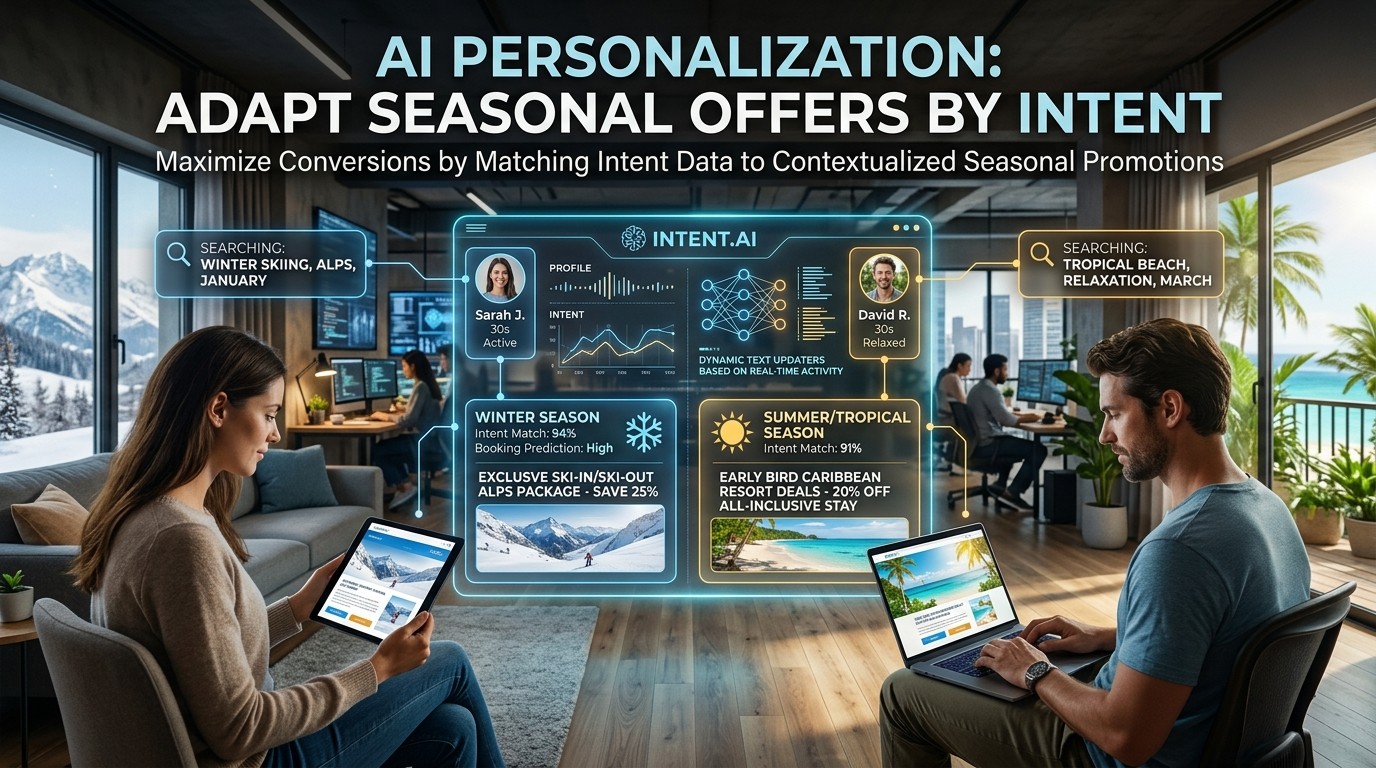
Seasonal shoppers arrive with changing needs, urgency, emotions, and buying motivations. AI Personalization helps brands match offers, messages, timing, and experiences to intent before interest becomes lost revenue.
Seasonal marketing becomes difficult when every visitor receives the same promotion despite having a different reason for shopping. A customer searching for a last-minute gift is not thinking like someone researching a purchase two weeks early. Someone comparing prices needs a different message from someone who already knows the exact product they want. AI Personalization helps marketers recognize these behavioral differences and adapt the customer experience accordingly. Instead of treating a seasonal audience as one large segment, AI Personalization can connect signals from searches, clicks, browsing patterns, purchase history, engagement, device behavior, and campaign interactions to create more relevant offer experiences.
The biggest opportunity is not simply displaying a different banner. The deeper opportunity comes from understanding why a person is active now. Seasonal demand is influenced by urgency, tradition, gifting, weather, events, discounts, social trends, availability, and personal circumstances. AI Personalization gives marketers a framework for interpreting these motivations at scale. When AI Personalization is aligned with search intent and real-time behavior, seasonal campaigns can feel less like broad promotions and more like timely assistance. That distinction matters because relevance can reduce decision friction while excessive promotion can cause shoppers to ignore the entire campaign.
Why Intent Matters More During Seasonal Campaigns
Seasonal intent changes much faster than ordinary evergreen intent. During a normal month, a customer may spend weeks comparing solutions before purchasing. During a holiday, event, festival, school season, travel period, or shopping peak, the same person may move from awareness to action in a few days or even a few hours. AI Personalization is valuable because it can react to these compressed decision cycles. AI Personalization also allows marketers to recognize when the same keyword, product, or page visit represents completely different motivations depending on timing and behavioral context.
Imagine two shoppers landing on the same product page during a seasonal sale. One has visited the product four times, read shipping information, checked reviews, and added the product to a wishlist. Another has clicked a social advertisement for the first time and is browsing several categories. Both users may appear interested, but their intent is different. AI Personalization can treat these signals differently by increasing purchase confidence for the first shopper while introducing education and discovery content to the second. This approach respects the user’s current decision stage instead of forcing the same message onto everyone.
Understanding Seasonal Intent Signals
Search queries are only one part of intent. A comprehensive intent model may evaluate page depth, search refinements, category movement, cart activity, product comparison, coupon interactions, email clicks, previous orders, content consumption, and engagement speed. AI Personalization can combine these signals to estimate whether a visitor is researching, comparing, planning, purchasing, replenishing, gifting, or responding to a temporary seasonal need. The goal is not to guess a person’s private thoughts. The goal is to interpret observable behavioral signals responsibly and use them to make the next interaction more relevant.
Fresh Content Signals can also reveal emerging demand. A sudden increase in searches around a specific seasonal product, style, package size, destination, or gift category may indicate that consumer interest is shifting. AI Personalization can use those patterns to adjust landing-page recommendations, merchandising priorities, creative themes, and promotional emphasis. When AI Personalization responds quickly, brands can reduce the delay between discovering a market shift and presenting an appropriate experience. This is especially useful when seasonal demand is unpredictable and historical performance alone cannot explain what customers are doing today.
Building Intent-Based Seasonal Segments
Traditional segmentation often relies on demographic categories, geographic areas, loyalty status, or broad customer groups. Those dimensions can remain useful, but they do not always explain immediate purchase motivation. AI Personalization works particularly well when segmentation includes behavioral intent. A practical seasonal framework might distinguish between discovery visitors, active researchers, offer seekers, ready-to-buy shoppers, repeat buyers, gift buyers, and returning high-intent visitors. AI Personalization can then connect each group with different content, recommendations, proof points, incentives, and calls to action.
Intent segments should also be dynamic rather than permanent. A visitor who begins by reading a buying guide may become a comparison shopper after visiting multiple product pages. Later, that same visitor may become highly purchase-ready after checking delivery information. AI Personalization can recognize the transition instead of leaving the person inside the original segment. This dynamic model matters because seasonal campaigns often compress the buyer journey. AI Personalization enables the experience to evolve as evidence of intent becomes stronger, creating a smoother path from curiosity to decision.
Matching Offers to Purchase Motivation
Discounts are not equally persuasive for every shopper. A price-sensitive customer may respond strongly to a percentage-off promotion, while an urgency-driven customer may care more about guaranteed delivery. Someone buying for a gift may value bundled packaging, curated recommendations, or easy returns. AI Personalization helps brands determine which benefit should receive the most attention. AI Personalization does not necessarily mean creating thousands of unique promotions. It can mean selecting the most relevant value proposition from a controlled set of approved messages.
Consider a seasonal customer who repeatedly checks delivery dates but never interacts with coupons. A discount-heavy message may not address the real obstacle. A stronger experience could highlight delivery certainty, inventory availability, or a simple purchasing process. AI Personalization can elevate those reassurance elements when behavior suggests that fulfillment confidence is more important than price. Another visitor may repeatedly open promotional emails and sort products by price. AI Personalization can shift the communication toward savings, bundles, and clear price comparisons without changing the underlying product catalog.
Seasonal Pricing and Incentive Strategy
Price promotions create urgency, but excessive discounting can damage perceived value and train shoppers to delay purchases. AI Personalization gives marketers another option: vary the presentation of the offer based on demonstrated intent instead of applying maximum discounts to the entire audience. AI Personalization can help determine when a shopper needs an incentive, when education is sufficient, and when confidence-building content may perform better than a larger price reduction.
For example, a new visitor may receive free-shipping messaging, while a highly engaged customer could see a limited-time bundle. A repeat buyer may receive a loyalty-oriented benefit instead of a generic discount. AI Personalization can support this structure by interpreting engagement intensity and purchase history within defined business rules. The important principle is to keep the optimization connected to profitability. AI Personalization should not simply maximize clicks or conversions if those outcomes depend on unnecessary discounts. The model should be measured against contribution margin, average order value, repeat behavior, and incremental revenue where possible.
Creative Adaptation Across Seasonal Touchpoints
Seasonal campaigns rarely depend on one creative asset. Brands may use search ads, social ads, email, landing pages, SMS, app messages, website modules, video, influencer content, and retargeting. AI Personalization can make these channels more coherent by identifying the strongest message for each intent state. Generative AI for Seasonal Ads can accelerate the creation of creative variations, but the strategic challenge remains deciding which variation should reach which audience. AI Personalization connects creative selection to observed signals rather than simply increasing the number of assets.
Creative relevance should extend beyond product selection. Headlines, images, proof points, urgency language, social validation, and calls to action can all vary. A researcher may need comparison-oriented messaging, while a ready-to-buy shopper may respond better to stock availability and delivery assurance. AI Personalization allows these differences to appear consistently across the customer journey. AI Personalization also reduces the risk of contradictory messaging, where one channel encourages research while another aggressively pressures the same shopper to purchase immediately.
Using Website Behavior for Intent Detection
A website contains a rich stream of behavioral information. Scroll depth, search usage, filters, product comparisons, review expansion, FAQ views, cart additions, and repeated visits can indicate where customers are in their decision process. AI Personalization can transform these interactions into actionable audience states. Instead of waiting for a completed transaction to understand customers, marketers can use these signals to improve the experience while the decision is still forming.
The timing of interactions is also important. A visitor who spends ten minutes comparing gift sets may have higher seasonal intent than another visitor who briefly views one product and exits. AI Personalization can consider both depth and recency. AI Personalization may also identify sequences rather than individual actions. For instance, a product view followed by size selection, review reading, and delivery checking suggests a different state than a product view followed by unrelated browsing. Sequence-based interpretation can make personalization more meaningful without requiring invasive individual-level assumptions.
Email Personalization Based on Intent
Email remains powerful during seasonal demand because it gives brands a direct communication environment. However, sending identical email campaigns to every subscriber can create fatigue. AI Personalization can adjust content based on recent engagement, purchase history, product interest, timing, and inferred intent. AI Personalization can help determine whether a subscriber should receive inspiration, product education, a direct offer, a reminder, or post-purchase recommendations.
Frequency also deserves attention. A subscriber opening every seasonal email may tolerate a different cadence from someone repeatedly ignoring promotional messages. AI Personalization can help control both content and timing. A highly engaged visitor who recently viewed several products could receive a concise message focused on those categories, while a less active subscriber might receive a broader seasonal guide. AI Personalization makes email more responsive because the campaign evolves with behavior rather than following a fixed calendar alone.
Search Intent and Seasonal Landing Pages
Search behavior frequently changes around seasonal events. People may progress from broad informational searches toward specific product, brand, price, shipping, or availability searches. AI Personalization can help landing pages respond to these different levels of intent. Instead of sending every searcher to a generic seasonal category page, marketers can emphasize the information most relevant to the visitor’s current stage.
For early researchers, the page might emphasize selection guides, use cases, comparisons, and inspiration. For high-intent searchers, the same page could prioritize pricing, reviews, availability, delivery deadlines, and simplified purchase paths. AI Personalization improves the usefulness of the page because the visible information reflects the visitor’s likely needs. AI Personalization can also connect search intent with onsite behavior, creating continuity between what someone expected from the advertisement and what they experience after clicking.
Personalizing Mobile Seasonal Experiences
Mobile shoppers often have shorter attention windows and may encounter seasonal content while commuting, waiting, browsing social platforms, or completing several tasks simultaneously. AI Personalization helps marketers simplify the experience for these high-context environments. Instead of displaying every promotion, AI Personalization can prioritize one relevant action, one product category, or one reassurance message based on current intent signals.
Mobile context can also influence urgency. A shopper browsing close to a shipping deadline may respond better to availability and fulfillment messaging than inspiration-heavy content. Another person casually exploring a seasonal category may respond to short-form discovery content. AI Personalization allows the interface to adapt without requiring the user to manually navigate through unnecessary information. When combined with fast-loading pages and clear hierarchy, AI Personalization can reduce cognitive load during high-pressure seasonal decision-making.
Personalizing Recommendations and Product Discovery
Recommendation systems are particularly useful when product catalogs become difficult to navigate. Seasonal collections can contain gifts, bundles, limited editions, accessories, new arrivals, and best sellers. AI Personalization can narrow that complexity based on observed behavior. A visitor searching for gifts under a specific budget can see products aligned with that constraint, while a repeat customer may receive complementary products related to previous purchases.
Recommendations should also consider negative signals. Showing the same item repeatedly after the customer ignores it can create irritation. AI Personalization can reduce repetition by learning from dismissals, skipped products, incomplete interactions, or category changes. AI Personalization can also balance relevance with discovery. A system that only recommends obvious choices may become predictable, while carefully introducing adjacent products can improve exploration. The objective is to make discovery easier without making the shopper feel trapped inside an algorithmic assumption.
Social Proof and Seasonal Trust
Seasonal buyers often face uncertainty because they have less time to evaluate products carefully. Reviews, ratings, customer photos, expert opinions, creator demonstrations, and authenticity signals can help reduce perceived risk. AI Personalization can determine which trust signal deserves more visibility based on user behavior. Someone comparing product quality may benefit from detailed reviews, while someone worried about suitability may respond to demonstrations or customer examples.
Creator UGC can strengthen this layer because it shows how products appear or perform in realistic contexts. AI Personalization can use engagement signals to determine when creator-driven proof should be emphasized. A visitor watching multiple demonstration videos may be more receptive to additional visual proof than a visitor primarily reading specifications. AI Personalization helps marketers connect trust content with the underlying decision barrier. The result is more than personalization of products; it becomes personalization of reassurance.
Ad Retargeting Without Repetition
Retargeting is useful when customers need more time before purchasing, but repeated exposure can quickly become annoying. AI Personalization can reduce this problem by adapting retargeting messages to changes in intent. If a customer viewed an item once and never returned, a soft reminder or useful guide may be appropriate. If that customer repeatedly returned and checked availability, the next communication could focus on decision support.
Retargeting should also account for completed actions. Once a customer purchases, showing the same acquisition advertisement can waste budget and create poor brand experiences. AI Personalization can suppress irrelevant acquisition messages and transition the customer into cross-sell, loyalty, or service communication. During seasonal periods, this can be especially important because customer journeys overlap rapidly. AI Personalization keeps campaigns more coordinated by treating purchase and engagement events as meaningful state changes rather than isolated events.
Real-Time Adaptation During Peak Seasonal Demand
One of the strongest advantages of AI Personalization is responsiveness. Seasonal campaigns can experience sudden changes caused by weather, product shortages, cultural moments, influencer exposure, competitor discounts, shipping disruptions, or unexpected demand. AI Personalization can detect changes in engagement patterns and adjust recommendations, messages, or audience priorities accordingly.
Real-time adaptation does not mean allowing an algorithm to change everything without control. Governance remains essential. AI Personalization should operate inside predefined boundaries for discounts, product eligibility, brand voice, legal requirements, inventory rules, and customer privacy. A safe operating model combines automated optimization with clear constraints. This approach lets AI Personalization respond quickly while keeping business and customer protections intact.
AI Personalization and Inventory-Aware Offers
Promoting a product aggressively when it is nearly unavailable creates disappointment and operational pressure. AI Personalization can connect customer intent with inventory availability so that seasonal recommendations remain realistic. When one product reaches low stock, related products with adequate inventory can become more prominent. This protects campaign continuity while reducing the risk of driving demand toward items that cannot satisfy it.
Inventory-aware experiences can also improve urgency messaging. A limited-stock item may require different communication from a widely available product. However, scarcity should be factual rather than artificially manufactured. AI Personalization should only use valid business data when presenting availability-related information. When customers trust the information they receive, personalized urgency can support decisions without crossing into manipulative pressure.
Balancing Relevance With Privacy
Personalization becomes less effective when customers feel that a brand knows too much about them. AI Personalization should therefore be designed around responsible data practices, transparency, consent requirements where applicable, data minimization, access controls, and clear retention policies. The goal is to use meaningful signals without creating unnecessary surveillance.
A useful principle is to collect and activate information because it improves the customer experience, not simply because it is technically available. AI Personalization can often deliver strong results using contextual signals such as current session behavior, recent campaign engagement, category interest, and broad lifecycle stage. Organizations should document what data is being used, why it is needed, how it is protected, and when it should stop influencing personalization. Responsible implementation protects both customer trust and long-term brand value.
Avoiding the Personalization Paradox
Too little personalization can feel irrelevant, but too much personalization can feel uncomfortable or repetitive. AI Personalization should therefore focus on meaningful adaptation rather than showing off technical sophistication. A customer does not need to know that a model identified their intent. They simply need to experience a more useful interaction.
The most effective personalization is often subtle. A relevant recommendation, a better product filter, a timely reminder, clearer shipping information, or a more appropriate content block can improve the experience without calling attention to the underlying technology. AI Personalization works best when it removes friction rather than adding complexity. AI Personalization should also preserve user control, allowing customers to explore beyond algorithmic recommendations and access broader categories when they choose.
Measuring Seasonal Personalization Performance
Measurement should move beyond click-through rate. Seasonal personalization can influence conversion rate, average order value, revenue per visitor, margin, repeat purchases, engagement, unsubscribe rate, return behavior, and customer satisfaction. AI Personalization should be evaluated according to the business objective rather than a single engagement metric.
Testing is essential because intuitive personalization is not always effective. A brand may believe that urgent messaging will increase conversions, yet some customers may respond better to reassurance or convenience. AI Personalization makes experimentation easier by enabling structured audience or treatment variations. Marketers should use holdout groups or other appropriate testing methods when possible to estimate incremental impact. AI Personalization becomes more valuable when the organization can distinguish genuine improvement from conversions that would have happened anyway.
| Intent State | Typical Signals | Useful Seasonal Experience | Primary Goal |
|---|---|---|---|
| Discovery | Broad browsing, low engagement | Guides, categories, inspiration | Build interest |
| Research | Reviews, comparisons, repeated content views | Education, comparisons, proof | Reduce uncertainty |
| Offer Seeking | Coupon views, price sorting, promotion clicks | Savings, bundles, clear value | Strengthen value perception |
| Purchase Ready | Cart activity, delivery checks, repeated visits | Availability, checkout support, urgency | Remove final friction |
| Repeat Buyer | Previous purchases, loyalty engagement | Complementary products, loyalty benefits | Increase lifetime value |
Designing an Intent-Based Personalization Framework
A practical framework starts with a small number of meaningful intent states. AI Personalization becomes difficult to manage when every tiny behavior creates a separate audience. Marketers should define clear signals for discovery, research, comparison, purchase readiness, loyalty, and post-purchase needs. Each state should have approved experiences and measurable outcomes.
The next layer is decision logic. AI Personalization can rank available experiences according to context, business priorities, and customer signals. Rules may control which products qualify, which discounts are allowed, and when a campaign should stop. AI Personalization can then optimize within those constraints. This combination is usually more manageable than trying to automate the entire customer experience without strategic guardrails.
Creating Better Seasonal Content With AI
Content production can become a bottleneck when seasonal demand changes rapidly. Brands may need new headlines, product explanations, email themes, social variations, comparison content, and landing-page modules within a short period. AI Personalization can help determine which content type should be emphasized for each intent state, while generative systems can accelerate drafting and variation.
However, volume should never replace relevance. Producing dozens of variations is not the same as producing useful experiences. AI Personalization should connect content variants to specific customer needs, measurable hypotheses, and contextual signals. Strong editorial review remains important because seasonal messaging can involve cultural sensitivity, pricing claims, deadlines, availability statements, and emotional language. Automation should increase speed without removing human judgment from critical brand decisions.
Using Seasonal Customer Journeys
A seasonal journey often begins before a customer actively searches for a product. Social exposure, email, creator content, previous purchases, or an upcoming occasion may start the process. AI Personalization can connect these touchpoints so that the experience becomes increasingly relevant as intent develops. The journey can evolve from inspiration to education, comparison, transaction, and retention.
This journey-based model is more effective than treating channels separately. A shopper who engages with an email should not receive a completely disconnected social advertisement. AI Personalization can help coordinate themes and suppress outdated messages based on current behavior. AI Personalization can also recognize when the journey is complete. After purchase, communication should change from acquisition to delivery, usage support, complementary products, reviews, or loyalty rather than continuing to push the same seasonal acquisition message.
Personalization for Different Seasonal Personas
Personas still have value when they describe behavior and context rather than relying only on demographic assumptions. A last-minute shopper may prioritize speed. A thoughtful gift planner may prioritize curation. A budget-conscious family may prioritize value. A loyal customer may care about exclusivity. AI Personalization can use these patterns to select more relevant experiences.
The important distinction is that personas should remain flexible. One customer can occupy multiple seasonal personas over time. AI Personalization can adapt as behavior changes. Someone who typically plans purchases early may become a last-minute shopper in an unusually busy season. AI Personalization allows the experience to reflect the current situation instead of blindly following an old profile. This adaptability is especially valuable during unpredictable seasonal periods.
Common Mistakes in Seasonal AI Personalization
One common mistake is equating personalization with aggressive targeting. AI Personalization is not about changing every visible element or mentioning private details simply because the system knows them. Relevance should always have a purpose. Another mistake is optimizing only for immediate conversion. Some seasonal customers need education first, and forcing them directly toward checkout may reduce trust.
Another mistake is ignoring operational realities. AI Personalization cannot compensate for inaccurate inventory, unclear delivery dates, slow websites, broken checkout flows, or inconsistent pricing. Personalization can improve the path, but the underlying experience still needs to work. A final problem is insufficient measurement. Without controlled testing, businesses may attribute seasonal demand itself to AI Personalization. Good experimentation separates technology impact from natural demand fluctuations.
A Practical Implementation Roadmap
Organizations can start small. First, identify two or three important seasonal intent states and define observable signals for each. Then choose a limited number of experiences, such as recommendation modules, landing-page content, email themes, or offer presentation. AI Personalization can initially operate within these boundaries while the team evaluates outcomes.
Next, connect analytics events, campaign interactions, product data, and relevant customer information. Establish governance before expanding the number of signals. AI Personalization should be documented so teams understand which data influences which experience. Once the foundation is stable, marketers can introduce more sophisticated prediction, real-time adaptation, and cross-channel coordination.
The final stage is continuous optimization. AI Personalization should not be launched once and forgotten. Seasonal markets evolve from one event to another, and customer behavior changes with competition, economic conditions, cultural trends, and product availability. Teams should review performance, examine unexpected behavior, update intent signals, and remove experiences that no longer contribute value. AI Personalization should become part of a learning system rather than a one-time campaign feature.
How AI Personalization Improves Customer Psychology
At a psychological level, relevance reduces the amount of mental effort required to make a decision. During seasonal shopping, people often face many options, limited time, and uncertainty about whether a product is appropriate. AI Personalization can reduce cognitive overload by helping visitors see information that matches their current concern.
AI Personalization can also support confidence. When shoppers encounter appropriate reviews, clear product recommendations, useful comparisons, or fulfillment information at the moment they need it, uncertainty decreases. This does not guarantee a purchase, but it can remove barriers that prevent action. AI Personalization is therefore most valuable when it helps customers feel understood without making them feel monitored. The experience should support agency, clarity, and convenience rather than manufacture pressure.
Building a Sustainable Seasonal Strategy
Short-term seasonal performance matters, but sustainable growth requires learning that carries forward. AI Personalization can reveal which signals consistently predict interest, which offers create profitable behavior, which content reduces hesitation, and which customer journeys create repeat purchases. These insights can improve future campaign planning.
The strongest organizations treat every seasonal campaign as a learning opportunity. AI Personalization can capture patterns from one event and help marketers prepare for the next, provided that historical signals are interpreted alongside current conditions. The objective is not to assume that last year’s behavior will repeat perfectly. Instead, AI Personalization creates a flexible foundation that combines historical knowledge with present intent, allowing seasonal marketing to become increasingly responsive over time.
Frequently Asked Questions (FAQ)
What is AI Personalization in seasonal marketing?
AI Personalization is the use of artificial intelligence to adapt customer experiences, recommendations, content, timing, and offers according to behavioral, contextual, and intent-related signals. In seasonal marketing, AI Personalization helps brands respond to rapidly changing customer motivations rather than delivering identical messages to everyone.
How does AI Personalization identify customer intent?
AI Personalization can evaluate observable signals such as search behavior, product views, filters, review interactions, cart activity, campaign engagement, visit frequency, and purchase history. These signals can be combined into broader intent states such as discovery, research, comparison, and purchase readiness.
Can AI Personalization improve seasonal conversion rates?
AI Personalization can contribute to stronger conversion performance by reducing friction and presenting more relevant experiences. However, results depend on implementation, audience quality, creative relevance, product-market fit, pricing, website performance, and measurement methodology. Controlled testing is important before attributing improvement directly to personalization.
Should every customer receive a different seasonal offer?
No. AI Personalization does not require every person to receive a unique offer. Businesses can create a limited set of experiences and use AI Personalization to determine which experience is most relevant to each intent state. This approach can be easier to govern and measure.
How can marketers avoid over-personalization?
Use only meaningful signals, maintain transparent data practices, avoid unnecessary personal references, and allow customers to explore beyond recommendations. AI Personalization should primarily reduce friction and improve usefulness rather than demonstrate how much customer data a system can process.
Is AI Personalization useful for email marketing?
Yes. AI Personalization can help adapt subject themes, content, recommendations, timing, and promotional emphasis based on recent engagement and customer behavior. It can also reduce unnecessary repetition by changing communication as customer intent develops.
How does AI Personalization work with seasonal advertising?
AI Personalization can help determine which creative theme, product, message, or offer should be shown to different intent groups. Advertising platforms, analytics systems, and internal customer data can provide signals that support this decision process while generative tools help produce approved creative variations.
What data is most useful for seasonal personalization?
Useful data can include current browsing behavior, search activity, product interactions, purchase history, campaign engagement, recent visits, category interest, and contextual information relevant to the experience. AI Personalization should use data proportionally and according to applicable privacy and governance requirements.
How should businesses measure AI Personalization?
Measurement should reflect the campaign’s objective. Common metrics include conversion rate, revenue per visitor, average order value, margin, repeat purchase rate, engagement, unsubscribe rate, and incremental revenue. AI Personalization should ideally be evaluated through controlled experiments or appropriate comparison groups.
Can small businesses use AI Personalization without a complex AI system?
Yes. A small business can begin with simple behavioral segments, recommendation rules, dynamic email content, or intent-based landing-page experiences. AI Personalization can become more sophisticated over time as data quality, analytics maturity, and operational capabilities improve.
Conclusion
AI Personalization makes seasonal marketing more responsive by connecting customer intent with relevant offers, content, recommendations, and timing. Rather than treating every seasonal shopper identically, brands can use behavioral signals to reduce friction, improve confidence, and coordinate experiences across channels. Effective implementation requires clear intent states, responsible data practices, controlled testing, operational alignment, and meaningful business metrics. The goal is not maximum automation or maximum message variation. The goal is a useful customer experience that adapts as intent changes. When implemented thoughtfully, AI Personalization can help seasonal campaigns become more relevant, efficient, measurable, and capable of learning from every customer interaction.