
Maximizing revenue during holidays requires more than just basic discounts; it demands meticulously planned seasonal marketing campaigns. By tapping into consumer emotions and timely trends, brands can exponentially boost sales, capture new audiences, and build lasting loyalty during the most profitable times of the year.
This comprehensive guide explores the strategies necessary for developing highly effective seasonal marketing campaigns. You will learn the psychological drivers behind holiday purchasing, actionable steps for strategic planning, and the best channels for execution. We also cover expert tips, common mistakes, and advanced metrics to ensure your seasonal promotions consistently deliver maximum return on investment.
The Psychology Behind Effective Seasonal Marketing Campaigns

Understanding why consumers buy during specific times of the year forms the foundation of all successful seasonal marketing campaigns. Human behavior shifts dramatically as holidays, weather changes, and cultural events approach. Marketers who decode these psychological triggers position their brands to capture attention and drive massive revenue. The most potent psychological driver is the Fear of Missing Out (FOMO). Scarcity and urgency dominate holiday shopping. When brands introduce limited-time offers or exclusive holiday bundles, they force the consumer to make a rapid decision. This urgency bypasses the traditional, prolonged buyer’s journey, accelerating the path to purchase.
Emotional Resonance and Nostalgia
During events like Christmas, Thanksgiving, or Valentine’s Day, emotional resonance takes precedence over logic. Consumers seek products that evoke warmth, connection, and nostalgia. Leveraging these emotions requires brands to craft narratives rather than just pushing products. When seasonal marketing campaigns tell a story—perhaps highlighting family gatherings, personal growth, or the joy of giving—they create an emotional bond with the audience. This bond reduces price sensitivity. Shoppers become willing to spend more on items that promise to deliver a specific emotional experience. By utilizing deep consumer behavior analytics, marketing teams can identify exactly which emotional triggers resonate most powerfully with their distinct audience segments.
The Impact of Anticipation
Anticipation plays a massive role in consumer psychology. People enjoy looking forward to events almost as much as the events themselves. Retailers capitalize on this by launching teaser campaigns weeks or even months in advance. Think about the build-up to Black Friday. Brands do not just drop discounts on Friday morning; they spend November priming their audience. They offer sneak peeks, early access for VIP members, and countdown timers. Building anticipation ensures that when the seasonal marketing campaigns officially launch, the audience is already primed, eager, and ready to convert immediately.
Strategic Planning for Seasonal Marketing Campaigns

Executing flawless seasonal marketing campaigns requires extensive lead time and meticulous preparation. Brands that wait until a month before a major holiday to start planning will inevitably lose market share to better-prepared competitors. Strategic planning must begin at least a quarter in advance to ensure all assets, inventory, and messaging align perfectly with the campaign objectives.
Setting Concrete Objectives and KPIs
Every campaign must begin with clearly defined goals. Vague objectives like “increase sales” provide no actionable direction. Instead, marketers must set Specific, Measurable, Achievable, Relevant, and Time-bound (SMART) goals. A precise objective might be to increase Q4 winter apparel sales by 25% year-over-year or to acquire 5,000 new email subscribers through a holiday giveaway. Once you define the goals, you must establish the Key Performance Indicators (KPIs) that will measure success. Common KPIs include Return on Ad Spend (ROAS), Customer Acquisition Cost (CAC), Average Order Value (AOV), and overall conversion rate. Establishing these benchmarks early allows teams to monitor performance in real-time and pivot if the data indicates a specific strategy is underperforming.
Deep Audience Segmentation
A broad, one-size-fits-all message rarely succeeds during peak seasons. Effective seasonal marketing campaigns rely heavily on advanced audience segmentation. You must categorize your audience based on past purchase behavior, engagement levels, demographics, and even psychographics. For example, a segment of high-value repeat customers should receive a completely different message than a segment of new subscribers who have never made a purchase. VIP customers might receive early access to seasonal sales, while new prospects might receive a compelling first-time buyer discount. Segmenting your audience ensures high relevance, which directly correlates to higher open rates, better click-through rates, and increased conversions. Implementing robust customer retention strategies during these peak times ensures that one-time holiday buyers transition into year-round loyalists.
Resource Allocation and Budgeting
Budgeting for seasonal marketing campaigns presents a unique challenge because ad costs typically skyrocket during peak times like Q4. Brands must allocate their resources intelligently to maximize visibility without draining profitability. This requires analyzing historical data to identify which channels yielded the highest ROI in previous seasons. If paid social media advertising drove 70% of your Black Friday revenue last year, a significant portion of this year’s budget should naturally flow there. However, you must also reserve a contingency budget. During active campaigns, certain ad creatives or target audiences might unexpectedly overperform. Having a flexible reserve budget allows you to quickly scale winning ads and capitalize on momentum. Furthermore, allocate budget for creative development—high-quality seasonal graphics, video production, and copywriting are essential investments that dictate the success of the overarching campaign.
The Ultimate Calendar for Seasonal Marketing Campaigns
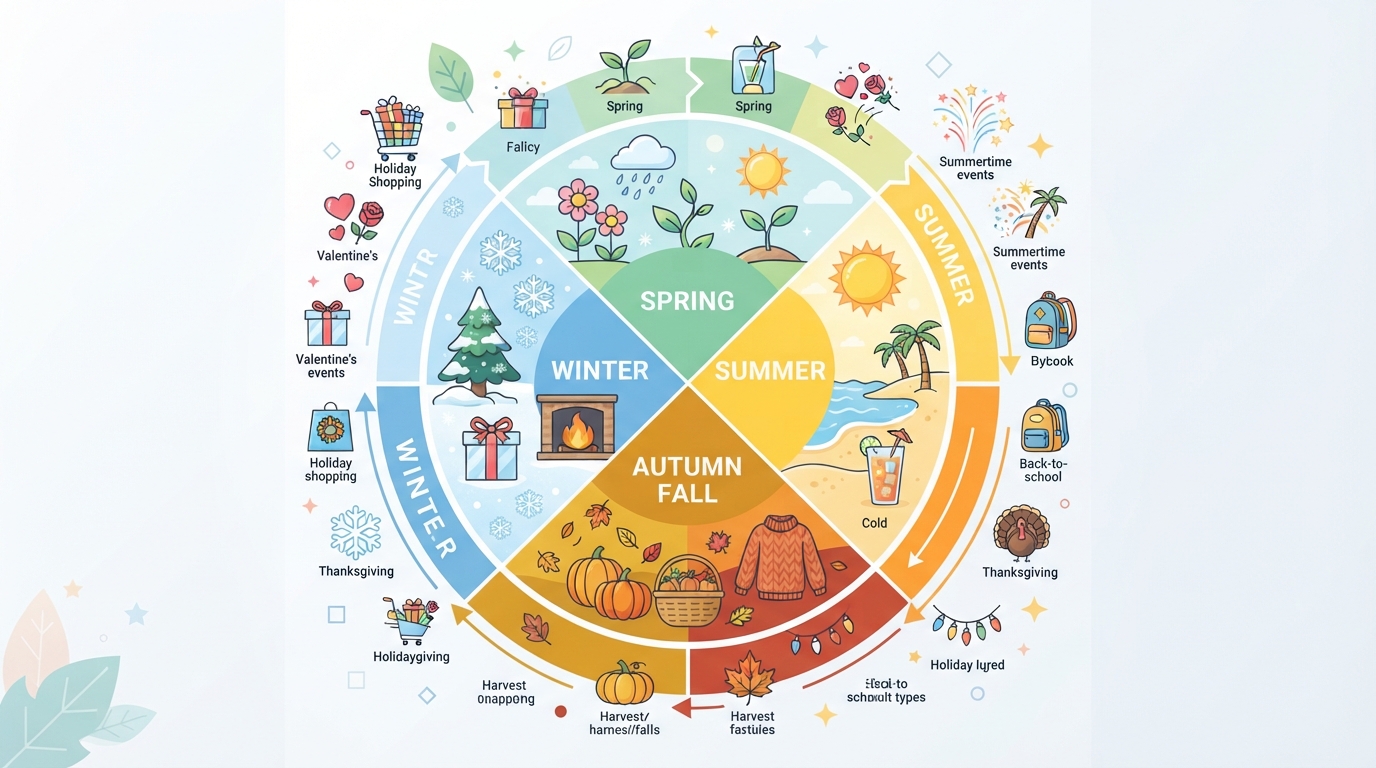
Timing dictates the success of seasonal marketing campaigns. Launching too early can fatigue your audience, while launching too late means missing the peak buying window. Structuring a comprehensive annual calendar ensures your brand maintains a consistent, strategic presence throughout the year.
1. Fresh Starts and Resolutions
The first quarter revolves around themes of renewal, self-improvement, and fresh starts. New Year’s resolutions drive consumer behavior heavily in January. Health, fitness, organization, and personal finance brands thrive during this period. However, even if your brand does not fit those exact niches, you can frame your seasonal marketing campaigns around the concept of starting the year strong. February introduces Valentine’s Day, triggering a massive spike in gifting, particularly in jewelry, chocolates, apparel, and experiential services. Planning for Q1 requires acknowledging the post-holiday spending hangover; therefore, messaging should focus on value, personal investment, and meaningful gifts rather than massive consumption.
2. Spring Renewal and Appreciations
Quarter two brings a shift in weather and mindset. Spring cleaning, outdoor activities, and preparation for summer take center stage. Key events include Easter, Mother’s Day, and Father’s Day. Mother’s Day and Father’s Day are highly emotional, gifting-centric holidays. Seasonal marketing campaigns during Q2 should focus heavily on appreciation and family. This is an excellent time to bundle products into gift sets. Additionally, Q2 often sees brands clearing out winter inventory through strategic spring transition sales, making room for summer product lines.
3. Summer Leisure and Back-to-School
Summer marketing focuses heavily on leisure, travel, and outdoor living. The Fourth of July represents a major retail event in the US, dominated by sales in home goods, outdoor equipment, and apparel. However, the most significant revenue driver in Q3 is the Back-to-School season. Starting in late July and peaking in August, this period requires aggressive omnichannel marketing strategies. Brands selling electronics, apparel, stationery, and dorm essentials must target both the end-users (students) and the purchasers (parents). Effective campaigns often leverage influencer partnerships on platforms like TikTok and Instagram to build hype among younger demographics while using search ads to capture high-intent parents looking for deals.
4. The Holiday Dominance
Quarter four represents the zenith of the retail year. Halloween, Thanksgiving, Black Friday, Cyber Monday, and Christmas create a relentless wave of consumer spending. Seasonal marketing campaigns in Q4 demand the highest budgets, the most aggressive strategies, and the tightest execution. Brands must begin their Q4 planning in July or August. The competition for ad space and consumer attention is fierce. Success in Q4 relies on massive list-building efforts in Q3, ensuring you have a massive audience to market to directly via email and SMS, bypassing expensive ad auctions where possible.
Seasonal Campaign Dynamics Comparison
| Campaign Variable | Q1 (New Year/Valentines) | Q2 (Mother’s/Father’s Day) | Q3 (Back to School) | Q4 (Black Friday/Holidays) |
| Primary Emotion | Renewal, Love, Ambition | Appreciation, Refreshment | Preparation, Excitement | Urgency, Generosity, Joy |
| Buying Trigger | Self-improvement, Partner gifting | Familial gifting, Weather shift | Necessity, Social status | Scarcity, Mass gifting, Deals |
| Ad Cost (CPM) | Low to Medium | Medium | Medium to High | Extremely High |
| Key Strategy | Value-driven messaging | Bundle offers, Gift guides | Influencer marketing, Checklists | Aggressive retargeting, Scarcity |
Top Digital Channels for Seasonal Marketing Campaigns
Executing seasonal marketing campaigns across multiple platforms simultaneously ensures you capture your audience regardless of where they spend their time online. However, different channels serve different purposes within the campaign funnel.
Leveraging Email and SMS Marketing
Owned channels like email and SMS remain the highest converting platforms for seasonal marketing campaigns. Unlike paid ads, you do not pay per click when communicating with your owned list. During busy seasons, email inboxes become incredibly crowded. To stand out, you must craft compelling, curiosity-inducing subject lines. Avoid generic phrasing like “Holiday Sale Inside.” Instead, utilize personalization and urgency. Implement automated email flows specifically designed for the season. A dedicated holiday abandoned cart sequence, featuring seasonal messaging and perhaps a time-sensitive discount, can recover massive amounts of lost revenue. SMS marketing provides an even more direct line to the consumer. With open rates frequently exceeding 90%, SMS serves as the perfect channel for flash sales, last-minute reminders, and VIP early access announcements.
- Design highly visual, mobile-optimized email templates that load instantly.
- Segment your lists meticulously to ensure product recommendations match past buying behavior.
- Utilize countdown timers inside emails to visually reinforce urgency.
Paid Social Media Advertising
Social media platforms offer unparalleled targeting capabilities, making them essential for seasonal marketing campaigns. Platforms like Meta (Facebook and Instagram), TikTok, and Pinterest allow brands to showcase their products visually. During the holidays, ad creative must clearly communicate the seasonal angle. Swap out generic lifestyle imagery for visually striking, holiday-themed creative. Video content consistently outperforms static images on paid social channels. Create short, engaging videos demonstrating the product in a seasonal context. Retargeting acts as the engine of paid social success during peak seasons. Consumers frequently browse multiple sites before making a holiday purchase. By implementing aggressive retargeting campaigns, you keep your brand top-of-mind, driving the consumer back to your site when they are finally ready to pull the out their credit card. According to a Think with Google retail insights report, shoppers use multiple touchpoints before purchasing, emphasizing the need for robust retargeting.
- Launch brand awareness campaigns early in the season to build large retargeting pools.
- Refresh ad creatives frequently to combat ad fatigue during long campaigns.
- Utilize dynamic product ads to show users the exact items they previously viewed.
Search Engine Optimization and Paid Search
Capturing high-intent traffic requires dominating search engine results. For organic traffic, prioritize seasonal SEO optimization months before the event. Create dedicated landing pages for specific holidays (e.g., “Black Friday Deals 2026”). Instead of deleting these pages after the season ends, keep them live year-round and simply update the content annually. This allows the page to build authoritative backlinks and domain authority over time. On the paid search side (Google Ads), bidding on seasonal keywords (e.g., “best gifts for dad”) becomes highly competitive. Focus on long-tail keywords relevant to your specific niche to maintain a profitable Cost Per Click (CPC). Ensure your ad copy reflects the seasonal offer and utilizes ad extensions to highlight site-wide sales, free shipping, or local inventory availability.
Common Mistakes to Avoid in Seasonal Marketing Campaigns
Even experienced marketers can stumble during high-pressure seasons. Avoiding these prevalent pitfalls can mean the difference between a record-breaking quarter and a costly disappointment. Understanding what not to do is just as important as knowing the right strategies to implement.
Starting the Planning Process Too Late
The most catastrophic error in executing seasonal marketing campaigns involves waiting too long to begin. If you start planning your Black Friday strategy in late October, you have already lost. Late planning leads to rushed creative, unoptimized landing pages, and a lack of audience priming. Furthermore, ad platforms require time to approve creatives, and machine learning algorithms need time to optimize delivery. By launching late, you force your campaigns into the most expensive, highly competitive bidding environments without any historical data to guide the algorithm. Always map out your campaigns at least three months in advance, locking in inventory, creative assets, and promotional mechanics early.
Neglecting the Mobile Experience
A massive portion of holiday shopping occurs on mobile devices. Consumers browse for gifts while commuting, waiting in line, or sitting on the couch. If your seasonal marketing campaigns direct traffic to a website that loads slowly, features tiny text, or has a clunky checkout process on mobile, you will hemorrhage sales. Ensure your site features a responsive design. Compress all large seasonal images to improve page load speed. Implement express payment options like Apple Pay, Google Pay, and Shop Pay. Forcing a mobile user to manually type in their credit card information and shipping address greatly increases cart abandonment rates. The mobile checkout experience must be frictionless.
Relying Exclusively on Deep Discounts
While discounts certainly drive conversions, relying solely on heavy markdowns degrades brand equity and destroys profit margins. Consumers become conditioned to only buy from your brand when items are on sale. Instead of just slashing prices, innovate your holiday promotional strategies. Consider offering tiered discounts (spend more, save more), creating exclusive holiday bundles that increase Average Order Value, or offering free gifts with purchase. Free shipping often acts as a stronger conversion driver than a percentage discount. By adding value rather than just cutting prices, you protect your margins while still giving the consumer a highly compelling reason to purchase.
- Avoid training your customers to wait for discounts by offering value-adds instead of straight price cuts.
- Never launch a campaign without thoroughly testing the website load capacity to prevent crashes during traffic spikes.
- Do not ignore post-purchase communication; the customer journey continues after the seasonal transaction.
Pro Tips and Expert Insights for Seasonal Marketing Campaigns
To elevate your strategies from good to exceptional, you must implement advanced tactics that outsmart the competition. The digital landscape is saturated; cutting through the noise requires creativity, precision, and a deep understanding of platform algorithms.
Harnessing User-Generated Content
Consumers trust other consumers far more than they trust branded advertising. Integrating User-Generated Content (UGC) into your seasonal marketing campaigns dramatically boosts credibility and conversion rates. Encourage your existing customers to share photos or videos of themselves using your products in a seasonal setting. Create a branded hashtag for the specific campaign. You can then repurpose this UGC across your email marketing, social media ads, and landing pages. Seeing real people enjoying a product provides the social proof necessary to convince hesitant shoppers to complete their purchase.
Implementing Advanced Personalization
Basic personalization, like using a subscriber’s first name in an email, is no longer sufficient. Advanced personalization involves tailoring the entire customer experience based on data. If a customer consistently purchases men’s athletic wear, your seasonal marketing campaigns should dynamically populate with winter running gear or targeted gift guides for athletes, rather than generic holiday banners. Personalize the website homepage based on the user’s referral source or past browsing history. According to data from the HubSpot State of Marketing report, highly personalized customer journeys yield significantly higher retention and conversion metrics. By showing the customer exactly what they want to see, you remove friction and accelerate the buying process.
Optimizing for Post-Holiday Retention
Many brands treat seasonal buyers as purely transactional, focusing entirely on the initial acquisition. This represents a massive missed opportunity. The true ROI of seasonal marketing campaigns often lies in the lifetime value of the newly acquired customers. Once the holiday passes, immediately implement onboarding sequences designed to turn these one-time buyers into loyal brand advocates. Send targeted emails offering advice on how to use their new product. Offer them a specialized discount for their second purchase in January or February. By prioritizing retention, you ensure that the money spent acquiring customers during peak seasons pays dividends for years to come.
Measuring the Success of Seasonal Marketing Campaigns
Data analysis acts as the compass for all future marketing efforts. Without rigorous measurement, you cannot accurately determine which strategies succeeded and which failed. Evaluating seasonal marketing campaigns requires looking beyond vanity metrics and focusing on data points that directly impact the bottom line.
Tracking Crucial Performance Indicators
While metrics like impressions and social media likes provide a baseline understanding of brand awareness, they do not pay the bills. Marketers must obsess over conversion-focused KPIs. Track the Return on Ad Spend (ROAS) meticulously for each individual channel. If Facebook generated a 3x ROAS while Pinterest generated a 1.5x ROAS, you know exactly how to adjust your budget for the next campaign. Monitor the Average Order Value (AOV); successful seasonal marketing campaigns should ideally drive a higher AOV through bundling and upselling. Finally, track the Customer Acquisition Cost (CAC). Ad costs spike during holidays, meaning your CAC will likely increase. You must ensure that the profit margin on your seasonal items can absorb this higher acquisition cost.
Conducting Comprehensive Post-Mortem Analysis
Once the seasonal marketing campaigns conclude, gather your entire team for a detailed post-mortem analysis. Document everything. What were the best-performing email subject lines? Which ad creatives generated the highest click-through rates? Did the website experience any downtime during peak traffic spikes? Did inventory levels hold up to the demand? By answering these questions honestly and comprehensively, you create a blueprint for the next year. A successful post-mortem identifies both the triumphant strategies to replicate and the operational bottlenecks to fix, ensuring continuous improvement in your marketing engine.
- Always isolate the performance of different audience segments to see which demographic yielded the highest lifetime value.
- Analyze the performance of specific product categories to inform inventory purchasing decisions for the following year.
- Document competitor strategies observed during the season to adapt and counter them in future campaigns.
Advanced Segmentation in Seasonal Marketing Campaigns
Going deeper into the mechanics of audience targeting, advanced segmentation serves as the backbone of high-converting seasonal marketing campaigns. Broad targeting guarantees wasted ad spend. When you segment dynamically, you speak directly to the nuanced needs of individual shoppers.
Behavioral and Intent-Based Targeting
Instead of just looking at demographics, marketers must focus on behavioral data. Track how users interact with your website. Did they read three blog posts about “winter skincare routines”? That user exhibits high intent for a specific product category. Your seasonal marketing campaigns should retarget that user with tailored ads featuring winter moisturizers, rather than a generic sitewide sale. Intent-based targeting also involves leveraging search query data. If a user lands on your site via a search for “urgent next-day gift delivery,” your landing page must immediately highlight shipping cutoff times and expedited delivery options to satisfy their immediate, intent-driven need.
Predictive Analytics and Machine Learning
The future of seasonal marketing campaigns heavily involves predictive analytics. By feeding historical purchase data into machine learning algorithms, brands can predict which customers are most likely to churn, which are most likely to purchase a high-ticket item, and exactly when they are most likely to buy. This allows marketers to proactively trigger automated campaigns before the customer even realizes they need the product. Predictive models can also forecast inventory demand for specific variations of a product, ensuring you do not sell out of your most profitable items during the peak of the campaign. By embracing data science, marketing teams move away from guessing and transition into precision-guided revenue generation.
Successful execution requires discipline, creativity, and a relentless focus on the consumer experience. The brands that win are those that prepare early, analyze the data deeply, and prioritize adding real value to their customers’ lives during special times of the year.
By mastering the strategies outlined in this guide, you can confidently launch seasonal marketing campaigns that not only capture attention but drive massive, sustainable revenue growth. Stop relying on last-minute discounts and start engineering predictable, high-converting promotions. Take action today by auditing your upcoming calendar and mapping out your next major seasonal initiative.
1. What are seasonal marketing campaigns?
Seasonal marketing campaigns are strategic promotional initiatives designed to capitalize on specific holidays, times of year, or cultural events. They leverage timely themes, changing consumer behaviors, and seasonal demands to drive engagement and boost sales. Examples include Black Friday sales, Back-to-School promotions, and Summer clearance events.
2. How early should I start planning seasonal marketing campaigns?
You should begin planning major seasonal marketing campaigns at least three to four months in advance. This lead time allows for thorough market research, creative asset development, inventory procurement, and the setup of complex digital advertising structures without rushing.
3. Which channels work best for holiday promotions?
An omnichannel approach works best. Email and SMS are top performers for direct conversions from existing customers. Paid social media (Meta, TikTok) excels at visual storytelling and retargeting, while search engine optimization captures high-intent shoppers actively looking for specific gifts or seasonal products.
4. How can small businesses compete during expensive peak seasons?
Small businesses should focus on organic channels and hyper-targeted niches rather than competing in broad ad auctions. Leveraging strong email lists, prioritizing outstanding customer service, offering unique local experiences, and utilizing organic social media effectively can yield high ROI without massive ad budgets.
5. Why is audience segmentation important during holidays?
Segmentation prevents your brand from sending generic messages that get ignored. By dividing your audience based on past purchases or engagement, you can tailor your seasonal marketing campaigns to show highly relevant products, drastically improving open rates, click-through rates, and overall conversions.
6. What are the biggest mistakes made in seasonal promotions?
Common mistakes include launching campaigns too late, neglecting the mobile checkout experience, relying entirely on heavy discounts instead of value-adds, and failing to ensure website servers can handle massive spikes in holiday traffic.
7. How do I maintain sales after a seasonal campaign ends?
Implement strong post-purchase retention sequences. Send educational content about the products they bought, offer exclusive discounts for their next purchase in the off-season, and enroll them in loyalty programs to turn one-time holiday shoppers into year-round customers.
8. Are seasonal marketing campaigns only for B2C companies?
No. B2B companies can also leverage seasonal shifts. For example, B2B software companies often run aggressive Q4 campaigns targeting businesses that need to spend their remaining annual budgets before the year ends, using themes of preparation and efficiency for the upcoming year.
9. How do I measure the success of my seasonal initiatives?
Look beyond vanity metrics. Measure Return on Ad Spend (ROAS), Customer Acquisition Cost (CAC), Average Order Value (AOV), and overall conversion rate. After the season, conduct a thorough post-mortem analysis to review what strategies generated the most profit.
10. Can I repurpose old seasonal content for SEO?
Yes, absolutely. Instead of deleting a “Christmas Deals” landing page in January, keep the URL live and update the content slightly. Next year, refresh it fully. This builds domain authority over time, ensuring your page ranks higher organically for future seasonal marketing campaigns
Conclusion
Mastering seasonal marketing campaigns is the ultimate key to driving predictable revenue growth and building lasting customer loyalty. By starting your strategic planning early, leveraging data-driven channel strategies, and focusing on audience personalization, your brand can consistently outperform competitors every quarter. Ready to transform your sales strategy? Start auditing your upcoming holiday calendar today to maximize your ROI.
FAQ
1. How do I determine the right budget allocation for seasonal marketing campaigns?
Determine your budget by analyzing historical Return on Ad Spend (ROAS) across individual acquisition channels from previous quarters. Allocate 60–70% of your total seasonal budget to proven, high-converting platforms (such as email marketing and paid social retargeting), reserve 20% for top-of-funnel brand awareness, and hold 10% in a flexible reserve fund. This contingency fund allows you to quickly scale budget toward top-performing ad creatives or specific high-intent audience segments during peak traffic windows.
2. What role does SMS marketing play in seasonal marketing campaigns?
SMS marketing acts as an immediate, direct line to high-intent consumers during high-volume promotional periods. With open rates routinely exceeding 90%, SMS is uniquely suited for time-sensitive offers such as flash sales, order cutoff countdowns, and VIP early access announcements. To maximize performance without alienating subscribers, limit messaging to highly targeted updates and pair SMS with automated abandoned cart workflows during peak buying days.
3. How can B2B companies leverage seasonal marketing campaigns effectively?
B2B companies can align their promotions with fiscal calendar cycles, budgeting timelines, and industry milestones. In late Q4, run campaigns targeting decision-makers looking to spend remaining annual budgets before year-end. In Q1, frame messaging around strategic annual goals, process optimization, and team scaling. Combining account-based marketing (ABM) with timely, value-focused incentives allows B2B firms to tap into seasonal spending behavior just like B2C brands.
4. What is the best way to handle unsold seasonal inventory after a campaign ends?
Address excess inventory without destroying profit margins by utilizing strategic post-season liquidation tactics. Instead of applying steep site-wide discounts that harm brand equity, create mystery box bundles, offer excess items as free gift-with-purchase incentives for early Q1 orders, or host exclusive clearance events for VIP email subscribers. Alternatively, hold evergreen seasonal items in storage for secondary promotional windows later in the year.
5. How do I prevent ad fatigue during extended holiday promotional windows?
Combat ad fatigue by implementing strict frequency capping and rotating creative assets every 7 to 10 days during long seasonal marketing campaigns. Build a diverse asset library containing short-form video testimonials, user-generated content, lifestyle imagery, and static graphics before launching. When click-through rates drop, shift ad messaging from early-bird discounts to fast-shipping guarantees or product-specific gift guides to maintain engagement without altering core pricing.