
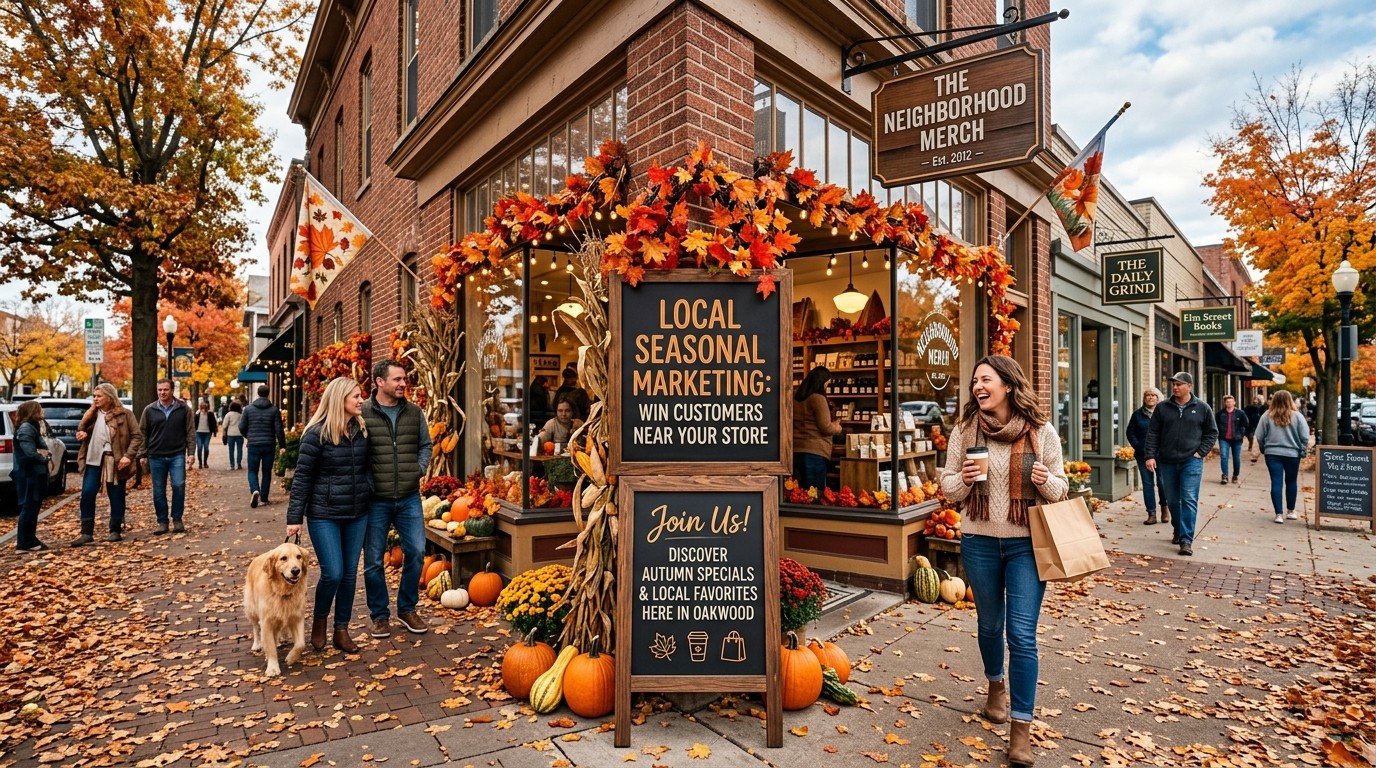
Local Seasonal Marketing helps nearby businesses turn seasonal changes, local habits, weather patterns, and community moments into timely campaigns that attract customers and increase store visits.
A customer can walk past your store every day without noticing it.
Then something changes.
The weather suddenly becomes colder. A local festival approaches. Schools close for a holiday. A neighborhood event brings additional foot traffic. A community celebration changes shopping behavior. A long weekend creates extra leisure time. A sudden rainstorm makes certain products immediately useful.
The store has not changed, but the customer’s priorities have.
That temporary shift creates one of the most valuable opportunities for local businesses: becoming visible at exactly the moment a nearby customer has a reason to buy.
Local Seasonal Marketing is built around this principle. Instead of relying only on broad annual holidays or generic discount campaigns, businesses connect their marketing to the seasonal, geographic, cultural, and behavioral conditions influencing customers near their locations.
This approach is particularly powerful for restaurants, retail stores, salons, pharmacies, gyms, home-service companies, cafés, entertainment businesses, grocery stores, automotive services, and other businesses where physical proximity influences purchase decisions.
Local Seasonal Marketing is not simply about saying “season sale.” It is about understanding what is changing around your customers and then turning that change into useful, relevant communication.
When done properly, Local Seasonal Marketing can make a business feel less like an advertiser and more like a nearby solution.
What Is Local Seasonal Marketing?
Local Seasonal Marketing is a location-focused strategy that adapts promotional messages, offers, content, products, and customer experiences to seasonal conditions and events affecting a specific local market.
Traditional seasonal marketing might promote winter products nationwide.
A localized approach asks a more useful question:
“What does winter mean for customers within a few miles of this business?”
The answer can vary considerably.
A clothing store in one area may see demand for jackets after an early cold spell. A café may see an increase in hot-drink orders during rainy mornings. A hardware store may benefit from local home-maintenance demand before a storm. A restaurant near a stadium may experience a customer surge around a major game.
This is why Local Seasonal Marketing depends on context.
The season provides a broad framework, but location provides meaning.
A smart business therefore combines seasonal knowledge with local customer behavior, geographic conditions, community events, and store-level data.
Why Local Customers Respond Differently
People do not make purchases according to national averages.
They respond to their immediate environment.
A person may ignore an online advertisement for rainwear when the forecast is clear. The same person may actively search for waterproof clothing when heavy rain begins and they need to commute.
That behavioral change is exactly why Local Seasonal Marketing can outperform generic seasonal promotion for location-based businesses.
Customers often have three questions in their minds:
“Do I need this?”
“Do I need it now?”
“Can I get it easily?”
A nearby business can answer all three when its marketing is timely.
The psychological advantage is relevance.
When a message reflects something happening in the customer’s real environment, the brain has less work to do to understand why the product matters.
The Psychology of Local Seasonal Demand
Purchase decisions are rarely driven by price alone.
Timing, convenience, familiarity, urgency, trust, identity, and environmental context all influence behavior.
Local Seasonal Marketing works by stacking these factors together.
Imagine a customer sees a generic advertisement for a coffee shop.
Later that same customer sees:
“Cold morning? Your warm breakfast is five minutes away.”
The second message is stronger because it matches the customer’s immediate context.
This creates contextual recognition.
The consumer does not simply process a product advertisement. They recognize a situation that already exists in their life.
That recognition can reduce friction.
The business does not have to convince the customer that cold weather exists. The customer is already experiencing it.
The same principle applies to seasonal clothing, home services, restaurants, beauty businesses, travel services, groceries, entertainment, and countless other local categories.
The Difference Between Local and National Seasonal Campaigns
A national seasonal campaign aims for broad relevance.
A local campaign aims for immediate relevance.
| National Seasonal Marketing | Local Seasonal Marketing |
|---|---|
| Broad geography | Specific local area |
| Large audience | Nearby audience |
| General seasonal message | Local contextual message |
| National trends | Local behavior |
| Broad offers | Location-specific offers |
| Mass media | Search, maps, social, email, local media |
| Less geographic personalization | High geographic relevance |
| Longer planning cycles | Faster local activation |
Neither approach needs to operate independently.
A larger brand can run a national campaign while individual stores customize creative and promotions according to local conditions.
That combination can create both scale and relevance.
Understanding Your Local Customer
Before launching a seasonal campaign, businesses need to understand who actually lives, works, shops, travels, and spends time around the store.
Demographic information can help, but behavior is often more revealing.
Look at:
- When customers visit
- What products sell during different months
- Which days are busiest
- Which neighborhoods generate traffic
- Which promotions receive responses
- What customers ask for
- Which products sell out early
- When repeat visits increase
- Which events influence traffic
Local Seasonal Marketing becomes much more effective when based on observed behavior rather than assumptions.
The more accurately a business understands the local customer, the easier it becomes to create useful seasonal messages.
Building a Local Seasonal Calendar
A local business should not rely only on a standard holiday calendar.
A better calendar contains several layers.
National Seasonal Events
These include major holidays, school periods, shopping seasons, and widely recognized cultural moments.
Regional Events
These might include state, provincial, city, or regional celebrations.
Neighborhood Events
Street fairs, markets, festivals, sports activities, school events, and community gatherings can influence nearby demand.
Weather Windows
Short weather changes can create sudden opportunities.
Business-Specific Seasons
Certain industries have their own cycles.
For example, tax services may experience predictable peaks. Landscaping companies may experience seasonal preparation periods. Fitness businesses may experience demand around lifestyle transitions.
Micro-Demand Windows
These are short periods triggered by temporary situations.
The strongest Local Seasonal Marketing calendars combine all of these layers instead of treating the year as twelve identical months.
Weather as a Local Marketing Signal
Weather is one of the most useful variables for local businesses because customers physically experience it.
A national forecast is helpful, but a local condition can be even more relevant.
A restaurant can promote delivery during heavy rain.
A clothing retailer can adjust promotions after a sudden temperature drop.
A home-improvement business can promote weather preparation before a storm.
A café can feature warm drinks on cold mornings.
A sunscreen retailer can emphasize outdoor protection during unexpected sunny periods.
Weather becomes a bridge between the customer’s current situation and the product’s immediate usefulness.
This makes Weather-Based Marketing particularly effective for businesses whose products or services solve weather-related problems.
The crucial lesson is that businesses do not always need to predict the entire season.
They need to identify moments when conditions create demand.
Location Intent and Search Behavior
Local customers frequently search with immediate intent.
Examples include:
- Coffee near me
- Clothing store nearby
- Emergency plumber
- Restaurant open now
- Grocery store near me
- Car repair near me
- Pharmacy open today
Seasonal context can strengthen these searches.
A customer may search for a product category and a local area because a seasonal problem has become urgent.
That means local businesses should optimize their online presence for both location and relevance.
Google Business Profile information, website location pages, accurate opening hours, reviews, product information, seasonal landing pages, and local content can all support discovery.
Local Seasonal Marketing should therefore not stop with social media.
Search visibility is often one of the most valuable components because the customer may already be looking for a solution.
Seasonal Google Business Profile Optimization
A local listing should communicate what is useful now.
Seasonal updates can include:
- Current offers
- Seasonal services
- Updated business hours
- Holiday opening information
- New product availability
- Seasonal photos
- Event announcements
- Service-specific descriptions
This may appear simple, but clarity has psychological value.
When a customer searches for a nearby business, uncertainty creates friction.
Are they open?
Do they carry what I need?
Can I visit today?
Is the offer still available?
Accurate information can reduce hesitation.
Local Seasonal Marketing becomes significantly stronger when a customer sees consistent seasonal information across search results, maps, website pages, and social profiles.
Creating Offers That Match Local Demand
Discounts are not automatically effective.
The offer needs to solve a real customer concern.
Consider four types of seasonal offers.
Convenience Offers
These reduce effort.
Examples include pickup, delivery, express service, or bundled solutions.
Value Offers
These reduce perceived financial risk.
Examples include seasonal bundles or limited-time savings.
Experience Offers
These make the seasonal occasion more enjoyable.
Examples include event menus, special packages, or themed experiences.
Urgency Offers
These encourage action within a real short-term window.
Examples include same-day availability or a weekend-specific promotion.
The best offer depends on why customers are behaving differently during the season.
Seasonal Messaging That Feels Local
A weak local campaign sounds like this:
“Winter Sale. Shop Now.”
A stronger version sounds like:
“Cold mornings have arrived. Pick up your winter essentials five minutes from downtown.”
The second message communicates:
Context.
Location.
Timing.
Utility.
Convenience.
That is why Local Seasonal Marketing should focus heavily on message specificity.
People generally notice information faster when they can connect it to something familiar.
Mentioning a neighborhood, local landmark, community event, nearby area, or recognizable seasonal condition can make a message feel immediately relevant.
Community Identity and Local Emotion
People often have emotional relationships with places.
They may identify with a neighborhood, town, school, sports club, local festival, street, market, or community tradition.
Brands can become more memorable when they participate authentically in that identity.
A local café might support a neighborhood event.
A retailer might sponsor a school activity.
A restaurant might create a seasonal menu connected to a local celebration.
A service company might offer a special preparation package ahead of a community event.
These activities create emotional associations.
Local Seasonal Marketing can become much more powerful when customers perceive the business as part of the community rather than simply a company attempting to make a sale.
Event-Based Opportunities
Local events can create concentrated demand.
Concerts, fairs, sporting events, school activities, cultural celebrations, conventions, exhibitions, and community gatherings can temporarily change customer behavior.
A store near an event location may experience increased foot traffic.
A restaurant may attract customers before and after the event.
A transportation service may see demand around arrival and departure times.
A convenience store may benefit from last-minute purchases.
A business does not necessarily need to sponsor the event.
It can simply understand the event-related customer journey.
This is where Event Marketing can complement seasonal activity by connecting the event to timing, location, audience needs, and nearby commercial opportunities.
Mapping the Customer Journey Around an Event
Consider what customers do before an event.
They may:
- Travel
- Eat
- Shop
- Prepare
- Meet friends
- Look for parking
- Buy necessities
- Search for directions
During the event, their needs may change.
After the event, different needs appear.
A nearby business can create separate offers around each stage.
For example, a restaurant could promote early dinner reservations before the event and late-night meals afterward.
A retailer might sell event-related accessories during the preparation period.
A transport company might target arrival and departure windows.
Local Seasonal Marketing is strongest when marketers think about the entire local customer journey rather than one promotional message.
Seasonal Content for Local SEO
Content can help local businesses capture seasonal searches before customers visit the store.
Potential topics include:
- Seasonal buying guides
- Local event guides
- Neighborhood activity guides
- Weather preparation articles
- Seasonal service checklists
- Holiday opening information
- Local product recommendations
- “Things to do” content
- Seasonal maintenance guides
- Community-focused articles
The content should be genuinely useful.
A page stuffed with city names will not create meaningful value.
A useful local article answers a question customers actually have.
That improves the relationship between search intent and business relevance.
Neighborhood Landing Pages
Businesses serving multiple nearby areas can create location-specific pages when those pages provide unique value.
For example, a home-service company might serve several neighborhoods.
Each page can explain service availability, common seasonal concerns, response areas, and relevant customer information.
The goal is not to duplicate one page repeatedly.
The goal is to show genuine local relevance.
This can strengthen Local Seasonal Marketing because customers can recognize that the business understands the environment in which they live.
Social Media and Local Seasonal Timing
Social media provides speed.
A local business can react to a weather change, event announcement, weekend activity, or seasonal moment within hours.
That makes social networks valuable for short-lived campaigns.
Posts can feature:
- Local images
- Seasonal products
- Event reminders
- Real-time offers
- Customer stories
- Behind-the-scenes preparation
- Local partnerships
- Community participation
Short-form content can work particularly well when the message is highly contextual.
The customer should quickly understand why the post matters today.
Using Local Influencers
Local creators can help translate seasonal relevance into social proof.
A neighborhood creator showing a seasonal product, visiting a store, attending a local event, or sharing a relevant experience can make the recommendation feel more personal.
However, audience size should not be the only consideration.
A smaller creator with strong local trust may produce more valuable results than a much larger creator whose audience is spread across unrelated regions.
Local relevance is the core advantage.
Email Marketing for Local Seasons
Email remains useful because businesses can communicate directly with existing customers.
Seasonal segmentation can improve relevance.
For example, a business can segment:
- Frequent visitors
- Recent purchasers
- Inactive customers
- High-value customers
- Customers interested in specific categories
- Customers from specific locations
A seasonal email should provide a reason to act now.
It might announce new seasonal products, opening-hour changes, event-related services, limited offers, or useful preparation advice.
The purpose is not simply to increase email volume.
It is to increase relevance.
SMS and Immediate Local Demand
Text messaging is especially powerful for short-term local opportunities because messages can reach customers quickly.
Examples include:
“Heavy rain today. Delivery available until 10 PM.”
“Last weekend for our local festival menu.”
“Cold weather special available today.”
“Extended holiday hours this weekend.”
These messages work because the timing is connected to the customer’s environment.
However, businesses should use direct messaging responsibly and only within applicable permission and communication rules.
Excessive messaging can quickly turn relevance into annoyance.
In-Store Experience and Marketing Consistency
Marketing should not promise one experience while the store delivers another.
If a seasonal advertisement says a product is available, it should actually be easy to find.
If a campaign promotes convenience, the checkout and fulfillment process should support that promise.
If a business promotes a local event offer, staff should know about it.
This is where operational coordination becomes important.
Local Seasonal Marketing is not only an advertising function.
It connects marketing, inventory, staffing, customer service, merchandising, and operations.
Inventory Planning
Seasonal marketing can increase demand rapidly.
That is good only when the business is prepared.
The marketing team should coordinate with inventory teams to understand:
- What is available
- What is arriving
- What is limited
- What should be promoted
- What should not be promoted
- Which products have strong margins
- Which products require preparation
Promoting something customers cannot buy creates frustration.
Promoting something with insufficient capacity can create service problems.
The campaign should match operational reality.
Creating a Local Seasonal Budget
Not every seasonal moment deserves the same investment.
A useful framework is to classify opportunities by:
Demand strength
How many customers are likely to care?
Intent strength
How close are customers to a purchase?
Competition
How many other businesses are advertising?
Business value
How profitable is the opportunity?
Timing
How long will the demand window last?
A short but high-intent opportunity can sometimes deserve more attention than a broad low-intent season.
This is why budget allocation should follow opportunity quality rather than the calendar alone.
Measuring Local Seasonal Performance
A local campaign should be measurable.
Useful metrics include:
| Metric | What It Tells You |
|---|---|
| Store visits | Physical response |
| Calls | Local purchase intent |
| Directions requests | Visit consideration |
| Website visits | Digital interest |
| Coupon use | Offer response |
| Conversion rate | Campaign effectiveness |
| Revenue | Commercial impact |
| Average order value | Customer value |
| Repeat visits | Retention |
| New customers | Acquisition |
| Search visibility | Discovery |
| Review activity | Customer engagement |
The right KPI depends on the objective.
A restaurant may focus on reservations and orders.
A retailer may focus on store visits and purchases.
A service company may focus on calls and bookings.
Attribution Challenges
Local marketing can be difficult to attribute perfectly.
A customer may discover a store through search, see a social post later, walk past the location, and finally visit because a friend recommended it.
No single channel necessarily deserves all the credit.
Businesses should therefore use multiple signals.
Coupon codes, tracking links, call tracking, campaign-specific landing pages, store surveys, Google Business Profile insights, loyalty data, and point-of-sale analysis can help create a more complete picture.
Local Seasonal Marketing should be measured with realistic expectations rather than pretending customer behavior follows a perfectly linear path.
The Importance of Reviews
Seasonal traffic can bring new customers.
Their experience can influence future decisions.
A customer who receives excellent seasonal service may leave a positive review, while a poor experience can produce the opposite result.
Reviews therefore become part of the post-campaign value.
A business should make it easy for satisfied customers to provide feedback without manipulating or fabricating reviews.
Strong reviews reinforce the trust created by seasonal campaigns.
Personalization Without Overcomplication
Local businesses do not need enterprise-level personalization to become relevant.
Simple segmentation can produce significant improvements.
For example:
By location: neighborhood or service radius.
By behavior: frequent visitor or first-time customer.
By category: product interest.
By timing: recent purchaser versus inactive customer.
By need: seasonal service relevance.
Combining location with one or two behavioral signals is often enough to produce a significantly more useful message.
The Role of Mobile
Local seasonal discovery often happens on mobile devices.
Consumers search while traveling, walking, commuting, shopping, dining, or planning.
This makes mobile experience essential.
The business should ensure that:
- The location is obvious
- Directions are easy to access
- Phone numbers are clickable
- Hours are accurate
- Pages load quickly
- Offers are easy to understand
- Booking is simple
- Product information is readable
Every extra step creates potential friction.
A customer searching for something nearby often values speed more than detailed brand storytelling.
Paid Search for Local Seasons
Local search advertising can capture high-intent customers.
Campaigns can focus on location-based phrases combined with seasonal needs.
For example:
“winter boots near me”
“rain repair service”
“holiday restaurant downtown”
“Christmas gifts near me”
“summer car service”
The exact opportunities differ by industry.
The strategic principle remains the same: connect location intent with seasonal need.
Ad copy should reinforce proximity, availability, timing, and relevance.
Paid Social for Local Seasons
Social advertising can create demand before the customer actively searches.
Geographic targeting allows businesses to focus on nearby audiences.
Creative can reference:
- The neighborhood
- The season
- Local conditions
- Community events
- Nearby landmarks
- Seasonal customer problems
This can be particularly useful for businesses that depend on awareness rather than only direct search demand.
A customer may not search for a café before leaving home, but a timely social advertisement can remind them that a nearby café has exactly what they want.
Collaborations With Local Businesses
Seasonal partnerships can expand reach.
A café can partner with a nearby bookstore.
A gym can partner with a healthy meal provider.
A clothing store can partner with a salon.
A restaurant can collaborate with an event organizer.
These partnerships create shared customer relevance.
The strongest collaborations solve a connected problem.
They should feel useful rather than forced.
Local Seasonal Marketing becomes more scalable when multiple local businesses create complementary experiences.
Seasonal Loyalty Programs
Existing customers are often the easiest audience to activate.
A loyalty program can offer:
- Seasonal points
- Member-only offers
- Early access
- Event invitations
- Bundled rewards
- Repeat-visit incentives
The objective should be long-term value.
A customer who visits once because of a discount is useful.
A customer who becomes more loyal because the business repeatedly provides relevant seasonal experiences is much more valuable.
Turning One Seasonal Visit Into Repeat Business
A seasonal campaign should not end at the purchase.
After the customer visits, the business can continue the relationship.
For example:
A first-time customer can receive a follow-up offer.
A seasonal buyer can receive relevant product recommendations.
An event visitor can be invited to future activities.
A service customer can receive maintenance reminders.
This creates a bridge from temporary seasonal demand to long-term customer value.
The smartest Local Seasonal Marketing strategies therefore include both acquisition and retention.
Common Local Seasonal Marketing Mistakes
Businesses often make predictable errors.
Mistake One: Using Generic National Creative
A local customer may not care about a broad message.
Mistake Two: Starting Too Late
A campaign launched after demand peaks cannot capture the full opportunity.
Mistake Three: Ignoring Real-Time Conditions
A calendar may say winter, but the actual weather may be unusually warm.
Mistake Four: Overusing Discounts
Discounting can weaken margins and train customers to wait.
Mistake Five: Forgetting Search
Customers with immediate intent may be searching while the social campaign is running.
Mistake Six: Poor Operational Preparation
Marketing cannot compensate for unavailable products or poor service.
Mistake Seven: Over-Targeting
Too much segmentation can create complexity without meaningful improvement.
Mistake Eight: Ignoring Community Context
A campaign can feel artificial when it does not respect local culture.
Avoiding these mistakes often matters more than adding sophisticated technology.
A Practical Local Seasonal Marketing Framework
A simple framework can guide execution.
Step 1: Identify the Local Trigger
What seasonal or environmental change affects customers?
Step 2: Define the Customer Problem
What does the customer need because of that trigger?
Step 3: Match the Product
Which product or service solves the immediate problem?
Step 4: Choose the Local Audience
Who is most likely to be affected nearby?
Step 5: Build the Message
Connect context, location, need, and solution.
Step 6: Select the Channel
Use search, maps, social, email, SMS, partnerships, or in-store channels according to intent.
Step 7: Prepare Operations
Confirm inventory, staffing, fulfillment, and customer-service capacity.
Step 8: Launch and Monitor
Track results while the demand window remains active.
Step 9: Capture Customer Data
Build relationships for future activity.
Step 10: Document the Learning
Record what happened so the next campaign improves.
Using Historical Data
Past performance can reveal recurring local patterns.
Maybe sales consistently increase before a particular community event.
Maybe one neighborhood responds strongly to a seasonal product.
Maybe rainy days produce more delivery orders.
Maybe weekend foot traffic rises significantly during school holidays.
These patterns should be documented.
Over time, historical data becomes a local demand intelligence system.
This gives businesses an advantage over competitors who repeatedly start from zero.
AI and Automation
AI tools can help local businesses analyze large amounts of data, generate creative variations, identify patterns, monitor conversations, and support campaign optimization.
Automation can also help schedule:
- Seasonal emails
- Social content
- Search campaigns
- Customer reminders
- Promotion alerts
- Inventory notifications
However, automation should not replace local understanding.
An AI system can identify a pattern, but someone still needs to understand whether that pattern is meaningful to the community.
Human judgment remains essential.
Real-World Asset Businesses and Local Demand
Seasonal thinking is not limited to conventional retail.
Businesses involved in emerging digital asset categories can also experience geographic and temporal demand shifts.
For instance, industries experimenting with RWA NFTs may use localized education, community events, or investor-oriented campaigns to explain unfamiliar concepts in region-specific ways.
Similarly, companies associated with Tokenized Real Estate may need to communicate according to local property conditions, buyer behavior, regulations, and market cycles.
These examples demonstrate a broader principle: even highly digital products can benefit from understanding local context.
The local market still influences trust, timing, language, and purchase behavior.
Local Seasonal Marketing for Service Businesses
Service businesses often have an advantage because seasonal needs can be highly predictable.
Examples include:
- HVAC
- Plumbing
- Roofing
- Landscaping
- Pest control
- Auto care
- Cleaning
- Fitness
- Beauty
- Home improvement
Customers usually do not purchase these services because a calendar tells them to.
They purchase because something has changed.
A heatwave creates cooling demand.
A storm creates repair needs.
A holiday creates cleaning demand.
A seasonal transition creates maintenance requirements.
This makes contextual campaigns extremely effective.
Local Seasonal Marketing for Restaurants
Restaurants can build seasonal demand through:
- Limited menus
- Local ingredients
- Event tie-ins
- Weather-sensitive promotions
- Holiday meals
- Weekend experiences
- Family packages
- Delivery incentives
A restaurant’s advantage is immediacy.
Customers can discover the offer and act within minutes.
That is why mobile search, maps, social media, and direct communication are so important.
The message should reduce uncertainty:
What are you offering?
Where are you?
When is it available?
Why is it relevant today?
Local Seasonal Marketing for Retail
Retail businesses can create seasonal relevance around products rather than just discounts.
A clothing retailer might organize a “cold-weather essentials” collection.
A home store might highlight storm-preparation items.
A beauty business might create a seasonal care package.
A gift store might curate products around a local event.
Merchandising and marketing should reinforce each other.
The customer should encounter the same seasonal story in advertisements, search results, social content, storefront displays, and product organization.
Measuring the Full Customer Value
A campaign can create value beyond immediate revenue.
A new customer may make multiple future purchases.
A successful event campaign can increase brand awareness.
A seasonal promotion can increase review volume.
A localized campaign can teach the business which neighborhoods respond best.
Therefore, analysis should include both immediate and downstream outcomes.
Revenue matters.
Customer lifetime value matters too.
The Future of Local Seasonal Marketing
Local marketing is becoming increasingly responsive.
Search engines are becoming more contextual.
Maps are increasingly important to discovery.
Mobile devices connect consumers with immediate local information.
Social platforms can distribute location-sensitive creative.
AI can process behavioral signals faster.
Weather and event data can trigger timely campaigns.
These developments make Local Seasonal Marketing increasingly practical.
The future is unlikely to belong entirely to brands with the largest budgets.
It may increasingly favor businesses capable of understanding context quickly and turning it into useful customer experiences.
Why Relevance Beats Noise
Consumers are exposed to enormous amounts of marketing information every day.
Most messages disappear.
A local seasonal message can break through when it feels directly connected to the person’s situation.
The customer does not necessarily need a bigger advertisement.
They need a more relevant one.
That is the central lesson.
Local Seasonal Marketing works because it narrows the distance between marketing communication and real-life customer need.
The business says something useful.
The customer recognizes the situation.
The solution is nearby.
The decision becomes easier.
Building a Sustainable Strategy
The goal should not be to create endless temporary promotions.
A sustainable strategy balances:
- Seasonal planning
- Local relevance
- Customer experience
- Operational capacity
- Brand consistency
- Data learning
- Long-term retention
Businesses should identify the seasonal moments that genuinely matter and build repeatable systems around them.
Some opportunities will become annual staples.
Others will remain flexible responses to unusual conditions.
Both are valuable.
The real advantage comes from developing the organizational habit of noticing changes in local demand.
The Core Strategic Principle
A customer usually does not wake up thinking, “I want to interact with a local brand.”
They think about a problem, desire, event, responsibility, opportunity, or experience.
They need food.
They need warmth.
They need repair.
They need a gift.
They need preparation.
They need entertainment.
They need convenience.
The business becomes valuable when it recognizes that need at the right time and makes the solution easy to access.
That is the heart of Local Seasonal Marketing.
It transforms seasonality from a calendar exercise into a customer-understanding system.
Frequently Asked Questions (FAQ)
What is Local Seasonal Marketing?
Local Seasonal Marketing is a strategy that connects seasonal events, weather, customer behavior, local culture, and geographic conditions with marketing campaigns designed for customers in a specific area.
Why is Local Seasonal Marketing important for small businesses?
Small businesses often depend heavily on nearby customers. Local seasonal campaigns can make their offers more relevant to immediate local needs and help increase visits, calls, bookings, and purchases.
How can a business find local seasonal opportunities?
Businesses can study sales history, weather patterns, local events, search behavior, customer questions, school calendars, holidays, community activities, and previous campaign performance.
Can Local Seasonal Marketing work without discounts?
Yes. Businesses can use convenience, exclusive access, useful content, seasonal bundles, experiences, services, or availability-based messaging instead of relying entirely on price reductions.
How does weather affect local seasonal marketing?
Weather can quickly change customer priorities. Rain, cold, heat, storms, or unusual conditions can create short-term demand for specific products and services.
Is Local Seasonal Marketing useful for restaurants?
Yes. Restaurants can use local events, weather conditions, holidays, weekends, community activities, and seasonal preferences to create timely menus, offers, delivery promotions, and experiences.
Can service businesses use Local Seasonal Marketing?
Yes. Service companies can target predictable seasonal needs such as maintenance, repairs, cleaning, landscaping, heating, cooling, vehicle care, and home preparation.
What digital channels work best for local seasonal campaigns?
Search, Google Business Profile, maps, social media, email, SMS, local websites, paid advertising, and location-specific website pages can all play important roles depending on customer intent.
How early should a seasonal local campaign begin?
It depends on the demand pattern. Predictable events can be planned in advance, while weather-driven and short-term opportunities may require rapid activation. Preparing assets early while keeping launch timing flexible is often effective.
What is the biggest benefit of Local Seasonal Marketing?
The biggest benefit is relevance. When a business connects its offer to something happening in a customer’s immediate environment, the customer has a clearer reason to notice, trust, and act on the message.
Conclusion
Local Seasonal Marketing helps businesses turn ordinary seasonal changes into highly relevant local opportunities. Its power comes from combining timing, geography, customer psychology, and practical needs rather than relying on generic promotions. Weather changes, community events, holidays, neighborhood activity, and short-term demand spikes can all create valuable opportunities when businesses respond quickly. The most effective strategy connects marketing with inventory, operations, search visibility, social communication, and customer experience. Ultimately, nearby customers do not need more advertising; they need useful solutions at the right moment. Businesses that consistently recognize and respond to those moments can strengthen foot traffic, conversions, loyalty, and long-term local brand relevance.