
This seasonal Google Ads campaign case study shows how a mid-sized ecommerce retailer grew holiday sales by 187% and cut cost-per-acquisition by 34% during a six-week festive push. The key drivers were early planning, smart budget pacing, audience segmentation, and aggressive bid adjustments tied to peak shopping days.
Holiday shopping seasons make or break many ecommerce businesses. Some brands earn a large share of their annual revenue in just a few weeks, yet many advertisers either underspend during peak demand or exhaust budgets too early. The difference between a profitable festive season and a wasted one often comes down to planning.
This seasonal Google Ads campaign case study walks through a real-world holiday push, from strategy to results. You’ll see exactly what worked, what didn’t, and how the numbers came together. More importantly, you’ll gain practical insights you can apply to your own seasonal PPC campaigns—whether you’re preparing for Black Friday, Christmas, Valentine’s Day, or back-to-school season.
By the end, you’ll understand how to structure a seasonal paid search strategy, pace your budget through demand spikes, and measure ROI in a way that improves future campaign performance.
What was the goal of this seasonal Google Ads campaign?

The advertiser was a mid-sized ecommerce retailer selling home and kitchen products, with an average order value (AOV) of around $65. Heading into the November–December holiday season, the business set three clear goals:
- Grow holiday revenue compared to the previous year’s festive period.
- Lower cost-per-acquisition (CPA) despite rising competition and ad costs.
- Improve return on ad spend (ROAS) across the most profitable product lines.
The previous year, the retailer had run a generic “always-on” campaign with little seasonal adjustment. Budgets stayed flat, ad copy never mentioned the holidays, and bids didn’t change during peak days like Black Friday or Cyber Monday. The result was mediocre: sales rose slightly, but CPA climbed and margins shrank.
This time, the team committed to a dedicated seasonal strategy with a defined start and end date, a flexible budget, and creative built specifically for holiday shoppers.
What seasonal Google Ads strategy did the campaign use?
The campaign ran for six weeks, from early November through mid-December. The strategy rested on four pillars: early planning, audience segmentation, festive creative, and dynamic bidding.
Planning also aligned with broader multi-channel execution approaches like building a structured framework using a social media marketing plan, ensuring consistency across paid and organic channels.
How early should you plan a seasonal PPC campaign?
Planning started in September—roughly eight weeks before launch. This lead time mattered. It allowed the team to research keywords, build new ad groups, design holiday creative, and warm up audiences before competition peaked.
A common mistake in holiday Google Ads advertising is launching campaigns the week before Black Friday. By then, cost-per-click (CPC) has already spiked and the algorithm hasn’t gathered enough data to optimize. Starting early let the campaign collect performance signals during the calmer first half of November, so bidding was sharper by the time demand surged.
Planning started in September—roughly eight weeks before launch. This lead time allowed keyword research, creative development, and audience prep. It also complemented broader campaign ideation frameworks such as 10 unique marketing ideas to grow your business.
How was the audience segmented?
Rather than treating all shoppers the same, the team split audiences into three groups:
- Cold audiences: New users discovering the brand through search and shopping ads.
- Warm audiences: Past site visitors who hadn’t purchased, reached through remarketing.
- Loyal customers: Previous buyers targeted with customer-match lists and tailored offers.
Each group received different messaging. Cold audiences saw broad value propositions and gift ideas. Warm audiences saw reminders and limited-time discounts. Loyal customers got early access and exclusive deals. This segmentation lifted relevance and click-through rates across the board.
What did the festive season creative look like?
Ad copy and assets were rebuilt for the season. Headlines mentioned specific events (“Black Friday Deals,” “Last-Minute Gifts,” “Free Holiday Shipping”). Countdown timers added urgency. Shopping ads featured gift-friendly bundles and clear price drops.
The team also created landing pages dedicated to holiday collections. Sending paid traffic to a focused, festive page—rather than a generic homepage—reduced friction and improved conversion rates.
This creative direction was influenced by broader seasonal content trends, similar to storytelling used in campaigns like 10 creative Eid marketing ideas, where emotional timing drives engagement.
How were bids adjusted for peak days?
Bidding followed the demand curve. The campaign used Target ROAS smart bidding, but the team layered manual controls on top:
- Early November: Conservative bids to gather data and build momentum.
- Black Friday through Cyber Monday: Aggressive bid increases to capture peak intent.
- Mid-December: Renewed push targeting last-minute and shipping-deadline shoppers.
Budget pacing matched this curve. Instead of spreading spend evenly, the team front-loaded data collection, then concentrated budget on the highest-converting days.
What were the seasonal Google Ads campaign results?

The six-week campaign delivered strong gains across every key metric compared to the prior year’s holiday period.
|
Metric |
Previous year |
This campaign |
Change |
|---|---|---|---|
|
Holiday revenue |
$142,000 |
$407,000 |
+187% |
|
Cost-per-acquisition |
$38 |
$25 |
−34% |
|
Return on ad spend |
3.1x |
5.8x |
+87% |
|
Conversion rate |
1.9% |
3.4% |
+79% |
|
Click-through rate |
2.2% |
4.1% |
+86% |
A few results stand out. Revenue nearly tripled, while CPA dropped by more than a third—proof that higher spend doesn’t have to mean worse efficiency when targeting and timing are dialed in. ROAS climbing from 3.1x to 5.8x meant the retailer earned $5.80 for every dollar spent, up from $3.10.
The biggest single sales day was Cyber Monday, which alone accounted for roughly 18% of total campaign revenue. Black Friday came in second. Together, the two days drove nearly a third of the six-week total—reinforcing why budget concentration around peak dates pays off.
What drove the strong ROI in this seasonal campaign?
Breaking down the Google Ads ROI for this seasonal campaign reveals four clear drivers.
1. Early data collection. By starting in early November, the smart bidding algorithm had reliable conversion data before peak demand. This made automated bidding far more accurate during Black Friday and Cyber Monday.
2. Audience segmentation. Remarketing to warm audiences delivered the lowest CPA of any segment—around $14—because those users already knew the brand. Loyal-customer campaigns produced the highest ROAS thanks to strong repeat-purchase rates.
3. Festive creative and landing pages. Dedicated holiday landing pages lifted conversion rates by an estimated 40% compared to sending traffic to the homepage. Clear urgency cues, like countdown timers, encouraged faster decisions.
4. Budget pacing. Concentrating spend on high-intent days, rather than spreading it evenly, captured shoppers when their purchase intent—and conversion rates—peaked.
What seasonal PPC optimization tips can you apply?
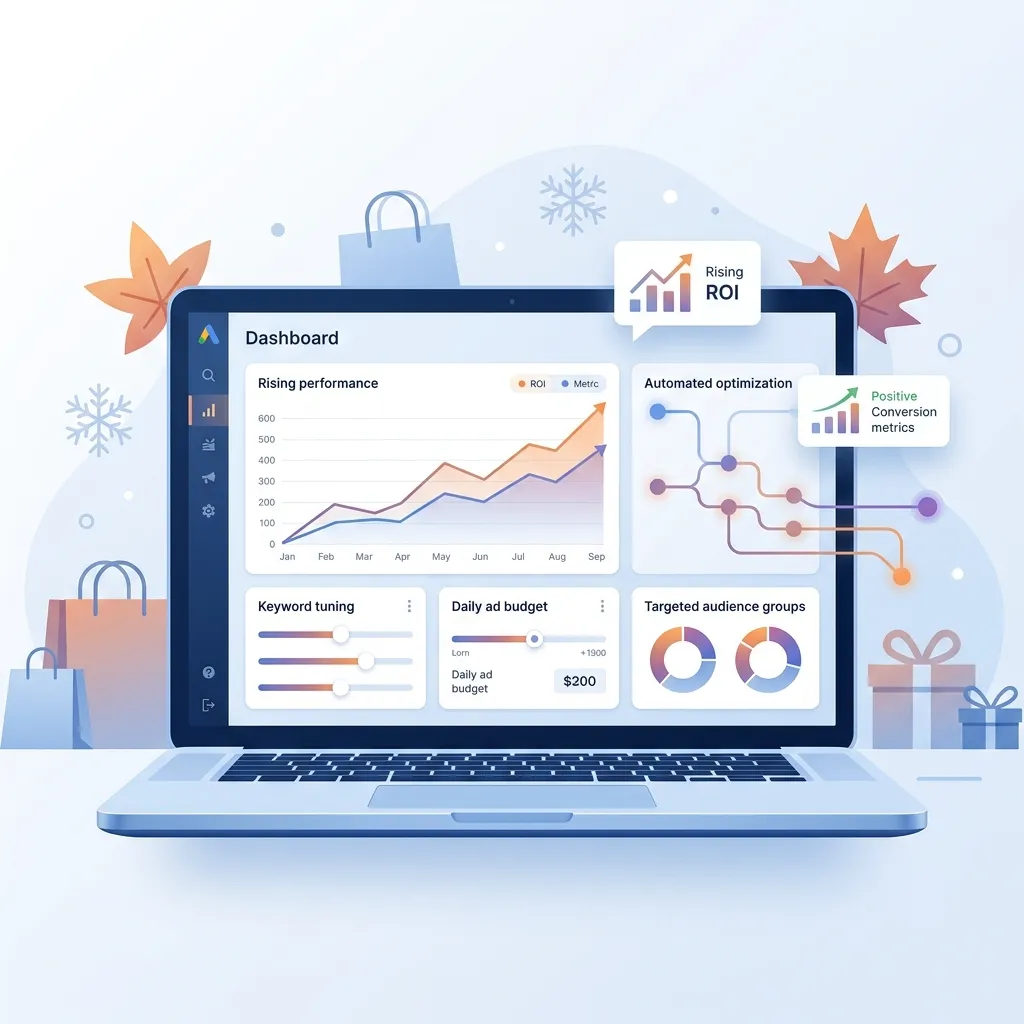
You don’t need a massive budget to replicate this success. The principles scale to businesses of all sizes. Here are the most transferable lessons from this paid search seasonal campaign.
Start planning at least six to eight weeks early
Give the algorithm time to learn and give yourself time to build creative. Early preparation is the single biggest predictor of seasonal success.
Build dedicated seasonal landing pages
Match your ad message to a focused landing page. A festive page with relevant products and clear offers will almost always outperform a generic homepage.
Segment audiences and tailor messaging
Cold, warm, and loyal audiences need different messages. Remarketing in particular tends to deliver the lowest CPA, so prioritize warm audiences during peak season.
Pace your budget around peak days
Identify your highest-demand dates and concentrate spend there. For most ecommerce brands, Black Friday and Cyber Monday justify a larger share of budget than quieter days.
Use smart bidding—but guide it
Automated bidding works best when fed good data and supported with seasonal bid adjustments. Combine Target ROAS with manual oversight during volatile peak periods.
Track the right metrics
Look beyond clicks. Monitor CPA, ROAS, and conversion rate by audience and by day. These insights tell you where to shift budget next season.
Key takeaways from this seasonal Google Ads case study
This seasonal Google Ads campaign case study proves that festive success isn’t luck—it’s preparation. The retailer turned a flat, generic holiday effort into a 187% revenue gain by planning early, segmenting audiences, building festive creative, and pacing budget around peak days.
If you’re planning your next holiday push, start with a calendar. Map your key sales dates, work backward six to eight weeks, and build a strategy around the moments when shoppers are ready to buy. Then measure everything, so each season teaches you how to win the next one.
Your next step: audit last year’s seasonal performance, identify your top three sales days, and draft a budget plan that concentrates spend where it counts.
Frequently asked questions
How long should a seasonal Google Ads campaign run?
Most effective seasonal campaigns run four to six weeks, with planning beginning six to eight weeks before launch. This gives smart bidding time to gather conversion data before peak demand and lets you build festive creative and landing pages without rushing.
When is the best time to launch a holiday Google Ads campaign?
Launch in early November for the winter holiday season, well before Black Friday. Early launches let the algorithm optimize during lower-competition periods, so your bids and targeting are sharper when CPCs spike during peak shopping days.
How much should I budget for a seasonal PPC campaign?
There’s no fixed number—it depends on your goals and margins. The key is pacing rather than total spend. Concentrate a larger share of your budget on high-intent days like Black Friday and Cyber Monday, where conversion rates and ROAS are typically highest.
What metrics matter most in a seasonal Google Ads case study?
Focus on cost-per-acquisition (CPA), return on ad spend (ROAS), and conversion rate, broken down by audience and by day. These metrics reveal which segments and dates drive profit, helping you plan smarter for the next season.
Do seasonal campaigns work for small ecommerce businesses?
Yes. The same principles—early planning, audience segmentation, festive creative, and budget pacing—scale to any budget. Small businesses often see strong results from remarketing, which delivers a low CPA by targeting shoppers already familiar with the brand.
What is a seasonal Google Ads campaign case study?
A seasonal Google Ads campaign case study is a real-world example showing how businesses improve sales, reduce CPA, and increase ROI during peak seasonal periods like holidays or festivals.
Why is a seasonal Google Ads campaign case study important?
It helps marketers understand proven strategies, budget planning, and optimization techniques used during high-demand seasons.
What can you learn from a seasonal Google Ads campaign case study?
You can learn how to structure campaigns, segment audiences, adjust bids, and improve conversions during seasonal sales spikes.
How long does a seasonal Google Ads campaign usually run?
Most seasonal Google Ads campaigns run between 4 to 6 weeks, depending on the business goals and peak shopping period.
When should you start planning a seasonal Google Ads campaign?
Planning should begin at least 6 to 8 weeks before the seasonal peak to allow proper keyword research, creative development, and testing.
What makes a seasonal Google Ads campaign successful?
Success depends on early planning, audience segmentation, optimized landing pages, and strategic budget pacing during peak shopping days.
How does a seasonal Google Ads campaign case study improve ROI?
It shows how targeted bidding, remarketing, and festive creatives can significantly increase return on ad spend during seasonal demand.
What industries benefit most from seasonal Google Ads campaigns?
Ecommerce, retail, travel, fashion, and gift-based businesses benefit the most from seasonal advertising strategies.
What are the key metrics in a seasonal Google Ads campaign case study?
Important metrics include ROAS, CPA, conversion rate, click-through rate, and overall revenue growth during the campaign period.
Can small businesses use strategies from a seasonal Google Ads campaign case study?
Yes, small businesses can apply the same principles like remarketing, budget pacing, and seasonal targeting even with limited budgets.