
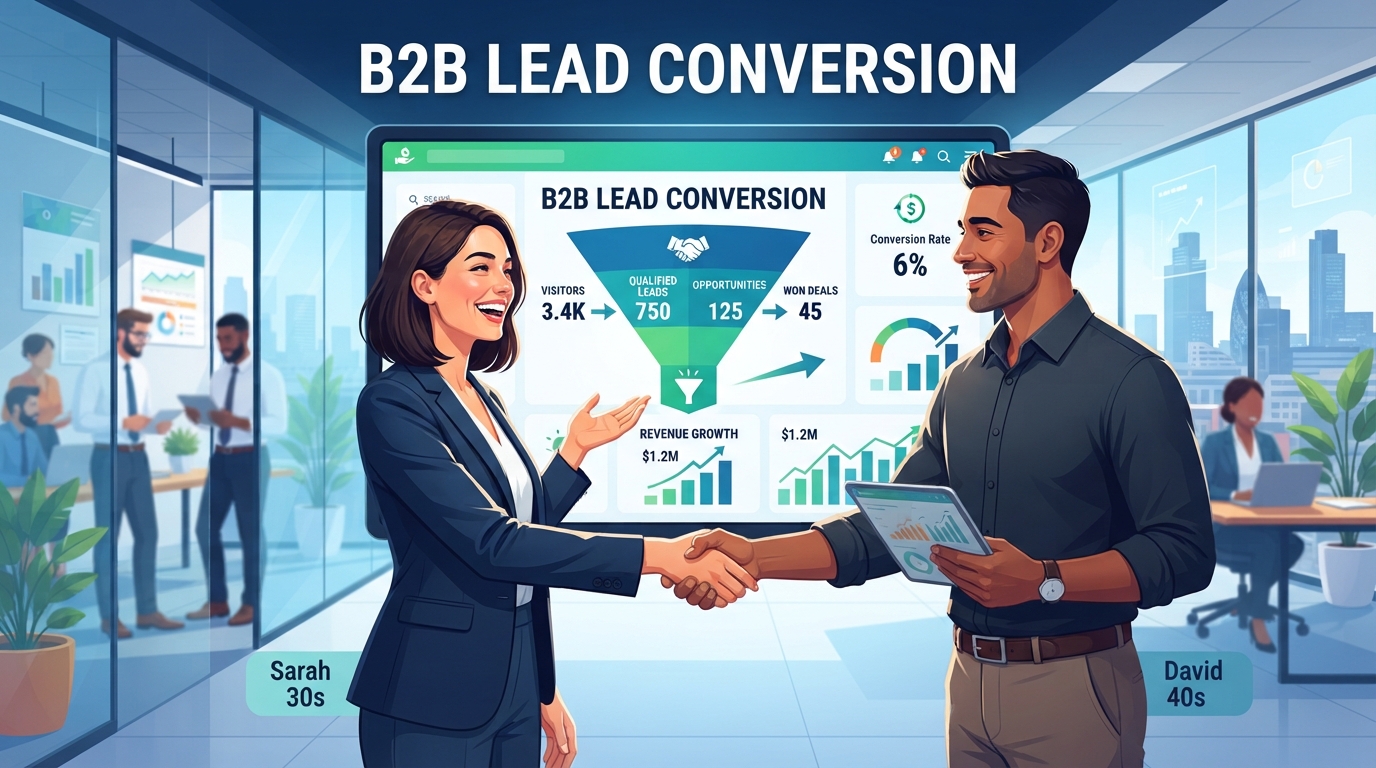
Transforming prospects into loyal clients remains the ultimate challenge for modern revenue teams. Mastering B2B lead conversion requires strategic alignment, personalized outreach, and data-driven insights to seamlessly turn qualified prospects into high-value accounts, accelerating your pipeline growth and driving long-term enterprise value.
This comprehensive guide explores the structural elements required to maximize your enterprise sales pipeline. You will discover advanced methodologies for aligning sales and marketing, leveraging predictive technology, and executing personalized outreach. By implementing these authoritative tactics, your organization can eliminate operational bottlenecks, reduce sales cycles, and significantly improve baseline conversion rates across every stage of the funnel.
Understanding the Modern Framework for B2B Lead Conversion
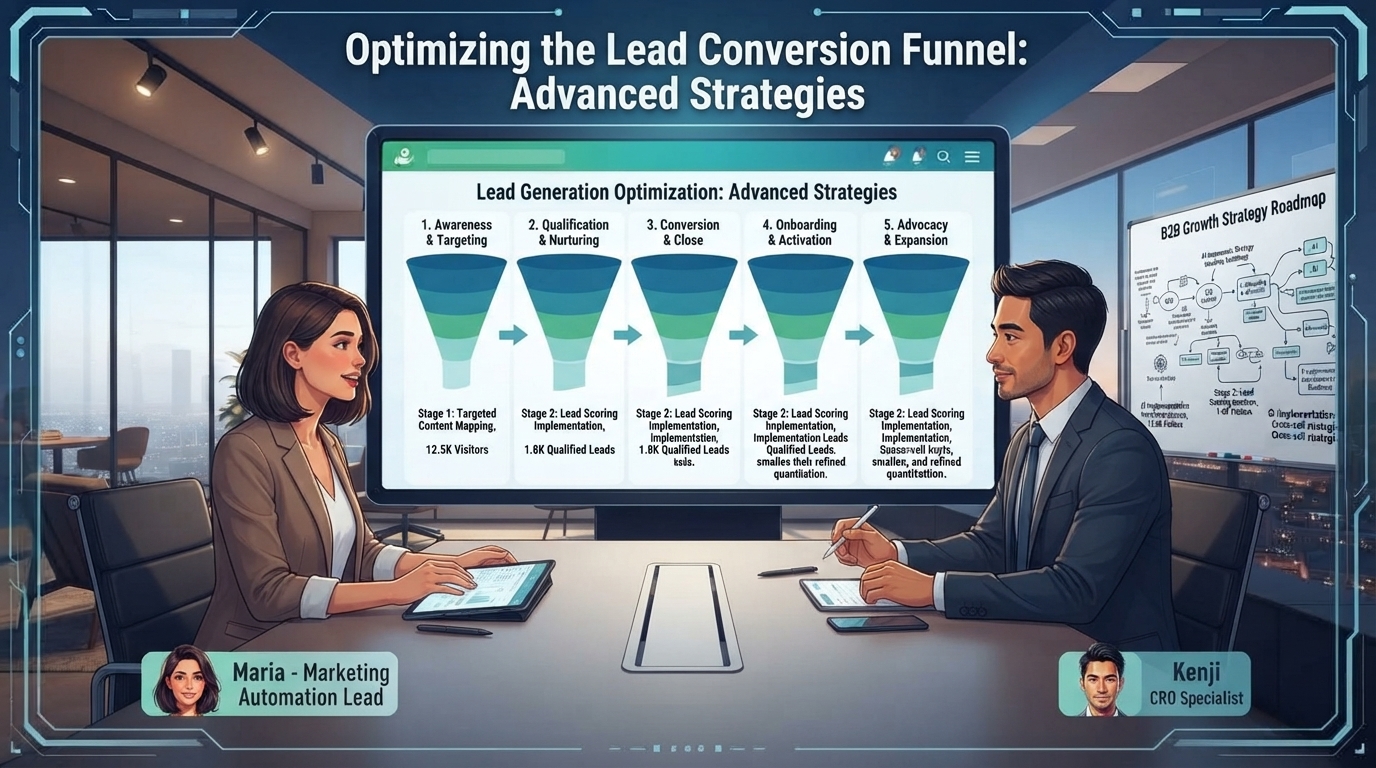
The landscape of enterprise sales has evolved dramatically over the last decade. Modern B2B lead conversion relies on a deeply nuanced understanding of prospect behavior, requiring sales professionals to act as trusted consultants rather than traditional vendors. Buyers now conduct extensive independent research before ever speaking to a representative. Consequently, the moment a prospect enters your pipeline, they are already evaluating your expertise and market positioning against a myriad of competitors. To succeed, organizations must construct a framework that addresses these elevated expectations immediately and comprehensively.
The Shift in the B2B Buyer Journey
Today, the B2B buyer journey is non-linear, fragmented, and highly complex. According to extensive research from Gartner, typical enterprise buying committees now consist of six to ten decision-makers. Each stakeholder brings unique priorities, departmental pain points, and specific evaluation criteria to the table. The IT director evaluates security compliance, the finance executive scrutinizes the return on investment, and the end-user assesses daily usability. Effective B2B lead conversion demands that sales teams identify these individuals early and tailor their messaging to address specific departmental concerns. If your marketing team hands off a qualified prospect, your sales framework must immediately deploy multi-threaded communication to engage the entire buying committee simultaneously. Relying on a single champion to sell your product internally is a fragile strategy that frequently leads to stalled deals and lost revenue.
Defining a Qualified Lead in Today’s Market
A fundamental prerequisite for high B2B lead conversion is a strict, universally understood definition of a qualified lead. Many organizations struggle because their sales teams are flooded with low-intent inquiries that artificially inflate pipeline metrics but rarely close. True qualification goes beyond basic demographic data; it encompasses firmographic fit, behavioral signals, and contextual readiness. A highly qualified prospect operates within your target industry, possesses the necessary budget, and exhibits behavioral indicators that suggest a pressing business problem. Establishing robust qualification criteria ensures that your most expensive resources—your senior account executives—spend their time negotiating with buyers who possess both the authority and the intent to finalize a purchase.
Essential Strategies for Accelerating B2B Lead Conversion
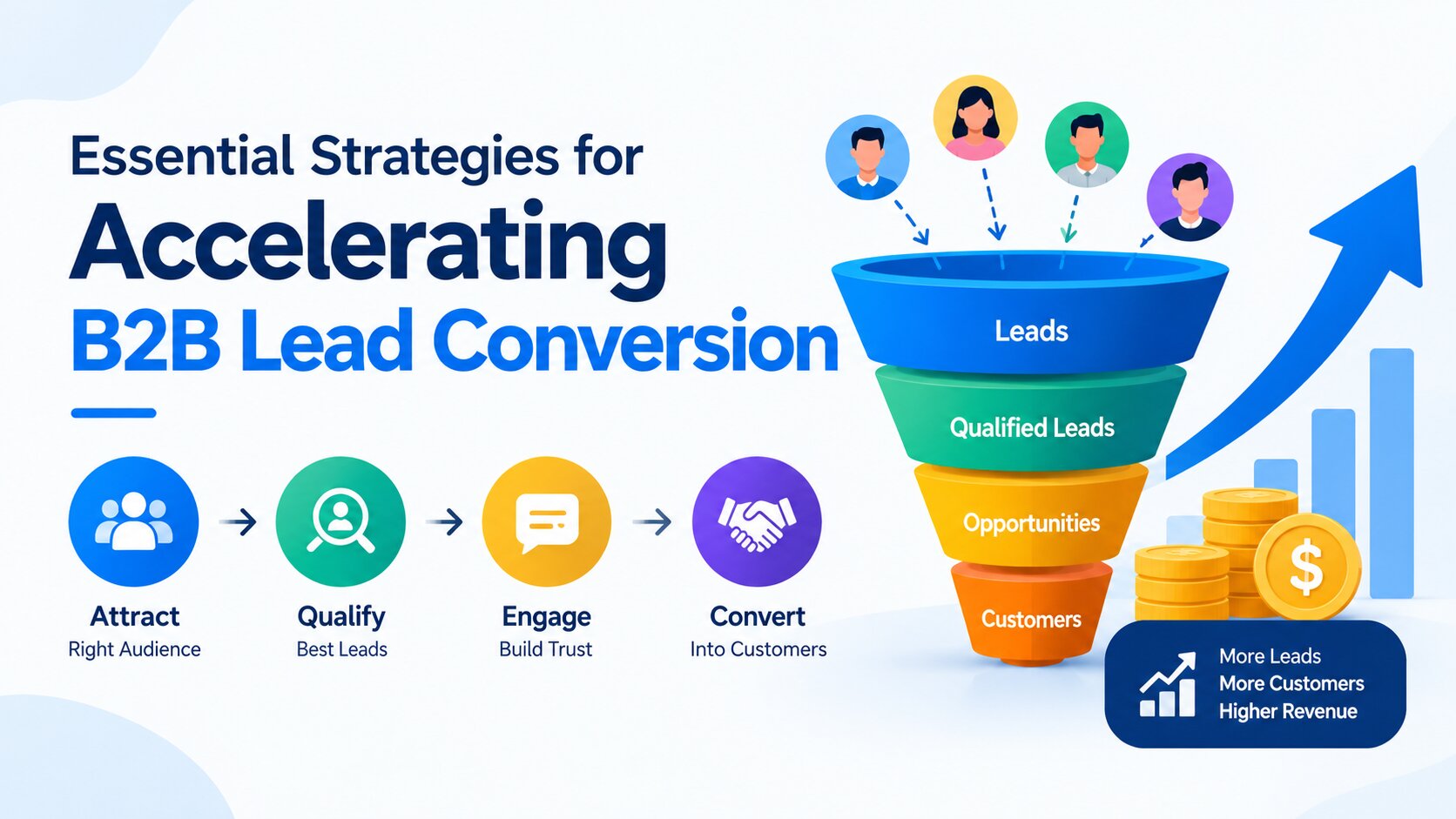
Once a prospect is properly qualified, the clock starts ticking. Accelerating B2B lead conversion requires proactive, highly targeted strategies that maintain momentum without overwhelming the buyer. The most successful organizations employ a mix of account-focused tactics and real-time data analysis to ensure they deliver the exact right message at the precise moment the buyer needs it most.
Implementing Account-Based Marketing (ABM)
One of the most powerful structural catalysts for sustainable B2B lead conversion is account-based marketing. Rather than casting a wide, generalized net to capture as many email addresses as possible, ABM treats individual high-value accounts as unique, standalone markets. Sales and marketing teams collaborate closely to map out the organizational structure of a target company. They then create hyper-personalized content, tailored product demonstrations, and bespoke outreach cadences designed specifically for that single account. By intentionally focusing financial resources and creative energy on accounts with the highest revenue potential and best strategic fit, companies inherently boost their conversion efficiency. This focused approach eliminates the waste associated with broad-spectrum marketing and ensures that every touchpoint resonates deeply with the target organization’s current corporate initiatives.
Leveraging Intent Data for Timely Outreach
Timing dictates success in enterprise sales. Intent data platforms analyze massive digital footprints—such as whitepaper downloads, industry keyword searches, and webinar attendance across the broader web—to identify when a prospect is actively researching solutions in your category. Integrating this third-party data into your strategy allows sales representatives to initiate conversations when the buyer’s pain is most acute, rather than relying on arbitrary follow-up schedules. This proactive approach significantly elevates B2B lead conversion metrics by ensuring your team is first to the table, often allowing you to frame the buying criteria before competitors even realize the account is in the market for a solution.
Personalization at Scale Through Segmentation
Generic, template-driven pitches instantly destroy credibility in the eyes of sophisticated enterprise buyers. However, writing completely unique emails from scratch for every single prospect is highly unscalable. Elite revenue teams achieve personalization at scale by meticulously segmenting their audiences based on industry vertical, job role, and historical engagement data. They utilize dynamic content insertion in their communication and build tailored landing pages to create a one-to-one experience for the buyer. When a prospect feels that a vendor fundamentally understands their specific industry challenges, trust forms rapidly, drastically shortening the time required to achieve a successful B2B lead conversion.
Aligning Sales and Marketing for Operational Efficiency
The most common and devastating point of failure in B2B lead conversion occurs during the operational handoff between marketing and sales. When these two vital departments operate in isolated silos, prospects experience disjointed communication, leading to profound confusion and lost deals. True alignment requires shared definitions, unified revenue goals, and constant, structured feedback loops.
Establishing Service Level Agreements (SLAs)
A robust Sales and Marketing SLA serves as a binding internal contract that outlines exactly what constitutes a sales-qualified prospect and dictates the acceptable timeframe for sales follow-up. Establishing mutual accountability is the bedrock of consistent conversion. It prevents marketing from complaining that sales ignores their generated pipeline and stops sales from claiming that marketing only delivers unqualified traffic.
- Clear demographic and firmographic criteria outlining the ideal customer profile.
- Agreed-upon behavioral thresholds that trigger a formal handoff to the sales team.
- Strict, measurable timelines for the initial sales engagement and subsequent follow-up cadences.
- Defined technological protocols for returning unready prospects back to marketing for further education.
Shared Metrics and Revenue-Driven KPIs
When marketing is evaluated solely on top-of-funnel volume and sales on closed revenue, operational friction is inevitable. To optimize the overarching sales funnel optimization strategy, both teams must be measured on shared outcomes, specifically pipeline velocity and overall revenue contribution. Strategic insights from McKinsey & Company show that integrated go-to-market models consistently outperform siloed organizations in customer retention and lifetime value. Holding joint weekly revenue reviews forces both departments to prioritize lead quality, directly driving up overall conversion performance.
The Role of Technology in Streamlining B2B Lead Conversion

Manual processes are the enemy of modern sales efficiency. Scaling your B2B lead conversion efforts across global markets requires a robust, integrated technological infrastructure that automates routine administrative tasks, surfaces actionable insights, and centralizes complex customer data.
Advanced CRM Capabilities
Your Customer Relationship Management platform functions as the central nervous system of your entire sales operation. Proper CRM integration ensures that every single interaction—from the very first anonymous website visit to the final contract negotiation—is meticulously logged and globally accessible to your internal teams. This holistic, 360-degree view prevents prospects from having to repeat their pain points to different representatives, thereby reducing conversational friction and accelerating the path to purchase. Modern systems also offer automated workflow triggers that proactively prompt sales representatives to follow up based on specific buyer actions.
Marketing Automation Tools
Not every qualified prospect is prepared to sign a contract immediately upon entering your ecosystem. Marketing automation platforms execute sophisticated lead nurturing campaigns that systematically drip relevant, educational content to prospects over weeks, months, or even years. By keeping your brand top-of-mind and continuously educating the buyer on industry best practices, these automated workflows ensure that when the prospect finally secures budget and is ready to buy, your firm stands as their primary choice.
AI and Predictive Analytics
Artificial intelligence is rapidly transforming the mechanics of B2B lead conversion. Predictive analytics models ingest vast quantities of historical win/loss data to identify the precise granular traits of your most successful, highest-retaining customers. The system then automatically scores incoming prospects based on their mathematical similarity to your ideal customer profile. This empowers sales representatives to prioritize their daily outreach efficiently, dedicating their premium hours to prospects statistically proven to have the highest probability of closing.
| Feature | Traditional Lead Scoring | Predictive Lead Scoring |
| Data Reliance | Relies on manual, rule-based points (e.g., +5 points for email open). | Utilizes machine learning to analyze thousands of hidden data points. |
| Accuracy | Prone to human bias and arbitrary point assignments. | Highly accurate, continuously learning from closed-won and closed-lost data. |
| Scalability | Requires constant manual updates as business strategies change. | Automatically scales and adapts algorithms to new market conditions. |
| Impact on Conversion | Moderate; helps prioritize but often surfaces false positives. | High; drastically increases efficiency by surfacing mathematically optimal targets. |
Common Mistakes to Avoid During the B2B Lead Conversion Process
Even with robust technological strategies in place, certain structural errors and poor daily habits can severely hinder your B2B lead conversion success. Recognizing and ruthlessly eliminating these bottlenecks is essential for maintaining a healthy, predictable revenue pipeline.
Neglecting Follow-Up Speed
In the modern digital economy, buyer patience is virtually nonexistent. Empirical research consistently demonstrates that the mathematical odds of making successful contact with a new inquiry drop exponentially if the follow-up occurs more than five minutes after their initial form submission. Automating the initial touchpoint and setting strict routing rules within your software stack can instantly rectify this issue, dramatically improving your baseline acquisition metrics.
Overlooking Customer Fit
Desperation for quarterly revenue often leads sales teams to pursue bad-fit prospects aggressively. Attempting to force a square peg into a round hole wastes valuable sales resources, damages team morale, and inevitably leads to high customer churn rates post-sale. Your qualifying criteria must include rigid disqualification parameters to protect pipeline integrity.
- Inadequate budget for enterprise-tier solutions or ongoing service agreements.
- Lack of internal technical resources required for seamless product implementation.
- Absence of a definitive timeline or internal trigger event within the next twelve months.
- No direct path to engage an executive sponsor with final signature authority.
Inconsistent Nurturing and Premature Abandonment
Many sales representatives give up completely after two or three unanswered emails or voicemails. In complex enterprise sales, it frequently takes eight to twelve distinct touches across multiple channels to generate a meaningful conversation with a decision-maker. Giving up prematurely is a massive waste of marketing capital. Implementing multi-channel cadences ensures consistent persistence without requiring heavy manual effort from representatives.
Pro Tips and Expert Insights for High-Performing Teams
To outpace nimble competitors, sales leaders must adopt advanced methodologies that go far beyond basic outreach. Elevating your B2B lead conversion requires a mastery of human psychology, strategic business communication, and continuous optimization.
Multi-Threading Your Sales Approach
Single-threaded sales—relying entirely on a single point of contact within an organization—is an inherently risky proposition. If your internal champion leaves the company or loses political influence, the deal dies. Expert sellers build simultaneous relationships with various stakeholders across the target organization, ranging from technical end-users to executive decision-makers. This approach insulates the proposed deal from unexpected internal corporate shifts.
Social Selling and Executive Thought Leadership
Modern buyers vastly prefer to purchase from recognized industry experts rather than aggressive quota-carriers. Encouraging your sales team to share original insights, comment intelligently on industry trends, and engage authentically on professional platforms builds immense digital credibility. When a prospect views a sales representative as a trusted advisor, negotiations become far more collaborative.
Strategic Micro-Commitments
Complex enterprise deals worth significant capital are rarely closed in a single meeting. Expert closers secure small, incremental agreements at the end of every interaction. These psychological micro-commitments maintain constant forward momentum and logically guide the prospect toward the final purchase decision without applying overwhelming pressure.
- Securing internal historical data to perform a customized ROI calculation.
- Obtaining formal introductions to the procurement team prior to pricing reviews.
- Scheduling a dedicated fifteen-minute session specifically to review implementation timelines.
Measuring and Optimizing Your B2B Lead Conversion Framework
Continuous improvement is the defining hallmark of elite revenue organizations. You fundamentally cannot improve a process that you do not rigorously measure. Applying a strict analytical approach to your pipeline efforts ensures that your overarching strategies evolve in tandem with rapidly changing market conditions.
Tracking Cohort Conversion Rates
Rather than looking at aggregate, company-wide conversion numbers which often hide underlying flaws, analyze your conversion rates by specific cohorts. Group prospects by the exact month they entered the pipeline, the specific marketing campaign that sourced them, or their particular industry vertical. This granular visibility highlights exactly which marketing channels produce the most lucrative outcomes and which underperforming channels require immediate budgetary re-evaluation.
Objective Win/Loss Analysis
Every closed-lost deal serves as a rich repository of valuable market data. Organizations must conduct objective post-mortems on lost opportunities to identify recurring structural patterns. Did the prospect choose a competitor due to rigid pricing structures, missing features, or poor sales communication? Systematically addressing these objections in future marketing collateral and sales playbooks proactively fortifies your pipeline against future losses.
Conclusion
Mastering B2B lead conversion requires aligning your marketing technology with deeply personalized, multi-threaded sales strategies. By understanding buyer intent, nurturing prospects systematically, and leveraging predictive analytics, your organization can completely transform its revenue pipeline. Audit your operational handoffs today and implement these actionable frameworks to start securing high-value customers immediately.
Frequently Asked Questions (FAQs)
1. What is the average timeframe for a successful B2B lead conversion?
The timeframe for a successful B2B lead conversion varies significantly based on industry, product complexity, deal size, and organizational structure. While transactional software solutions may convert in a few weeks, enterprise deals typically span anywhere from six to eighteen months. Modern buying decisions involve multiple stakeholders, extensive security compliance checks, and formal procurement reviews. To streamline this extended timeline, high-performing sales teams utilize multi-threaded outreach and continuous value delivery to ensure the B2B buyer journey remains active and forward-moving.
2. How does lead scoring impact B2B lead conversion?
Lead scoring systematically ranks prospects based on their firmographic profile, demographic alignment, and behavioral engagement. By assigning numerical values to specific actions—such as attending webinars, viewing pricing pages, or downloading technical documentation—lead scoring allows revenue teams to distinguish between high-intent buyers and casual browsers. This objective prioritization prevents account executives from wasting expensive sales hours on low-quality prospects, ensuring their energy is focused squarely on deals with the highest probability of closing.
3. What role does content marketing play in B2B lead conversion?
Content marketing serves as the underlying backbone for educating, qualifying, and nurturing prospects throughout the entire sales lifecycle. Because modern buyers perform significant independent research prior to engaging a sales representative, high-value collateral—such as whitepapers, ROI calculators, case studies, and technical implementation guides—builds immediate trust and topical authority. Strategic content addresses common buyer objections upfront and smoothly transitions prospects through your sales funnel optimization workflows.
4. How can small teams compete in B2B lead conversion against larger enterprise competitors?
Smaller organizations can outperform larger, bureaucratically constrained competitors by leveraging extreme agility, deep industry specialization, and automated personalization. While massive enterprise sales machines often rely on generic, rigid cadences, smaller revenue teams can execute targeted account-based marketing strategies that speak directly to an individual prospect’s unique corporate initiatives. Furthermore, by pairing modern AI capabilities with streamlined workflows, smaller teams can achieve hyper-responsive follow-up speeds that larger firms struggle to match.
5. Why is sales and marketing alignment crucial for B2B lead conversion?
Sales and marketing alignment removes the operational friction that frequently destroys qualified pipeline during the departmental handoff. When marketing and sales operate in isolated silos, prospects experience disjointed messaging, slow follow-up, and conflicting product expectations. Establishing a formal Service Level Agreement (SLA) enforces shared definitions of qualified prospects, sets strict follow-up timelines, and aligns both teams around common revenue goals rather than vanity metrics like form fills or website traffic.
6. What are the key metrics to track for B2B lead conversion success?
Evaluating the efficiency of your pipeline requires tracking metrics that extend beyond simple win rates. Revenue leaders must monitor overall pipeline velocity, stage-by-stage conversion ratios (e.g., MQL to SQL and SQL to Opportunity), average deal cycle duration, customer acquisition cost (CAC), and customer lifetime value (LTV). Analyzing these metrics across specific buyer cohorts allows revenue operations teams to pinpoint precise funnel bottlenecks and allocate capital toward the highest-performing marketing channels.
7. How do you re-engage a stalled prospect during the B2B lead conversion process?
Re-engaging a stalled prospect requires shifting the conversation away from generic check-ins and returning strictly to business value. Rather than asking “just checking in on the proposal,” sales representatives should offer fresh contextual insights, such as an updated industry benchmark report, a newly published case study detailing a similar client’s ROI, or an invitation to a private executive round-table. Offering tangible value re-ignites interest and gives the prospect an internal reason to re-open commercial discussions.
8. Is cold outreach still effective for B2B lead conversion in modern sales?
Generic, automated cold outreach yields diminishing returns in today’s saturated digital landscape. However, highly targeted “warm outreach”—where representatives leverage intent data, recent corporate announcements, mutual executive connections, or dynamic social engagement—remains exceptionally effective. Combining precise buyer context with tailored multi-channel messaging elevates response rates and converts top-of-funnel prospects into active sales opportunities.
9. How does intent data specifically improve B2B lead conversion rates?
Intent data platforms monitor web-wide behavioral signals to identify when an organization is actively researching solutions within your specific category. By detecting surges in topic research, technology evaluations, or competitor comparisons, intent data allows your sales team to initiate contact at the exact moment a buyer’s pain is most acute. Intercepting prospects early in their research phase enables your team to help shape their evaluation criteria before competitors even realize the opportunity exists.
10. What is the difference between an MQL and an SQL in B2B lead conversion?
A Marketing Qualified Lead (MQL) is a prospect who has demonstrated engagement with your marketing collateral—such as downloading an ebook or attending a webinar—and matches your general firmographic profile, but has not yet signaled immediate buying intent. A Sales Qualified Lead (SQL) is an MQL that has undergone rigorous vetting by the sales team to confirm direct buying authority, defined budget, clear business need, and an active project timeline. Converting MQLs to SQLs through automated lead nurturing campaigns and robust CRM integration ensures a predictable flow of enterprise customers.
B2b sales, Lead generation, Sales funnel, Marketing alignment, Conversion rate optimization