
Attending industry trade shows and conferences offers unparalleled brand exposure, but converting booth traffic into revenue requires deliberate planning. Implementing 15 Strategic Marketing Tips enables organizations to bridge the gap between initial handshake and closed deal, ensuring that every interaction yields measurable pipeline growth and sustainable business success.
This comprehensive guide delivers a data-driven framework designed to optimize your trade show performance. You will explore actionable pre-event preparation, friction-free on-site data capture, real-time lead qualification, automated post-event nurturing, and full-funnel attribution models. Following these proven strategies will transform passive event attendees into high-intent B2B opportunities and maximize your overall marketing return on investment.
Pre-Event Preparation and Strategic Alignment Utilizing 15 Strategic Marketing Tips
1. Implement Advanced Audience Segmentation and ICP Targeting
Maximizing event ROI begins long before the exhibition floor opens. Organizations frequently make the error of treating all event attendees as a homogeneous group, leading to diluted messaging and wasted sales resources. Establishing precise ideal customer profile (ICP) parameters allows marketing teams to filter pre-registered attendee lists, identify decision-makers, and focus outreach efforts where conversion probability is highest. By evaluating company firmographics, technological stacks, current revenue tiers, and job titles prior to the event, your team can construct highly targeted sub-segments that receive tailored pre-event communication.
According to research from Gartner, B2B buying groups typically involve six to ten decision-makers, each armed with four to five pieces of information they have gathered independently. Pre-event segmentation empowers your team to map key stakeholders within target accounts before stepping foot in the venue. Utilizing intent data alongside registration lists reveals which attending companies are actively researching solutions in your category. This predictive intelligence ensures that your sales development representatives (SDRs) focus their pre-event scheduling exclusively on high-value accounts that match your exact buying criteria, setting the stage for effective B2B lead generation.
When preparing your segmentation model, create customized battle cards for each key vertical or buyer persona attending the event. These internal playbooks should outline specific industry pain points, relevant customer success stories, and distinct value propositions. Equipping your on-site team with persona-specific insights transforms generic booth conversations into consultative consultations. When booth visitors feel that your representatives understand their specific operational challenges, the transition from passive attendee to qualified opportunity occurs naturally and rapidly.
2. Execute Account-Based Marketing (ABM) Pre-Event Outreach
Integrating account-based marketing (ABM) methodologies into your event strategy dramatically increases high-value prospect engagement. Rather than waiting for target prospects to stumble upon your booth by chance, proactive multi-touch outreach secures dedicated meeting slots well in advance. Begin campaign execution six to eight weeks prior to the event date, leveraging personalized email cadences, direct mail activations, and targeted LinkedIn communications aimed directly at executive stakeholders from target accounts.
Personalized invitations should provide genuine value rather than a generic sales pitch. Offer tier-one prospects exclusive access to private executive luncheons, invite-only roundtable discussions, or one-on-one strategy sessions with your C-suite executives. According to studies by Forrester Research, executive buyers prioritize face-to-face interactions that deliver strategic peer networking and high-level industry insights over standard product presentations. Creating VIP buyer experiences incentivizes busy executives to block off dedicated time on their crowded event schedules specifically to meet with your leadership team.
To streamline meeting bookings, deploy dedicated landing pages featuring real-time calendar integration that automatically syncs booked slots with designated sales executives. Provide prospects with clear agendas outlining what they will gain from the meeting, such as custom benchmark reports or exclusive technology previews. Confirming these calendar invites prior to travel establishes strong accountability, significantly lowers no-show rates, and guarantees that your highest-value prospects receive red-carpet treatment from the moment they step onto the conference floor.
3. Launch Multi-Channel Pre-Event Teaser Campaigns
Building excitement across digital channels creates strong momentum ahead of physical or virtual events. A robust multi-channel promotion strategy captures mindshare across social media, email newsletters, digital advertising, and industry communities, ensuring your brand stays top-of-mind as attendees plan their event agendas. Deploying short-form video teasers, speaker spotlight posts, and interactive polls across channels like LinkedIn and X (formerly Twitter) establishes an active, authoritative digital presence that drives booth traffic.
Coordinate your content release schedule to build anticipation incrementally as the event date approaches. Four weeks out, announce major booth attractions, product launches, or guest speakers. Two weeks out, launch targeted digital ad campaigns geo-fenced around conference venues and surrounding hotels to reach traveling attendees. Research from Content Marketing Institute underscores that consistent, cross-channel messaging reinforces brand recall and drives significantly higher physical booth visits compared to single-channel campaigns.
Incorporate dynamic social proof and custom event hashtags into all pre-event materials to foster community engagement. Encourage your company executives, keynote speakers, and sales representatives to post personal video invitations on LinkedIn detailing what they look forward to discussing at the event. Tagging registered attendees and industry peers creates organic social amplification, expands your reach beyond your existing database, and establishes an cohesive omnichannel marketing strategy that connects online engagement with off-line venue interactions.
High-Impact On-Site Engagement and Data Capture
4. Utilize Frictionless Lead Capture Technology and Badge Scanning
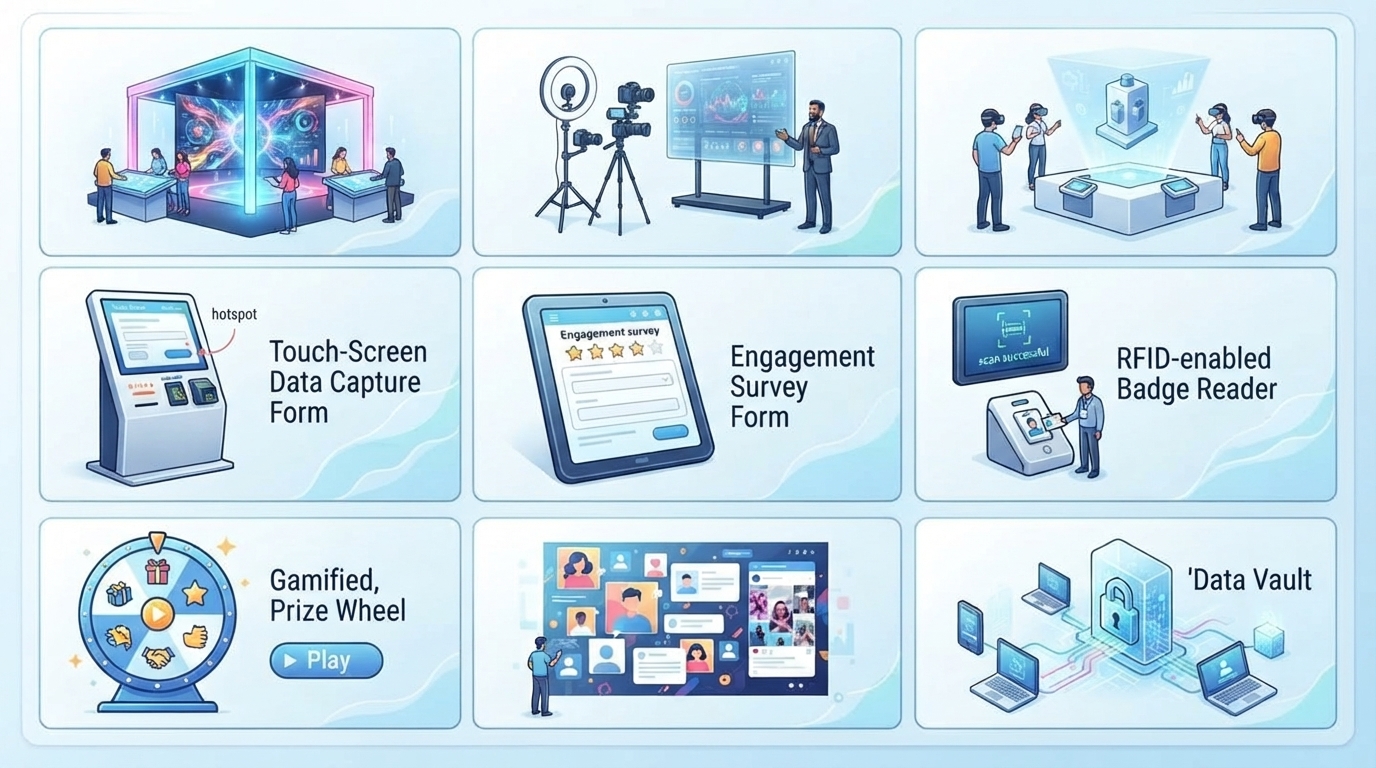
The speed and accuracy of on-site data collection directly influence post-event conversion rates. Reliance on traditional paper business cards or manual data entry introduces severe human error, lost contact details, and significant processing delays that allow hot leads to grow cold. Deploying modern badge scanning software equipped with optical character recognition (OCR) and automated field mapping ensures that attendee details are captured instantly and accurately with a single tap or scan.
To maximize the utility of captured data, customize your mobile lead capture forms with mandatory qualification fields. Rather than capturing only basic contact info, enable custom drop-down menus, radio buttons, and voice-to-text note features within your software interface. Representatives can immediately log critical context such as budget availability, purchase timelines, current software vendors, and primary pain points. Leading platforms integrate seamlessly with major solutions like Salesforce, allowing field data to upload directly to cloud databases in real time.
Modern event technology stack tools also support digital business card exchanges and immediate content fulfillment. When a representative finishes speaking with an attendee, they can instantly email relevant whitepapers, product brochures, or case studies directly from the scanning app while standing in front of the prospect. This immediate digital touchpoint reinforces the conversation, demonstrates technical sophistication, and creates an instant paper trail in the prospect’s inbox before they even leave your booth footprint.
5. Design Experiential Booth Activations and Interactive Demos
Capturing attendee attention on a crowded, noisy exhibition floor requires shifting from passive marketing displays to immersive, experiential activations. Traditional booth setups featuring static pop-up banners and passive collateral displays fail to differentiate your brand from neighboring competitors. Designing interactive booth activations—such as live self-service product kiosks, augmented reality demonstrations, or interactive benchmark assessments—draws attendees in and actively engages them in hands-on problem-solving.
Experiential booth design should follow a logical visitor flow that seamlessly guides attendees from initial curiosity to active qualification. Place high-impact visual elements and interactive stations near the perimeter to attract foot traffic, while reserving semi-private discussion areas near the back for deeper sales conversations. According to research from Marketing Profs, interactive content generates twice as many conversions as static content because it actively involves the user in a personalized learning process rather than delivering generic marketing monologues.
Incorporate live product demonstrations led by senior sales engineers or product specialists at scheduled intervals throughout the day. Promote these micro-demos through digital schedule boards displayed prominently at your booth. Ensure that every demonstration focuses directly on solving specific real-world industry pain points rather than merely listing product features. By showing concrete business outcomes and quantifiable ROI during live demos, your team creates memorable impressions that motivate attendees to request formal follow-up discovery calls.
6. Host Exclusive Micro-Sessions and Interactive Workshops
Positioning your organization as a trusted industry authority requires moving beyond product pitches and delivering genuine educational value on the trade show floor. Hosting exclusive micro-sessions—15-minute tactical presentations or small-group workshops within your booth footprint—attracts sophisticated buyers seeking solutions to complex operational challenges. These focused sessions allow your subject matter experts to showcase deep domain knowledge, discuss emerging market trends, and present proprietary industry research.
Structure micro-sessions around highly actionable, problem-centric topics rather than commercial sales messages. Titles such as “Solving Enterprise Data Silos in 2026” or “3 Strategies for Scaling B2B Revenue” attract target decision-makers who possess active buying intent. Keep seating limited to foster an intimate, high-touch environment that encourages interactive Q&A sessions. Capturing attendee questions during these workshops yields valuable buyer intent signals that inform subsequent post-event follow-up discussions.
To capitalize on micro-session attendance, require a simple badge scan for entry or participation. This lightweight barrier to entry is readily accepted by attendees in exchange for high-value educational content. Following each session, instantly distribute digital executive slide decks and companion resource guides to participants via email. This approach enriches your database with highly engaged leads who have spent quality time directly interacting with your team’s thought leadership assets.
Real-Time Lead Qualification and Instant Scoring

7. Deploy a Custom B2B Event Lead Scoring Framework
Not every lead collected on an exhibition floor possesses equal commercial value. Treating a student collecting free merchandise the same as an enterprise Vice President evaluating software solutions severely degrades sales efficiency and inflates acquisition costs. Establishing a systematic event lead scoring matrix on-site enables your sales team to prioritize follow-up efforts based on objective, multi-factorial evaluation criteria.
A robust event lead qualification framework evaluates both explicit demographic data and implicit behavioral signals gathered during the event interaction. Explicit criteria include job title authority, company revenue, industry vertical fit, and immediate budget allocation. Implicit criteria measure behavioral engagement, such as length of time spent at the booth, participation in live demos, attendance at hosted micro-sessions, and specific questions asked regarding implementation timelines. Combining these inputs produces an immediate numeric score that classifies leads instantly into defined categories.
Automating this scoring methodology directly within your lead capture app ensures that booth staff apply uniform standards across all conversations. Representatives select pre-defined badges or rating toggles based on the interaction, which calculates the final lead score in real time. This immediate categorization eliminates post-event lead triage bottlenecks, boosting your MQL to SQL conversion rate and guaranteeing that high-intent sales opportunities receive rapid, white-glove attention from senior account executives.
8. Enable Instant On-Site CRM Integration and Sales Routing
The time elapsed between an initial event interaction and the first sales follow-up directly dictates conversion success. Industry benchmarks published by HubSpot indicate that sales conversion probabilities drop exponentially when initial response times exceed 24 hours. Integrating your event scanning software directly with enterprise platforms like Salesforce, HubSpot, or Microsoft Dynamics via instant API integrations eliminates traditional data lag, pushing newly captured contacts into active sales workflows within minutes.
Configuring automated lead routing rules ensures that captured leads bypass manual spreadsheet uploads entirely. When a representative tags a lead as “Hot” or “High Priority” on the event floor, automated routing algorithms assign the contact directly to the appropriate account owner based on geographic territory, account ownership, or industry vertical. Automated alerts via Slack or Microsoft Teams instantly notify assigned reps with complete contact details and interaction notes while the prospect is still attending the conference.
Real-time integration also triggers instant automated workflows that benefit the attendee experience. As soon as a lead is scanned, the CRM can initiate an automated confirmation email containing personalized resources, direct calendar booking links for account executives, and access to exclusive post-event content hubs. This level of immediate digital responsiveness sets your brand apart from competitors who delay follow-up until days after the trade show concludes, reinforcing your corporate commitment to operational excellence and customer service.
9. Categorize Attendees by Decision-Making Authority and Urgency
Effective conversion requires tailoring sales messaging to match both the decision-making level of the prospect and their specific purchasing timeframe. Standardizing sales conversation frameworks around established methodologies—such as BANT (Budget, Authority, Need, Timeline) or MEDDPICC—equips booth staff to uncover key purchasing dynamics without making prospects feel interrogated. Categorizing contacts based on authority and urgency ensures that post-event messaging addresses precise commercial drivers.
When evaluating buying authority, instruct your staff to distinguish between ultimate economic decision-makers, internal champions, technical evaluators, and end-user researchers. An enterprise Chief Technology Officer requires strategic ROI calculations and architectural oversight details, whereas a Manager-level technical evaluator focuses on feature functionality, workflow integrations, and ease of implementation. Aligning conversational messaging to persona-specific needs increases engagement and builds consensus across multi-stakeholder buying committees.
Assessing buying urgency allows marketing and sales teams to establish precise service level agreements (SLAs) for post-event outreach. High-urgency leads with active budgets and near-term deployment windows require immediate direct intervention from senior sales personnel. Conversely, low-urgency leads undergoing early-stage discovery should be directed toward educational post-event lead nurturing sequences designed to build technical trust over time. Clear categorization prevents high-priority deals from stalling while protecting sales reps from spending excessive time on long-term educational accounts.
Automated Post-Event Nurturing and Campaign Execution
10. Deploy Hyper-Personalized Post-Event Follow-Up Sequences
Generic mass email blasts sent to entire event attendee lists destroy campaign performance and lead to elevated unsubscribe rates. Modern B2B buyers expect post-event communications to reflect the specific discussions, questions, and context established during their booth interactions. Implementing hyper-personalized email cadences that incorporate custom dynamic fields—such as booth representative names, specific product features discussed, and custom collateral requested—dramatically improves open, click-through, and appointment booking rates.
Construct multi-stage follow-up cadences tailored specifically to each qualification tier identified on-site. The initial touchpoint should occur within 24 hours of the interaction, expressing genuine appreciation for their time at the event while referencing specific notes taken during the conversation. Avoid launching immediately into an aggressive hard-sell pitch; instead, deliver immediate value by attaching high-level assets directly relevant to the specific operational challenges highlighted during their booth visit.
Utilizing short personalized video messages generated by sales reps via tools like Loom or Vidyard further humanizes post-event communications. A brief 45-second video referencing the attendee’s visit to your booth builds instant rapport and reinforces technical trust. By combining automated CRM workflows with authentic human touches, your post-event outreach stands out in crowded candidate inboxes, driving higher meeting conversion rates and accelerating revenue pipeline progression.
11. Align Post-Event Content Mapping to Buyer Funnel Stages
Delivering the right content asset at the right moment is essential to moving event leads smoothly through the buying funnel. A common execution error is sending top-of-funnel broad educational articles to high-intent leads ready for commercial evaluations, or pushing aggressive pricing calculators onto early-stage researchers. Strategic content mapping aligns content distribution directly with buyer readiness and booth engagement depth.
Top-of-funnel (ToFU) leads, who spent brief moments at your booth or attended general micro-sessions, should receive foundational industry reports, trend analyses, and educational infographics designed to expand problem awareness. Middle-of-funnel (MoFU) leads, who evaluated specific product features or requested technical whitepapers, require comparative buyer guides, architecture blueprints, and detailed customer case studies demonstrating quantifiable business impacts within their specific industry vertical.
Bottom-of-funnel (BoFU) leads, who requested pricing, booked executive meetings, or participated in detailed technical architectural reviews, should be provided with actionable tools like custom ROI calculators, security compliance documentation, customer implementation roadmaps, and direct pilot proposal templates. Research from McKinsey & Company highlights that B2B organizations delivering tailored, journey-aligned content see a 20% increase in sales efficiency and higher deal velocity. Matching content precision to funnel placement maximizes campaign impact and speeds up contract executions.
12. Execute Omnichannel Digital Retargeting Campaigns
Relying solely on email channels for post-event engagement creates operational single-point-of-failure risks, as email deliverability challenges or inbox clutter can diminish reach. Reinforcing email communications with synchronized digital retargeting campaigns across social networks and display networks creates a comprehensive omnichannel marketing strategy that keeps your solutions top-of-mind throughout the post-event evaluation period.
Upload segmented event attendee lists directly into platforms like LinkedIn Campaign Manager, Google Ads, and Meta Business Suite to create matched target audiences. Launch targeted video ads, customer testimonial carousels, and single-image sponsored content campaigns directed specifically at event attendees during the two to four weeks following the conference. Because these prospects have recently interacted with your team in person, brand recognition is exceptionally high, resulting in significantly higher click-through rates and lower cost-per-click metrics compared to cold audience targeting.
Vary your creative messaging based on the qualification tier of the target audience. Display high-level thought leadership and brand messaging to general conference registrants, while delivering specific customer case studies, product feature tours, and direct demo request offers to high-intent booth visitors. Maintaining consistent, highly visible digital presence across multiple channels builds continuous psychological familiarity, reinforces sales outreach efforts, and drives leads back to custom post-event landing pages built for conversion.
Pipeline Velocity, Attribution, and Long-Term ROI
13. Implement Multi-Touch Full-Funnel Event ROI Attribution Modeling
Accurately measuring the true economic impact of major event investments requires sophisticated attribution modeling that goes far beyond simple first-touch or last-touch calculations. Trade shows rarely serve as single-touch acquisition channels; instead, they function as complex multi-touch interaction nodes that accelerate existing pipeline opportunities while simultaneously generating new top-of-funnel accounts. Single-touch models fail to account for this nuance, frequently underestimating or misrepresenting event contribution to closed-won revenue.
To capture complete financial impact, deploy multi-touch attribution models—such as W-shaped or full-path attribution frameworks—within your marketing analytics architecture. A W-shaped attribution model assigns distinct weighted values to key conversion milestones: initial contact creation, lead-to-opportunity creation, and final opportunity conversion. This approach accurately credits the trade show for its specific role, whether it served as the initial discovery channel, an opportunity acceleration point, or the final validation touchpoint preceding contract signature.
Track key financial metrics beyond initial lead counts, including Total Cost Per Lead (CPL), Cost Per Opportunity (CPO), Pipeline Created, Pipeline Influenced, and Closed-Won Revenue directly tied to event interactions. Comparing total event spend—including booth space, sponsorship fees, travel expenses, collateral, and staff time—against pipeline outcomes over 6, 12, and 18-month cycles reveals your true event ROI. Transparent reporting justifies marketing budget allocations and guides strategic decision-making for future trade show investments.
14. Foster Sales and Marketing Alignment for Rapid Lead Handoff
Organizational alignment between sales and marketing teams represents a critical success factor in converting event interactions into closed-won commercial contracts. Disconnects surrounding lead handoff protocols, qualification definitions, or follow-up timelines can cause leads to stall, undermining overall campaign performance. Establishing a unified SLA framework prior to the event aligns expectations, establishes clear accountability, and ensures smooth operational handoffs.
Conduct comprehensive pre-event alignment workshops involving both sales leadership and field marketing teams. Clearly define lead transfer criteria, mandatory CRM field requirements, lead distribution protocols, and post-event follow-up cadences. Schedule joint daily debrief meetings during multi-day conferences to review lead quality, address operational bottlenecks, refine qualification scoring criteria, and celebrate early sales wins. This daily operational feedback loop keeps teams synchronized and motivated throughout demanding event schedules.
Post-event, establish mandatory joint lead review sessions conducted 7, 14, and 30 days after the conference closes. During these sessions, review conversion progress across qualification tiers, evaluate initial sales contact rates, address stalled pipeline accounts, and refine messaging cadences based on real-world buyer feedback. Aligning incentives around shared pipeline and revenue goals fosters collaborative sales and marketing alignment, transforms potential organizational friction into shared purpose, and accelerates overall sales velocity.
15. Conduct Comprehensive Post-Mortem Analytics and Process Iteration
Continuous optimization requires conducting structured post-mortem evaluations following every major event execution. Rather than immediately moving to the next campaign on the marketing calendar, dedicate time with key stakeholders to analyze quantitative metrics, collect qualitative feedback, and document key lessons learned. Thorough post-event reviews turn single trade show investments into repeatable, continuously improving revenue engines.
Structure your post-mortem analysis across four core operational pillars: quantitative performance metrics, sales team feedback, booth operational execution, and event vendor performance. Evaluate performance against original key performance indicators (KPIs), analyzing cost per qualified lead, booth visitor engagement rates, and meeting booking rates against historical benchmarks. Collect qualitative feedback from sales representatives regarding booth traffic quality, competitive presence at the show, buyer interest trends, and collateral effectiveness.
Document actionable findings into a standardized event playbook that serves as an evolving organizational guide for future conference planning. Highlight successful activations to replicate at future events, while identifying operational bottlenecks, ineffective messaging, or tech stack gaps that require corrective action. Rigorous post-mortem analysis ensures that your organization builds cumulative expertise, optimizes budget allocations, and systematically outperforms market competitors show after show.
Comparative Evaluation of Event Lead Conversion Frameworks
Comparing traditional, reactive event marketing approaches against modern, integrated data-driven frameworks illustrates the clear business value of structured execution methodologies. The table below compares historical event approaches against the strategic framework detailed in this guide.
| Strategy Dimension | Traditional Event Execution | Basic Badge Reader Setup | Integrated Strategic Engine (15 Tips Method) |
| Pre-Event Engagement | None; reliance on random booth drop-ins | Generic blast emails announcing booth presence | Segmented ABM outreach, pre-booked VIP executive meetings |
| On-Site Qualification | Manual business cards; memory-based notes | Basic contact retrieval; zero context logging | Instant mobile scoring, voice notes, mandatory field tags |
| CRM Data Sync | Manual entry days or weeks post-event | Spreadsheet upload 3–5 days post-event | Real-time automated API sync within minutes of scan |
| Follow-Up Cadence | Batch-and-blast marketing newsletter email | Standard generic thank-you template sent days later | Hyper-personalized multi-stage workflows within 24 hours |
| Attribution Model | Single-touch first/last contact estimation | Basic count of raw scanned contacts | Multi-touch full-funnel pipeline and closed revenue attribution |
| Average Conversion Rate | 1% – 3% lead-to-opportunity rate | 4% – 7% lead-to-opportunity rate | 12% – 22%+ lead-to-opportunity rate |
Executing a structured, integrated strategy delivers clear operational advantages over legacy approaches:
- Speed to Pipeline Entry: Real-time CRM synchronization reduces response times from days to minutes, capitalizing on buyer intent while prospects remain actively engaged at the event venue.
- Higher Conversion Quality: Multi-factor lead qualification models eliminate low-value data noise, enabling sales representatives to focus their time exclusively on high-probability target accounts.
- Comprehensive Attribution: Full-path attribution models provide complete visibility into pipeline creation and influenced revenue, transforming trade shows from perceived cost centers into proven growth channels.
Common Mistakes to Avoid in B2B Event Lead Generation
Even experienced enterprise organizations can fall into execution traps that reduce event ROI and cause high-value opportunities to slip through the cracks. Identifying and eliminating these common errors is critical to optimizing campaign performance:
- Treating Events as Siloed Brand Awareness Exercises: Viewing trade shows solely as brand awareness activations without establishing clear pipeline goals leads to weak qualification, delayed follow-ups, and poor financial returns.Failing to Enforce
- Immediate Post-Event Follow-Up SLAs: Allowing days or weeks to pass before contacting scanned attendees dramatically lowers response rates, enabling faster-moving competitors to capture prospect interest.
- Sending Generic Mass Email Blasts Post-Event: Blast-mailing entire attendee lists with identical messaging damages domain reputation, causes high unsubscribe rates, and alienates qualified executive buyers.
- Relying on Fragmented or Unintegrated Event Technology: Utilizing standalone badge scanners that do not connect directly to primary CRM systems creates data silos, manual entry bottlenecks, and lost contact context.
- Ignoring Pre-Event Account-Based Outreach: Waiting for booth traffic to happen organically misses out on high-value buyers who plan their schedules weeks before arriving on the exhibition floor.
Expert Insights and Pro Tips for Enterprise Marketers
To further boost campaign performance and maximize conversion velocity, leading B2B marketers leverage these advanced tactical enhancements:
- Deploy On-Site Video Recording for Instant Content Creation: Utilize a simple video setup in your booth to record brief 2-minute executive interviews, client testimonials, or expert insights. These clips provide valuable assets for post-event digital retargeting and social amplification.
- Leverage Conversational AI for Real-Time Intent Routing: Integrate conversational AI bots on custom event landing pages to answer attendee technical questions instantly, pre-qualify inbound digital leads, and automatically schedule on-site meetings.
- Establish Dedicated VIP Concierge Workstations: Designate a specific booth staff member as a concierge responsible for managing pre-booked executive meetings, greeting high-value target accounts, and facilitating seamless introductions with senior executives.
Implement Gamified Lead Capture with Intent Gating: When incorporating booth games, raffles, or giveaways, gate entry behind substantive qualification questions to filter out casual prize seekers from genuine prospective buyers.
Conclusion: Transforming Event Presence into a Predictable Revenue Engine
Executing these 15 Strategic Marketing Tips empowers B2B organizations to bridge the disconnect between event attendance and pipeline revenue. By aligning pre-event outreach, frictionless lead capture, and rapid automated nurturing, you turn brief handshakes into high-value commercial partnerships. Start refining your event strategy today to maximize campaign performance and drive measurable growth.
Frequently Asked Questions
1. What is the most effective timeline for pre-event marketing outreach?
An optimal pre-event marketing campaign should launch six to eight weeks prior to the event date. The initial phase (weeks 6–8) focuses on high-level multi-channel awareness, announcing attendance, and initiating targeted Account-Based Marketing (ABM) outreach to top-tier target accounts. The middle phase (weeks 3–5) centers on securing dedicated calendar bookings for executive meetings, VIP dinners, and private booth demonstrations. The final phase (weeks 1–2) delivers critical logistical details, personalized reminder cadences, and targeted geo-fenced digital advertising to traveling attendees. Initiating outreach too late results in empty meeting calendars, as executive buyers finalize their event schedules weeks before arrival.
2. How can B2B marketers accurately calculate event ROI?
Calculating accurate event ROI requires tracking both top-line pipeline generation and bottom-line closed-won revenue directly attributed to event interactions against total campaign investment. The total expense figure must include all direct and indirect costs: exhibition space fees, sponsorship packages, booth design and construction, shipping, staff travel, accommodation, marketing collateral, and digital promotional ad spend. On the revenue side, apply multi-touch attribution modeling within your CRM to track pipeline creation, pipeline acceleration of existing deals, and closed-won contracts over 6 to 18-month buying cycles. Divide net revenue generated by total campaign cost and multiply by 100 to yield true ROI percentage.
3. What is the ideal lead follow-up timeframe after a trade show?
The ideal follow-up timeframe for high-priority, hot leads is within 12 to 24 hours of initial booth interaction, and ideally while the event is still active. For general qualified leads (Tier 2), outreach should occur within 24 to 48 hours following the event’s conclusion. Wait periods exceeding 72 hours result in sharp drops in response rates, higher email unsubscribe rates, and lost deal momentum, as prospect recall diminishes rapidly once they return to normal workplace duties. Automating immediate initial digital confirmations via real-time CRM integration ensures prospects receive personalized value touchpoints before competitors even process their badge scanner spreadsheets.
4. How do you qualify event leads on-site without creating friction?
Qualifying event leads smoothly requires embedding natural evaluation questions directly into active consultative conversations, supported by customizable mobile lead capture applications. Rather than running through a formal survey script, train booth staff to ask open-ended diagnostic questions regarding current operational bottlenecks, existing tech stacks, and active project timelines during live product discussions or demo interactions. Modern lead capture apps allow representatives to tap pre-set qualification tags, select single-choice radio buttons, or use voice-to-text dictation to log critical notes in seconds while scanning the attendee’s badge, preserving natural conversational flow while gathering crucial intent data.
5. What role does Account-Based Marketing (ABM) play in event lead conversion?
Account-Based Marketing (ABM) transforms trade show performance by shifting focus from sheer booth traffic volume to high-value target account penetration. ABM strategies involve cross-referencing official conference registration or attendee lists against your target account lists (TAL) weeks before the event. This enables marketing and sales teams to coordinate highly tailored multi-channel campaigns, personalized direct mail invitations, and customized executive meeting requests aimed specifically at key decision-makers within target accounts. Securing pre-booked meetings with high-priority accounts ensures that your team achieves high-value pipeline outcomes regardless of general exhibition floor foot traffic.
6. How can sales and marketing teams improve alignment before and after events?
Sales and marketing alignment improves through shared quantitative goals, unified lead qualification definitions, agreed-upon service level agreements (SLAs), and joint planning sessions. Prior to the event, both teams must collaboratively define what constitutes a qualified lead tier, establish mandatory CRM data capture fields, assign account coverage, and agree on follow-up timelines. During the event, holding brief daily debrief sessions ensures smooth operational handoffs and real-time adjustments. Following the event, conducting joint lead reviews at 7, 14, and 30-day intervals maintains accountability, tracks pipeline velocity, and refines follow-up messaging based on direct buyer feedback.
7. What key metrics should be tracked in an event lead scoring model?
A comprehensive event lead scoring model should track both explicit demographic data and implicit behavioral signals captured during on-site interactions. Explicit criteria include job title authority, department, company size, annual revenue, vertical industry match, and active budget availability. Implicit criteria evaluate engagement intensity, including length of time spent at the booth, participation in interactive demos, attendance at hosted micro-sessions, specific technical questions asked, and requests for custom pricing or proposals. Combining explicit target fit with implicit interaction intensity yields an accurate lead score that drives automated lead routing and sales prioritization.
8. How can tech stack integration prevent event leads from going cold?
Direct API integration between mobile lead capture software, marketing automation platforms, and enterprise CRM systems eliminates the manual data processing delays that allow leads to stall. Without real-time integration, collected business cards and scanner files often sit unprocessed for days while teams return from travel. Automated integrations instantly upload captured contact information, interaction notes, and assigned qualification scores directly into your central CRM platform within seconds of a badge scan. This instant sync triggers automated lead assignment, pushes real-time notifications to sales reps, and launches automated personalized email follow-up cadences immediately.
9. What post-event content offers yield the highest conversion rates?
Post-event content offers that deliver the highest conversion rates are highly tailored, problem-centric assets directly aligned with the specific topics discussed during on-site booth interactions. High-performing assets include custom benchmark reports, slide decks from hosted micro-sessions, exclusive buyer evaluation frameworks, interactive ROI calculators, and customer case studies demonstrating clear results within the attendee’s specific industry vertical. Conversely, generic company slide decks, broad marketing brochures, and pushy sales pitches exhibit significantly lower conversion performance. Delivering actionable educational content builds technical trust and motivates prospects to schedule follow-up discovery calls.
10. How do you re-engage event attendees who did not convert immediately?
Re-engaging non-converting event attendees requires deploying long-term educational nurture sequences combined with multi-channel digital retargeting rather than aggressive sales pushes. Place lower-urgency contacts into specialized marketing nurture tracks that deliver steady value over 3, 6, and 12-month periods through quarterly industry reports, invitations to exclusive webinars, and relevant customer success stories. Concurrently, build custom matched audiences within LinkedIn and Google Ads using event attendee contact lists to deliver non-intrusive digital retargeting ads featuring thought leadership content. Maintaining consistent brand visibility ensures your solutions stay top-of-mind when the prospect’s buying project opens up in the future.