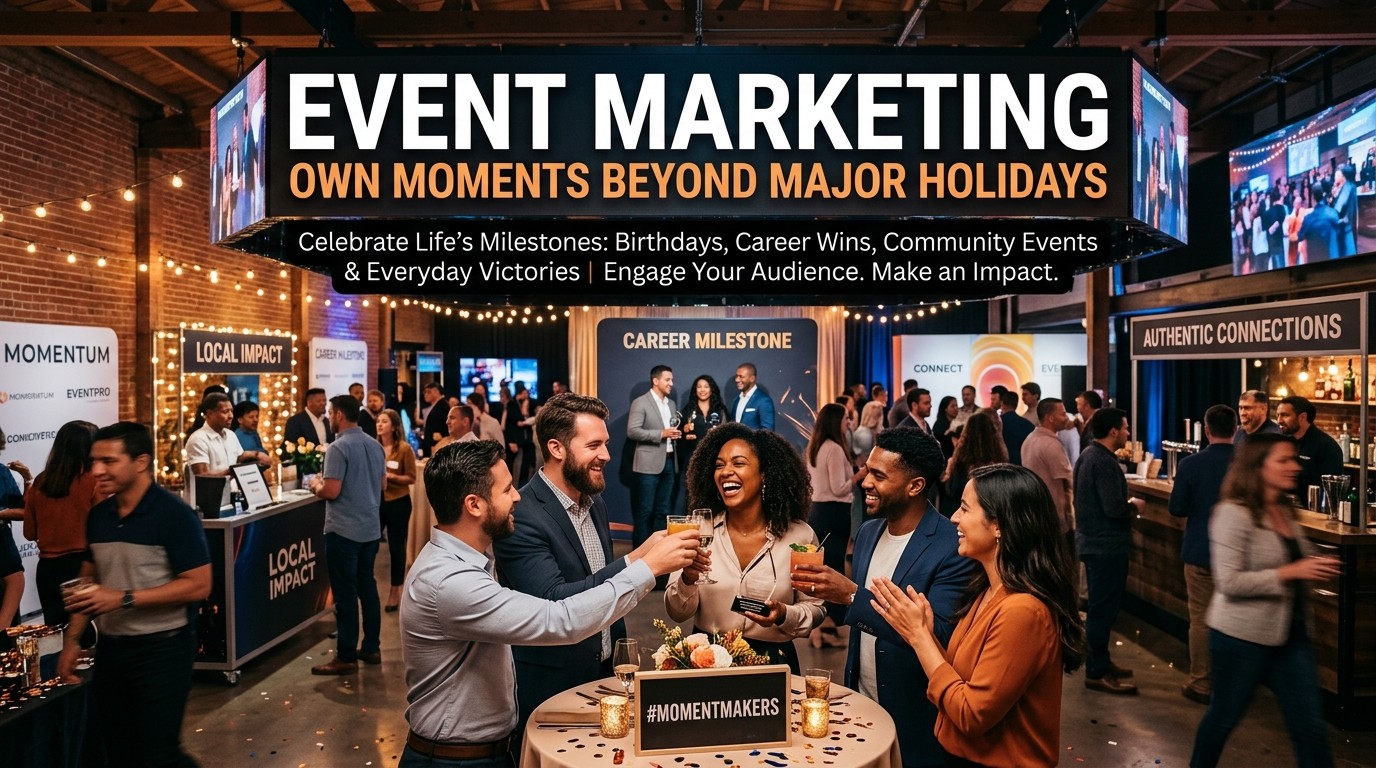
Event Marketing helps brands turn cultural, community, seasonal, professional, and unexpected moments into relevant demand without relying entirely on major holidays.
Event Marketing is the strategic use of events, occasions, cultural moments, community activities, industry gatherings, and meaningful dates to connect a brand with an audience through timely and relevant communication. While many businesses concentrate their promotional calendars around major holidays, there are hundreds of smaller moments throughout the year that can create attention, emotional connection, and purchase intent.
The core idea behind Event Marketing is simple: people pay more attention when something meaningful is happening around them. A local festival, sports tournament, product launch, graduation season, industry conference, back-to-school period, cultural celebration, or even a major weather event can temporarily change what consumers care about.
Major holidays are valuable because they already have massive awareness. The challenge is that they also produce extraordinary competition. Almost every brand is publishing, advertising, discounting, and competing for the same attention during the same narrow window.
That creates an opportunity for brands willing to look beyond the obvious calendar.
Event Marketing can help businesses identify smaller moments where audience attention is high but competitive pressure is lower. Instead of shouting louder during the busiest promotional period, a brand can become more relevant during a moment that genuinely matters to a specific audience.
The strongest Event Marketing strategies therefore do not begin with the question, “What holiday can we promote?” They begin with a better question: “What moments matter to our customers?”
That change in perspective opens a much larger strategic landscape.
Why Event Marketing Matters Beyond Major Holidays
Event Marketing becomes powerful because consumer attention is not distributed evenly throughout the year.
There are moments when people become more emotionally engaged, socially active, financially motivated, curious, or action-oriented. Brands that understand those moments can enter conversations when customers are naturally receptive.
Consider a few examples.
A university may be preparing for graduation. A local community may be organizing a cultural festival. A city may be hosting a marathon. A technology company may be preparing for a major industry conference. Families may be planning a school transition. Professionals may be preparing for an annual conference season.
None of these are necessarily global holidays, but they can create intense pockets of demand.
Event Marketing turns those pockets into marketing opportunities.
Attention is easier to capture when context already exists
Advertising usually has to create interest before it can create action.
An event can reverse that sequence.
The audience already knows what is happening. They already have a reason to pay attention. The marketer simply connects the brand to the existing context.
This reduces the psychological distance between the message and the consumer.
For example, a clothing retailer does not need to convince customers that graduation is important. The audience already understands that. The retailer only needs to position suitable products as part of the preparation.
That is one reason Event Marketing can outperform generic promotional messaging during relevant moments.
The Psychology Behind Event-Driven Demand
Event Marketing succeeds because people respond strongly to context, anticipation, belonging, identity, and urgency.
Anticipation increases attention
Humans naturally anticipate upcoming events.
Before a concert, people search for outfits, transportation, schedules, restaurants, and accessories. Before a conference, attendees think about travel, networking, presentation materials, and professional appearance.
The anticipation phase is extremely valuable.
Consumers are mentally preparing before the event actually happens.
A brand that communicates during that period can influence planning decisions before competitors enter the customer’s consideration set.
Belonging influences behavior
Events can create a sense of collective participation.
People want to feel included in experiences shared by their peers, communities, workplaces, or social groups.
This creates a powerful psychological mechanism for Event Marketing.
A campaign can position a product as part of participation rather than merely a transaction.
The customer is not simply buying an item. They are preparing for an experience that matters to them.
Identity shapes purchase decisions
Some moments become expressions of identity.
Graduation represents achievement. A professional conference represents expertise. A cultural celebration can represent heritage and community. A sporting event can represent loyalty and enthusiasm.
Marketing messages become more persuasive when they respect this identity dimension.
Instead of asking, “What can we sell during this event?” ask, “What does this event mean to the audience?”
That question produces stronger creative.
Event Marketing vs. Holiday Marketing
Holiday marketing focuses primarily on predefined calendar moments.
Event Marketing is broader.
| Holiday Marketing | Event Marketing |
|---|---|
| Focuses on recognized holidays | Covers many types of meaningful moments |
| Often highly competitive | Can target underserved moments |
| Frequently promotional | Can be experiential, educational, or community-driven |
| Strong mass awareness | Can be highly niche |
| Usually predictable | Can respond to emerging opportunities |
| Often national or global | Can be local, professional, cultural, or audience-specific |
Holiday marketing should not be abandoned.
Instead, brands can build an expanded calendar in which major holidays represent only one category of opportunity.
This allows marketers to create a more balanced demand-generation system.
Types of Events Brands Can Own
There is no single definition of an event.
A useful Event Marketing strategy categorizes opportunities into different groups.
Cultural events
Cultural festivals, heritage celebrations, public celebrations, and community gatherings can create powerful emotional connections.
Brands should approach these moments with authenticity.
Participation should reflect a genuine understanding of the community rather than simply attaching a logo to a popular occasion.
Sporting events
Sport creates emotion, anticipation, conversation, and community.
Brands can participate through sponsorships, content, limited offers, viewing experiences, contests, or relevant product bundles.
Even businesses without direct sports connections can identify adjacent needs.
For example, a grocery brand can support at-home viewing. A restaurant can create group ordering options. A furniture retailer can position seating products around gathering experiences.
Professional events
Trade shows, conferences, webinars, workshops, and industry events provide opportunities for B2B and professional brands.
These moments can support thought leadership, lead generation, networking, product demonstrations, and relationship building.
A B2B brand might release a research report before an industry conference and then use the event as a distribution and conversation engine.
Community events
Local events can be highly valuable for businesses with geographic audiences.
Examples include:
- Neighborhood festivals
- School events
- Charity runs
- Local fairs
- Community markets
- Public celebrations
- Arts events
- Food festivals
Local relevance can make a campaign feel significantly more personal than broad national messaging.
Educational moments
Graduation, admissions periods, exam seasons, training cycles, and certification milestones can all create demand.
Educational moments frequently involve emotional and financial decision-making, making timing especially important.
Entertainment events
Concerts, film premieres, fan conventions, theater productions, and cultural performances can create opportunities for relevant products and experiences.
The best campaigns attach themselves to the audience’s enthusiasm rather than attempting to manufacture artificial excitement.
Finding Events Your Competitors Ignore
One of the biggest opportunities in Event Marketing is identifying overlooked moments.
Start by researching how customers spend their time, what they prepare for, what they celebrate, and what causes them to change purchasing behavior.
Build a broad event inventory containing:
- Public events
- Industry events
- Local events
- School events
- Cultural occasions
- Sports schedules
- Professional milestones
- Community programs
- Entertainment releases
- Shopping moments
- Seasonal transitions
Then evaluate each opportunity using four questions.
Is there audience attention?
An event should already have some level of awareness or relevance.
Is there a customer problem?
The best events create a predictable need.
Is the brand relevant?
The connection should make sense naturally.
Is competition manageable?
A less crowded moment can offer more efficient attention.
This approach turns event discovery into a structured marketing process.
How to Build an Event Marketing Calendar
A strong event calendar should include more than dates.
Each opportunity should contain strategic information.
| Calendar Field | Purpose |
|---|---|
| Event Name | Identifies the moment |
| Date | Establishes timing |
| Audience | Defines relevance |
| Location | Supports geographic targeting |
| Customer Need | Identifies commercial opportunity |
| Content Angle | Defines communication |
| Offer | Determines conversion mechanism |
| Channel | Selects distribution |
| Lead Time | Determines preparation |
| Owner | Establishes responsibility |
| KPI | Defines success |
The calendar should ideally be divided into three planning windows:
Pre-event: Build anticipation, awareness, and preparation.
During event: Increase participation, engagement, and real-time relevance.
Post-event: Extend the conversation and capture follow-up demand.
This three-stage structure makes Event Marketing more strategic than simply posting something on the event date.
The Pre-Event Opportunity
Many marketers focus on the event itself.
However, the strongest purchase decisions may happen beforehand.
Customers often research, compare, plan, budget, and prepare before participating in an event.
This creates a valuable pre-event window.
A travel company could promote destination planning before a major festival.
A fashion retailer could publish preparation guides before graduation.
A software company could release a conference checklist weeks before an industry gathering.
The goal is to arrive before the customer reaches the final decision stage.
Building anticipation
Anticipation can be created through:
- Countdown campaigns
- Preparation checklists
- Guides
- Early access
- Educational content
- Product previews
- Registration reminders
- Expert recommendations
These tactics help customers feel prepared while positioning the brand as useful.
The During-Event Opportunity
Real-time marketing can create a sense of immediacy.
However, speed should never replace relevance.
During-event content can include:
- Live commentary
- Behind-the-scenes content
- Audience reactions
- Interactive polls
- Event-related offers
- User-generated content
- Short-form video
- Real-time social posts
This is particularly effective when the audience is already discussing the event online.
The brand does not need to dominate the conversation. It needs to contribute something worthwhile.
The Post-Event Opportunity
The end of an event does not mean the opportunity has disappeared.
The post-event period often contains reflection, follow-up, sharing, comparison, and continued interest.
A business can publish:
- Recap content
- Photo collections
- Customer stories
- Lessons learned
- Product recommendations
- Follow-up offers
- Related educational resources
For B2B events, this may include follow-up calls, downloadable reports, webinar recordings, or personalized communications.
This extended lifecycle helps extract more value from one event.
Event Marketing and Customer Journey Mapping
Event Marketing should align with customer journey stages.
| Customer Stage | Event Opportunity |
|---|---|
| Awareness | Event-related educational content |
| Interest | Guides and recommendations |
| Consideration | Comparisons and product demonstrations |
| Purchase | Timely offers |
| Experience | Event participation or service |
| Loyalty | Follow-up and community engagement |
| Advocacy | Reviews and user-generated content |
This prevents brands from reducing every event to a discount.
Different customers may need different messages at different times.
A first-time attendee may need education.
A repeat participant may want speed and convenience.
A loyal customer may be interested in exclusive access.
The event is the same, but the customer journey is different.
Event Marketing and Content Strategy
Events provide an endless source of content ideas.
A single event can support:
- Blog posts
- Videos
- Short social posts
- Email campaigns
- Guides
- Interviews
- Checklists
- Case studies
- Podcasts
- Webinars
- Landing pages
The key is to create content around audience questions rather than simply reporting that the event exists.
For content planners, this creates a useful opportunity to connect event calendars with broader Seasonal Marketing Trends without allowing the strategy to become dependent on holidays alone.
Content before the event
Focus on preparation.
Content during the event
Focus on participation and experience.
Content after the event
Focus on reflection, education, and continued relevance.
A single event can therefore produce a multi-week content ecosystem.
Balancing Automation With Human Relevance
Modern marketing platforms make it easier to automate event reminders, audience segmentation, scheduling, and content distribution.
Automation can be valuable.
But complete automation can produce generic messaging.
That becomes dangerous when an event is emotionally important or culturally sensitive.
AI Content Briefs can help marketing teams organize event-related content ideas, search themes, audience questions, and structural requirements. Yet the final campaign still needs human judgment about context, tone, originality, and appropriateness.
The most effective approach combines speed with editorial intelligence.
Automation handles repetition.
Humans handle meaning.
Weather and Event Context
Events do not happen in isolation.
Environmental conditions can change attendance, mobility, demand, and customer preferences.
A festival may experience heavy rainfall. A sporting event may take place during extreme heat. An outdoor market may face sudden temperature changes.
This is where Weather-Based Marketing can add contextual intelligence to event campaigns.
For example, an outdoor event organizer could adapt communications depending on weather conditions. A retailer near an event venue might change product recommendations when weather changes.
The broader lesson is that event relevance can intersect with other real-world conditions.
The more contextual signals marketers combine intelligently, the more useful their communication becomes.
How to Create an Event Marketing Campaign
A reliable campaign can be built through the following sequence.
Step 1: Select the event
Choose a moment with genuine audience relevance.
Step 2: Understand the audience
Identify who participates, what they value, what they fear, and what they need.
Step 3: Identify the problem
Determine what customers need before, during, or after the event.
Step 4: Establish the brand role
Decide whether the brand will educate, facilitate, entertain, sponsor, supply, or enhance the experience.
Step 5: Create the message
Connect the event with a useful customer outcome.
Step 6: Select channels
Choose platforms where the relevant audience already spends time.
Step 7: Build the timeline
Create pre-event, event-day, and post-event activities.
Step 8: Measure outcomes
Track engagement, leads, sales, attendance, and long-term customer value.
This framework creates consistency while leaving enough flexibility for different event types.
Creating Strong Event Messaging
Effective event messaging usually contains three components:
Context: Why is this moment important?
Relevance: Why does it matter to this customer?
Action: What should the customer do next?
For example:
“Heading to the city marathon? Prepare with lightweight running essentials and race-day nutrition.”
This is stronger than:
“Marathon Sale — 20% Off!”
The first message connects the product with the event experience.
That relevance can improve perceived value.
Why Generic Event Promotions Fail
Event Marketing can fail when the brand simply attaches an event name to an unrelated promotion.
Customers quickly recognize forced relevance.
A discount does not automatically become meaningful because a brand mentions a popular occasion.
To create credibility, the product or service should solve a real event-related problem.
A travel company around a festival makes sense.
A food delivery service around a major sports event makes sense.
A professional software product around an industry conference may make sense.
The connection must survive the “Why?” test.
Why would this customer want this product because of this event?
If the answer is weak, the campaign probably needs a different angle.
The Role of Exclusivity
Events naturally create opportunities for limited access.
Exclusive offers can work because scarcity and belonging influence behavior.
Possible approaches include:
- Event-only bundles
- Early access
- Limited editions
- Reserved experiences
- VIP packages
- Member-only access
- Special event pricing
But scarcity should be genuine.
Artificial urgency can undermine trust.
Real exclusivity works better when customers understand why access is limited.
Event Marketing and Community Building
Events can be used to create relationships that extend beyond transactions.
A brand can support an event through:
- Sponsorship
- Volunteer programs
- Educational sessions
- Community resources
- Local partnerships
- Customer participation
- User-generated stories
This can increase brand familiarity and social credibility.
Community involvement is particularly powerful when the brand contributes something meaningful rather than simply promoting itself.
The long-term value is often stronger than the immediate campaign result.
Measuring Event Marketing Performance
A complete measurement framework should examine short-term and long-term outcomes.
Awareness metrics
Track:
- Reach
- Impressions
- Video views
- Brand searches
- Share of conversation
Engagement metrics
Track:
- Comments
- Shares
- Saves
- Event interactions
- Participation
- Content completion
Conversion metrics
Track:
- Sales
- Leads
- Registrations
- Coupon usage
- Landing-page conversions
- Average order value
Relationship metrics
Track:
- New subscribers
- Repeat purchases
- Retention
- Customer lifetime value
- Community participation
The appropriate KPI depends on the role of the campaign.
An awareness campaign should not be judged purely by immediate sales.
A retail promotion should not be judged only by impressions.
Measurement should match the strategic objective.
Event Marketing ROI
ROI analysis should include all relevant costs.
These may include:
- Sponsorship
- Creative production
- Advertising
- Event staff
- Discounts
- Partnerships
- Technology
- Influencer costs
- Logistics
Then compare the investment against measurable business outcomes.
However, not every event should be judged exclusively through immediate revenue.
Some events create valuable relationships that produce future business.
This is particularly true in B2B marketing and community-driven campaigns.
How AI Can Improve Event Marketing
AI can help marketers process large quantities of information and identify opportunities faster.
It can assist with:
- Event discovery
- Audience segmentation
- Demand prediction
- Campaign personalization
- Content ideation
- Performance analysis
- Message variation
- Timing recommendations
- Trend detection
However, AI should support the marketer rather than replace strategic thinking.
A system can identify that a certain event produces high engagement.
It cannot automatically understand every cultural nuance surrounding that event.
Human context remains essential.
Building a Year-Round Event Marketing Strategy
A mature strategy treats the year as a network of moments rather than twelve isolated months.
Start with major events.
Then add industry events.
Then local events.
Then audience-specific moments.
Then emerging opportunities.
A useful framework is:
Tier 1: Major national or global events.
Tier 2: Industry and cultural events.
Tier 3: Local and community moments.
Tier 4: Brand-owned events.
Tier 5: Emerging or unexpected moments.
This hierarchy helps teams prioritize resources.
Not every event deserves a full campaign.
Some may require a blog post.
Others may require social content.
Only the highest-value opportunities should receive significant paid media and operational investment.
Creating Brand-Owned Events
One of the most powerful Event Marketing strategies is creating your own moment.
Brands can create:
- Workshops
- Challenges
- Webinars
- Product launches
- Community days
- Customer appreciation events
- Educational sessions
- Online competitions
- Industry roundtables
Brand-owned events provide more control.
Instead of waiting for external attention, the company creates a recurring reason for customers to engage.
The event can eventually become part of the brand identity.
Event Marketing for Small Businesses
Small businesses often assume event campaigns require large budgets.
They do not.
A local café can create an event around a neighborhood celebration.
A fitness studio can host a wellness workshop.
A bookstore can run an author discussion.
A local retailer can support a community activity.
The objective is not to compete with massive advertising budgets.
The objective is to become relevant within a smaller community.
Local relevance can be a significant competitive advantage.
Event Marketing for Ecommerce Brands
Ecommerce companies can connect events to product discovery.
A useful event campaign may include:
- Event-related landing page
- Curated product collection
- Preparation guide
- Email sequence
- Social campaign
- Limited bundle
- Post-event follow-up
This turns an event into a complete commercial journey.
The product selection should always be logically connected to the audience’s needs.
Event Marketing for B2B Brands
B2B companies can use professional events to demonstrate expertise.
Potential tactics include:
- Executive roundtables
- Research reports
- Conference content
- Expert interviews
- Event-specific webinars
- Networking sessions
- Product demonstrations
- Follow-up resources
The biggest mistake is treating B2B events as lead-volume exercises.
High-quality relationships can be more valuable than a large database of low-intent contacts.
The best Event Marketing programs prioritize relevance over volume.
Event Marketing and Experiential Strategy
Experiential campaigns allow customers to interact with a brand rather than simply seeing an advertisement.
Experiences might include:
- Pop-up installations
- Interactive demonstrations
- Sampling
- Competitions
- Workshops
- Immersive displays
- Digital experiences
Experiential campaigns work because participation creates stronger memories than passive exposure.
When the experience reflects the brand promise, it can create emotional associations that remain after the event ends.
Avoiding Event Marketing Mistakes
Choosing events solely because they are popular
Popularity does not equal relevance.
Starting too late
Some events require weeks or months of preparation.
Overpromoting
The brand should contribute to the moment rather than dominate it.
Ignoring logistics
Customer experience can collapse when demand exceeds operational capacity.
Using insensitive humor
Certain events require respect and cultural awareness.
Measuring only immediate sales
Some campaigns have significant long-term value.
Copying competitors
A copied event concept rarely creates distinctive brand equity.
A Practical Event Marketing Checklist
Before launch, ask:
Audience: Who cares about this event?
Meaning: Why does it matter to them?
Problem: What need does the event create?
Relevance: Why should our brand participate?
Message: What useful idea are we communicating?
Offer: Is there a meaningful commercial reason to act?
Timing: When will customers be most receptive?
Channels: Where will they see the message?
Experience: Can operations deliver what we promise?
Measurement: How will success be evaluated?
These questions can prevent wasted spend and superficial campaigns.
Advanced Event Marketing: Combining Multiple Signals
The most sophisticated Event Marketing systems combine event information with other customer signals.
For example:
Event + Location
Event + Purchase History
Event + Weather
Event + Search Intent
Event + Customer Lifecycle
Event + Inventory
Event + Social Engagement
This creates a more personalized marketing environment.
Imagine a customer has purchased running shoes before, lives near a city hosting a marathon, and has recently searched for running accessories.
That combination creates a much stronger signal than simply knowing that a marathon is happening.
Modern marketing increasingly depends on contextual combinations.
The event is one signal among many.
Event Marketing and Search Intent
Search behavior can reveal what customers want before, during, and after events.
Before an event, users may search for preparation information.
During an event, searches may become highly specific and immediate.
Afterward, they may search for reviews, photos, results, recommendations, or related products.
This creates content opportunities throughout the event lifecycle.
A brand should therefore build content around actual questions rather than only promotional messaging.
Event Marketing and Social Proof
People frequently look to others when deciding how to participate in an event.
Reviews, testimonials, user-generated content, influencer recommendations, and social conversations can reduce uncertainty.
Brands can encourage customers to share:
- Event preparation
- Product usage
- Experiences
- Photos
- Results
- Recommendations
Social proof works especially well when the audience can imagine itself having the same experience.
Event Marketing and FOMO
Fear of missing out can increase action when used responsibly.
Limited event access, registration deadlines, exclusive experiences, and time-sensitive opportunities naturally create urgency.
But FOMO should reflect reality.
False scarcity can create distrust.
Authentic scarcity communicates something customers genuinely risk missing.
That difference matters.
Turning One Event Into a Content Engine
A well-planned event can generate months of reusable intellectual property.
Before the event, create preparation resources.
During the event, capture interviews and experiences.
After the event, transform those materials into:
- Case studies
- Blog posts
- Videos
- Testimonials
- Social snippets
- Educational guides
- Email content
- Industry reports
This increases the return on creative investment.
Instead of thinking of an event as a one-day campaign, think of it as a content ecosystem.
Human Creativity in Event Marketing
Automation can make event calendars efficient.
But memorable campaigns usually come from insight.
A marketer who understands why a community values an event can create ideas that feel authentic.
That human layer matters because customers remember meaning more than mechanics.
Human-Led Blogging can also strengthen event-based content by bringing experience, editorial judgment, storytelling, and audience empathy into articles that might otherwise become repetitive calendar-driven pages.
The goal is not to produce more event content.
The goal is to produce better event relevance.
How to Differentiate Your Event Campaign
A brand needs an angle.
Possible angles include:
Utility: Help customers prepare.
Education: Teach something valuable.
Entertainment: Make the moment more enjoyable.
Community: Help people connect.
Exclusivity: Provide special access.
Convenience: Make participation easier.
Identity: Support what the event represents.
A strong campaign usually chooses one primary role and executes it consistently.
The Long-Term Value of Owning Moments
Major holidays will continue to dominate marketing calendars.
But relying exclusively on them creates predictable competition.
Brands that discover and own meaningful moments can create more consistent engagement throughout the year.
That does not mean turning every minor occasion into a campaign.
It means developing a stronger understanding of audience behavior.
The best Event Marketing strategies are selective.
They choose moments that genuinely matter.
They contribute value.
They create relevance before asking for a transaction.
They use data without losing humanity.
And they evaluate outcomes without reducing every relationship to a click.
Future Opportunities in Event Marketing
As personalization technology improves, brands will increasingly be able to identify individual moments of relevance.
A national campaign could become thousands of localized experiences.
Different customers might receive different event messages based on geography, interests, behavior, and timing.
AI can help process those signals.
Automation can help activate campaigns.
Analytics can help measure outcomes.
But the strategic question remains human:
“Why should this moment matter to this person?”
Brands that answer that question clearly will have an advantage.
Conclusion
Event Marketing gives brands a way to create relevance beyond crowded major holidays by identifying the moments, experiences, and occasions that genuinely influence customer attention and behavior. The strongest approach begins with audience understanding rather than a promotional calendar. Brands can use cultural events, professional gatherings, community activities, sports, educational milestones, and brand-owned experiences to create meaningful touchpoints before, during, and after each moment. Success depends on authentic relevance, thoughtful timing, useful messaging, operational readiness, and appropriate measurement. When data and automation are balanced with human judgment, Event Marketing becomes more than a promotional tactic. It becomes a year-round system for building attention, demand, participation, and stronger customer relationships.
Frequently Asked Questions
1. What is Event Marketing?
Event Marketing is the practice of using events, occasions, cultural moments, professional gatherings, community activities, and brand-owned experiences to attract, engage, convert, and retain customers.
2. Is Event Marketing only useful for major holidays?
No. It can be used around local festivals, conferences, sporting events, graduations, community activities, product launches, educational milestones, cultural occasions, and emerging moments.
3. Why is Event Marketing effective?
It works because events already create attention, anticipation, social participation, and emotional relevance. Brands can connect their products or services to those existing motivations.
4. How early should a business start an event campaign?
The ideal lead time depends on the event. Large events may require months of preparation, while smaller social campaigns may be created within days. The key is to start early enough to influence customer planning.
5. What type of content works best for Event Marketing?
Preparation guides, checklists, educational content, product recommendations, videos, interviews, event recaps, social posts, user-generated content, and event-specific landing pages can all work effectively.
6. Can small businesses use Event Marketing?
Yes. Small businesses can focus on local and community moments where relevance is more important than advertising scale. Workshops, neighborhood activities, local celebrations, and customer events can all create opportunities.
7. How can brands avoid making an event campaign feel forced?
The brand should solve a genuine problem connected to the event. Simply attaching an event name to an unrelated discount can feel artificial and may reduce credibility.
8. How should Event Marketing performance be measured?
Measurement should reflect the objective. Relevant metrics can include reach, engagement, registrations, leads, sales, average order value, customer retention, brand searches, and long-term customer value.
9. Can AI be used for Event Marketing?
Yes. AI can assist with event discovery, audience segmentation, content ideation, personalization, forecasting, campaign analysis, and performance optimization. Human oversight remains essential for context and creativity.
10. What is the biggest strategic advantage of Event Marketing?
Its biggest advantage is the ability to discover relevant moments outside the most crowded promotional periods. By owning meaningful moments that matter to specific audiences, brands can build attention and demand in a more focused and differentiated way.