
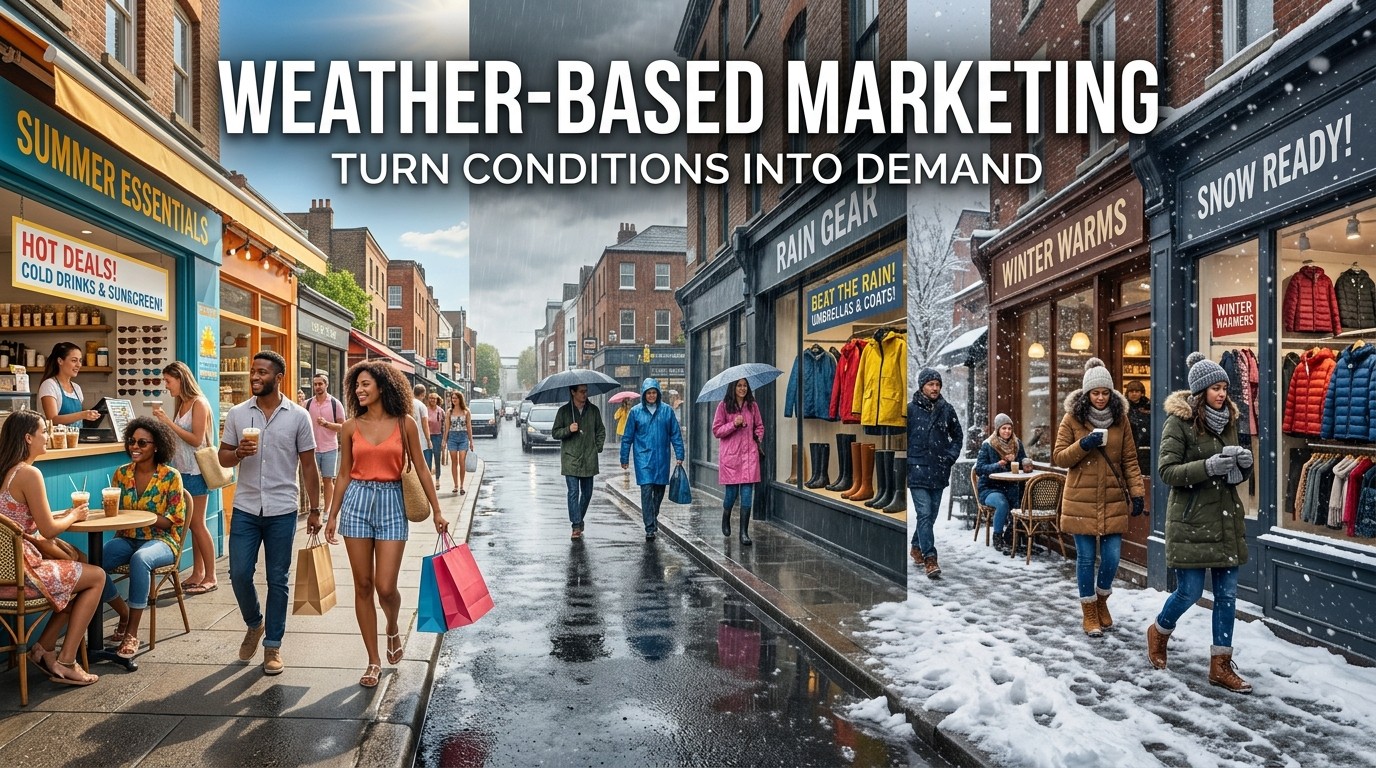
Weather changes customer behavior faster than many brands realize. A hot afternoon can increase demand for cold drinks, a storm can shift shoppers toward delivery, and a sudden cold spell can trigger urgent purchases of warm clothing. Weather-Based Marketing helps brands recognize these behavioral shifts and turn real-world conditions into relevant, timely demand.
Weather-Based Marketing is a strategy that uses current, forecasted, or historically observed weather conditions to influence when, where, and how a marketing message is delivered. Instead of presenting the same promotion regardless of the environment, a business adapts its communication to what customers are experiencing or likely to experience.
At its simplest, Weather-Based Marketing connects three variables: weather, customer behavior, and marketing action. When temperatures rise, a retailer may promote cooling products. When rain is expected, a food delivery company may increase visibility for delivery offers. When snow approaches, an outdoor brand may prioritize winter gear.
The strategy becomes more powerful when weather is treated as a behavioral signal rather than merely a background condition. People do not buy because a weather API says the temperature is 34°C. They buy because the heat changes how they feel, what they need, where they go, and what problems they want solved.
That psychological connection is the real advantage of Weather-Based Marketing. Weather creates context, context changes perceived need, and perceived need can shorten the distance between attention and action.
For marketers, this means a campaign does not always need a new product to generate urgency. Sometimes the trigger already exists outside the brand. The marketer’s job is to recognize it and connect the customer’s existing situation with a useful solution.
Why Weather Influences Consumer Psychology
Human behavior is deeply contextual. The environment around a customer can alter comfort, mood, mobility, attention, and purchase priorities.
When conditions become uncomfortable, people often become more problem-aware. A customer who normally ignores air-conditioning content may suddenly search for cooling solutions during extreme heat. Someone who rarely orders food delivery may reconsider leaving home during heavy rain.
Weather-Based Marketing works because it aligns marketing communication with this changing level of problem awareness.
Weather changes perceived urgency
A product that feels optional on Monday can become highly relevant on Thursday.
Consider sunscreen. It may remain somewhere in a customer’s mental background for weeks. A bright, extremely hot day can suddenly increase its perceived importance. The product did not change. The context did.
This is a classic psychological shift from passive awareness to active need.
Brands can use Weather-Based Marketing to reach customers during that shift instead of waiting for them to enter a generic buying cycle.
Weather affects emotional states
Weather also influences mood and emotional energy.
Bright conditions may support outdoor activity, social plans, and leisure spending. Cold or rainy conditions may encourage staying indoors, comfort-oriented consumption, and convenience purchases.
Marketers should therefore think beyond physical needs. The strongest weather-triggered campaigns often address both functional and emotional motivations.
A rainy-day promotion for food delivery solves convenience. A cozy indoor entertainment promotion addresses boredom and comfort. A winter fashion campaign can combine warmth, appearance, and self-expression.
Weather changes routines
People often have different routines under different conditions.
On clear days, someone may walk to a store. During a storm, that same customer may switch to an app. On a very hot afternoon, they may postpone outdoor activities. During a cold morning, they may spend longer indoors before starting their day.
These routine changes create marketing opportunities.
Weather-Based Marketing becomes particularly valuable when marketers identify not only what customers buy, but how weather changes the path they take toward the purchase.
Weather-Based Marketing vs. Traditional Seasonal Marketing
Traditional seasonal marketing is usually built around fixed calendar periods such as summer, winter, holidays, school seasons, or annual events.
That approach remains useful, but it can be too broad.
A summer campaign assumes that customers respond to summer conditions consistently. In reality, a 30°C day and a 40°C day can produce very different consumer behavior.
Weather-Based Marketing adds a dynamic layer to seasonal strategy.
| Traditional Seasonal Marketing | Weather-Based Marketing |
|---|---|
| Based mainly on calendar periods | Based on real-world conditions |
| Often planned months in advance | Can react dynamically |
| Uses broad seasonal assumptions | Uses granular weather signals |
| Same message may run for weeks | Messages can change by condition |
| Strong for predictable seasonality | Strong for short-term demand shifts |
| Less sensitive to local variation | Can be highly location-specific |
The strongest marketing systems do not treat these approaches as competitors. They combine them.
Seasonal planning establishes the broader commercial direction. Weather intelligence helps determine when the audience is most responsive inside that season.
This is where understanding Seasonal Marketing Trends can give marketers useful context, but weather data can add another layer of precision by showing how immediate conditions shape behavior.
The Core Data Signals Behind Weather-Based Marketing
A strong strategy requires more than simply knowing whether it is raining.
Weather data can include:
- Temperature
- Feels-like temperature
- Precipitation
- Rain probability
- Snow probability
- Wind speed
- Humidity
- UV index
- Visibility
- Cloud cover
- Air pressure
- Storm warnings
- Heat advisories
- Cold conditions
- Hourly forecasts
- Daily forecasts
- Historical weather patterns
The useful signal depends on the product.
For example, humidity may be more relevant to skincare or HVAC products, while precipitation probability may be more useful for delivery services or outdoor events.
The goal is not to collect the maximum amount of data. The goal is to collect the signals that correlate with customer behavior.
How to Build a Weather-Based Marketing Framework
Weather-Based Marketing becomes easier to execute when it is structured into a repeatable framework rather than handled as a collection of random promotional ideas.
A practical framework has six stages.
1. Identify weather-sensitive products
Start with products or services that logically respond to environmental changes.
Typical categories include:
- Food and beverage
- Apparel
- Travel
- Hospitality
- Grocery
- Home improvement
- Beauty and skincare
- Fitness
- Automotive
- Delivery
- Outdoor recreation
- Entertainment
- Home climate products
The more directly weather affects product utility, the more obvious the opportunity.
2. Define behavioral triggers
Ask what happens when a specific weather condition occurs.
For example:
Hot weather may increase demand for hydration, cooling, lighter clothing, outdoor refreshments, and indoor entertainment.
Rain may increase demand for delivery, umbrellas, waterproof products, indoor activities, and convenience services.
Cold weather may increase demand for heating, warm clothing, comfort food, blankets, and indoor experiences.
The objective is to turn weather conditions into behavioral hypotheses.
3. Match the trigger to a customer segment
Not every customer responds to weather in the same way.
A parent may respond differently to rain than a university student. A traveler may care about storms differently from a local resident. A commuter may react strongly to temperature changes while a remote worker may not.
Weather-Based Marketing becomes more effective when conditions are combined with audience characteristics.
4. Create a message for the moment
The message should connect the weather condition to the customer’s current problem.
Weak:
“20% Off Today.”
Stronger:
“Rain on the way? Stay in tonight and save on delivery.”
The second message provides context. It explains why the offer matters now.
5. Select the correct channel
The channel should match customer behavior.
Possible channels include:
- Search advertising
- Social media
- SMS
- Push notifications
- Display advertising
- Ecommerce banners
- Website personalization
- Digital out-of-home advertising
- Mobile applications
A weather trigger is valuable only when it reaches the customer quickly enough to influence behavior.
6. Measure commercial impact
Track more than clicks.
Measure:
- Conversion rate
- Revenue per campaign
- Average order value
- Customer acquisition cost
- Product-level demand
- Incremental sales
- Geographic performance
- Trigger accuracy
- Engagement by weather condition
- Profitability by condition
The ultimate objective of Weather-Based Marketing is not higher engagement. It is better commercial timing.
Weather Triggers Every Marketer Should Test
Different weather conditions can activate different forms of demand.
Heat
Heat can create urgent needs around hydration, cooling, comfort, skin protection, travel adjustments, and indoor experiences.
A beverage company might increase promotions when temperature crosses a predefined threshold.
A retailer selling fans or portable cooling devices can prioritize products when hot conditions become widespread.
A restaurant might promote cold beverages or lighter meals during unusually hot afternoons.
Rain
Rain often changes mobility and convenience preferences.
A delivery business can emphasize speed and comfort.
A fashion retailer can promote waterproof footwear.
A grocery company can make ordering online easier and more prominent.
The key is relevance. A rain message should not simply announce that it is raining. It should answer the question, “What can I do about it?”
Cold
Cold weather creates demand around warmth, protection, indoor comfort, and seasonal products.
A hotel could promote cozy packages.
A food brand could highlight warm meals.
An apparel company could recommend layering products.
This is where Weather-Based Marketing can become especially persuasive because discomfort makes problem-solving messages feel immediately useful.
Wind
Wind may influence transportation, outdoor activity, events, and certain consumer categories.
A travel company may use wind conditions to update outdoor activity recommendations.
An automotive brand could use strong wind warnings as a context for safety-related content.
Extreme weather
Severe conditions require greater responsibility.
Marketers should avoid turning disasters into insensitive promotional opportunities.
When safety is involved, usefulness should come before conversion.
A brand may offer information, flexible cancellation policies, emergency support, or practical resources rather than trying to force a sales message.
This distinction is important because customers can easily detect when a brand is exploiting anxiety.
Weather-Based Marketing and Personalization
Personalization often focuses on demographic or behavioral data, but environmental context can be equally important.
Imagine two customers browsing the same online store.
Customer A is in a city experiencing heavy rainfall.
Customer B is in a city experiencing extreme heat.
Serving both customers the same homepage experience ignores useful context.
Weather-Based Marketing can support localized personalization by changing:
- Homepage banners
- Product recommendations
- Promotional copy
- Search ads
- Email subject lines
- App notifications
- Delivery messages
- Landing pages
The deeper principle is contextual relevance.
Customers increasingly expect brands to understand why a message matters, not simply who they are.
Weather-Based Marketing for Ecommerce
Ecommerce is one of the strongest environments for weather-driven campaigns because digital stores can respond quickly.
A retailer could automatically promote rain jackets when rain probability rises.
A home retailer could promote cooling products when temperatures increase.
A beauty retailer could prioritize moisturizers during dry weather.
A grocery platform could feature ingredients associated with seasonal comfort.
The tactic becomes even stronger when product recommendations are paired with content.
Instead of simply saying “Buy this product,” the store can explain the problem:
“Dry air can make your skin feel tighter. Here are lightweight hydration options for today’s conditions.”
This moves the campaign from promotion to problem-solving.
Weather-Based Marketing in Search Advertising
Search behavior often changes with immediate needs.
When conditions shift, users may search with highly contextual intent.
Examples include:
- best food delivery during rain
- cooling products near me
- what to wear in extreme heat
- waterproof shoes
- indoor activities tonight
- winter heating solutions
Search advertising can respond to those patterns through location, timing, keyword intent, and weather-related triggers.
A weather-aware search strategy should avoid creating irrelevant ads merely because the forecast changes.
The condition should have a meaningful relationship with the promoted product.
For example, promoting sunglasses because clouds increased slightly may create noise. Promoting rain boots when heavy rain is expected has a much stronger logic.
Weather-Based Marketing on Social Media
Social media makes weather campaigns particularly easy to contextualize because content can be timely, visual, and conversational.
A brand might publish:
“Rainy outside. Movie night inside.”
A beverage company could say:
“Temperature climbing? Time for something ice-cold.”
A fashion brand could build a carousel around “What to wear when the forecast changes.”
The opportunity is not merely to mention weather. It is to make the brand feel aware of the customer’s current world.
That feeling of situational awareness can increase relevance and attention.
Weather-Based Marketing Through Email and SMS
Email gives marketers more room for education and recommendation.
A weather-triggered email could contain:
- The condition
- The customer problem
- The recommendation
- The offer
- A clear next step
SMS and push notifications work differently because brevity matters.
A useful notification might be:
“Rain expected this evening. Order before 6 PM and skip the rush.”
The value comes from timing.
Sending the same message four days after the weather event eliminates much of its psychological impact.
Weather-Based Marketing for Local Businesses
Local businesses can often benefit significantly because weather creates strong geographic differences.
A chain with locations across multiple cities may experience rain in one market and clear weather in another on the same day.
A centralized national campaign would ignore that difference.
Local weather triggers can help businesses adjust:
- Promotions by location
- Inventory visibility
- Delivery messaging
- Store traffic campaigns
- Local search ads
- Social posts
- Push notifications
This is especially relevant for restaurants, retail stores, gyms, entertainment venues, garden centers, and other businesses whose demand can shift quickly.
Using Weather Forecasts Without Overreacting
Forecast data is useful, but forecasts are not certainty.
A smart system should account for confidence.
For example, a campaign might require:
- Temperature above a threshold
- Rain probability above a threshold
- Forecast confidence above a threshold
- Target audience present in the affected area
This reduces unnecessary campaign activation.
One of the biggest mistakes in Weather-Based Marketing is reacting to every tiny weather change. Constant switching can create inconsistent messaging and operational complexity.
Triggers should be commercially meaningful.
The Role of AI in Weather-Based Marketing
Artificial intelligence can make weather-triggered marketing more scalable.
AI can help marketers:
- Detect correlations between weather and demand
- Predict product demand
- Generate message variations
- Segment audiences
- Estimate campaign timing
- Recommend trigger thresholds
- Analyze historical performance
- Personalize creative
- Forecast inventory pressure
AI becomes particularly useful when the amount of data exceeds what a marketing team can reasonably evaluate manually.
However, AI should not replace strategy.
A machine can discover that orders increase during certain conditions. A human still needs to determine whether the pattern makes business sense and whether using it would improve the customer experience.
For content teams, AI Content Briefs can help transform structured signals into topic directions, but the final messaging should still reflect brand voice, customer reality, and editorial judgment.
That balance becomes essential because weather-triggered content can become repetitive very quickly.
Human Judgment Still Matters
Automation can detect patterns, but humans understand nuance.
Suppose rain typically increases food delivery orders. A simple model may recommend aggressive promotional activity during every rain event.
A human marketer may notice that a severe storm changes the context entirely.
Customers might not be in a buying mood. They might be worried about safety, transport, or power outages.
In that scenario, pushing a discount can feel tone-deaf.
Human-led decision-making protects brands from this kind of automation failure.
The goal of Weather-Based Marketing should be relevance, not robotic responsiveness.
How Seasonal Demand Forecasting Complements Weather Data
Weather signals become more valuable when combined with historical sales data.
Suppose a retailer sees higher demand for a particular product during temperatures above 32°C.
The company can compare:
- Temperature
- Product sales
- Geographic demand
- Time of day
- Day of week
- Promotions
- Stock levels
- Competitor activity
Over time, this can create a predictive model that anticipates demand before it peaks.
That means marketing and inventory planning can work together.
Marketing might prepare campaigns before the weather arrives, while operations ensure the promoted products are available.
This coordination is critical.
There is little value in generating demand for a product that is out of stock.
A Practical Weather-Based Campaign Example
Imagine a fictional beverage brand selling cold tea.
The company discovers that sales increase significantly when temperatures rise above a particular level.
Instead of running the same promotion all summer, the brand creates dynamic rules.
Normal conditions
The brand runs standard product awareness campaigns.
Warm conditions
Creative emphasizes refreshment and hydration.
Very hot conditions
The brand increases promotional visibility, prioritizes delivery messaging, and highlights cold-serving suggestions.
Extreme heat
The brand focuses on practical comfort messaging and avoids excessive frequency.
The campaign can also differ by city.
A customer in a very hot region may need less educational messaging because the product category is already familiar.
A customer in a cooler region may respond more strongly to seasonal context.
This is how Weather-Based Marketing moves from simple weather-themed content to a real demand-generation system.
Common Mistakes to Avoid
Mistake 1: Treating weather as the strategy
Weather is a trigger, not the entire marketing strategy.
A campaign still needs a clear value proposition, audience, offer, and channel.
Mistake 2: Using irrelevant weather references
Mentioning weather without connecting it to customer needs creates superficial personalization.
The weather should explain why the message matters now.
Mistake 3: Triggering campaigns too frequently
Customers can become fatigued when every forecast produces a new promotion.
Use thresholds and meaningful events.
Mistake 4: Ignoring geography
Weather conditions vary by location.
A city-level strategy often performs better than broad national assumptions.
Mistake 5: Forgetting inventory
Demand generation must be connected to operational readiness.
Mistake 6: Over-automating creative
Not every weather situation should use the same template.
Humans should review high-impact campaigns and sensitive conditions.
Mistake 7: Measuring clicks instead of business outcomes
A weather joke may generate engagement without generating meaningful revenue.
Measure incremental sales and profitability.
How to Measure Weather-Based Marketing Performance
A good measurement system compares behavior during triggered periods with a suitable baseline.
Useful metrics include:
| Metric | Why It Matters |
|---|---|
| Conversion Rate | Shows how responsive customers are |
| Revenue | Measures commercial output |
| Incremental Revenue | Estimates additional demand |
| Average Order Value | Shows basket quality |
| CTR | Measures message relevance |
| CAC | Measures acquisition efficiency |
| ROAS | Evaluates paid campaign performance |
| Stock Sell-Through | Connects marketing with inventory |
| Regional Lift | Identifies location-specific impact |
| Trigger Accuracy | Evaluates the quality of weather rules |
The most important question is:
“Did weather-aware intervention generate more business than what would have happened naturally?”
Without this comparison, marketers can easily mistake correlation for causation.
How to Test Weather-Based Campaigns
Testing can start small.
Select one product category, one weather condition, one market, and one channel.
Then create a control group or compare performance against similar historical periods.
For example:
- Campaign A uses generic messaging.
- Campaign B uses weather-triggered messaging.
Compare conversion rate, revenue, and incremental performance.
Then test variables such as:
- Trigger threshold
- Message framing
- Discount size
- Timing
- Audience
- Channel
- Creative format
Over time, these experiments can reveal which weather conditions truly matter.
Building a Scalable Weather Marketing System
Once initial tests prove successful, the system can become more sophisticated.
A scalable framework can include:
Data layer
Collect real-time and forecast weather information.
Customer layer
Connect weather conditions with customer geography and behavior.
Decision layer
Define rules that determine when a campaign should activate.
Content layer
Maintain approved creative variations for different conditions.
Activation layer
Push campaigns through advertising, email, SMS, ecommerce, and social channels.
Analytics layer
Measure performance and feed results back into the model.
This creates a loop:
Weather → Context → Customer Need → Message → Action → Measurement → Learning
That feedback loop makes the strategy more intelligent over time.
Weather-Based Marketing and Content Strategy
Content teams can create weather-responsive editorial calendars.
For example, a travel site might prepare content for:
- rainy-day city activities
- hot-weather travel essentials
- winter packing guides
- extreme-weather planning
- indoor weekend ideas
The content can remain evergreen while becoming more relevant when specific conditions occur.
This approach avoids creating an entirely new article for every weather event.
A sustainable editorial strategy should combine evergreen expertise with contextual activation.
That is also where Human-Led Blogging remains important. Human editors can determine whether a weather angle genuinely adds value, rather than forcing weather into every topic simply to satisfy a trigger.
Weather-Based Marketing and Customer Experience
Marketing should not stop when the customer clicks.
Suppose a campaign promotes fast food delivery during heavy rain.
If delivery times become significantly slower because of the weather, the campaign may create frustration instead of loyalty.
The entire customer journey should reflect the condition.
That means checking:
- Delivery capacity
- Customer support
- Website performance
- Inventory
- Product availability
- Fulfillment speed
- Store staffing
The marketing promise must remain realistic.
Trust grows when the experience matches the message.
When Weather-Based Marketing Works Best
The strategy tends to work particularly well when five conditions exist:
- Weather materially affects customer needs.
- Products can be purchased quickly.
- The business can target locations.
- Campaigns can activate dynamically.
- Sales data can be measured against environmental conditions.
Industries with strong context-dependence often have the greatest upside.
However, almost any business can find smaller applications.
A software company might promote productivity tools for remote work during disruptive weather.
A streaming service might highlight indoor entertainment during prolonged rain.
A financial brand might publish practical guidance around travel disruptions.
The opportunity is broader than direct weather products.
A Step-by-Step Implementation Plan
A business can begin with the following roadmap.
Phase 1: Discovery
Identify products, services, and customer behaviors that appear weather-sensitive.
Phase 2: Historical Analysis
Compare sales with weather patterns.
Look for correlations by location, temperature, precipitation, and time.
Phase 3: Trigger Design
Define thresholds such as temperature ranges or precipitation probability.
Phase 4: Creative Development
Prepare condition-specific messages and landing page variations.
Phase 5: Controlled Testing
Run limited experiments before scaling.
Phase 6: Automation
Connect weather inputs with marketing activation systems.
Phase 7: Optimization
Refine thresholds, messages, audiences, and channels based on results.
A disciplined rollout reduces risk and helps teams understand what actually drives performance.
Advanced Weather-Based Marketing Strategies
Once the fundamentals are working, brands can combine weather with other signals.
For example:
Weather + Location
Weather + Purchase History
Weather + Time of Day
Weather + Inventory
Weather + Search Intent
Weather + Customer Lifecycle Stage
Weather + Event Calendar
This creates richer contextual targeting.
Imagine a customer who previously purchased hiking equipment and lives in an area where clear weather is forecast for the weekend.
A retailer could promote trail-related products at exactly the right moment.
The relevance is far stronger than a generic hiking promotion sent to every subscriber.
The Future of Weather-Based Marketing
The next phase of Weather-Based Marketing will likely involve greater predictive capability.
Instead of waiting for conditions to occur, systems can estimate how specific weather patterns may influence future demand.
This can connect marketing with:
- Inventory planning
- Pricing
- Staffing
- Logistics
- Forecasting
- Customer service
- Product recommendations
The result is a more responsive commercial ecosystem.
Marketing becomes less about broadcasting the same message to everyone and more about recognizing context.
That is a fundamental shift.
Customers do not experience products in abstract conditions. They experience them in real life.
And real life includes temperature, rain, wind, seasonality, mobility, mood, and unexpected changes.
Why Relevance Beats More Advertising
One of the biggest strategic lessons behind Weather-Based Marketing is that better timing can sometimes outperform higher frequency.
Customers are constantly exposed to messages.
The problem is not always lack of advertising.
The problem is lack of relevance.
A campaign that arrives exactly when a customer feels a problem may outperform a campaign that reaches the same customer repeatedly under neutral conditions.
This is a psychological advantage.
Instead of interrupting the customer, the message can appear to fit the situation they are already experiencing.
That difference can make marketing feel less like persuasion and more like assistance.
Final Checklist for Weather-Based Marketing
Before launching a campaign, ask:
- Is the weather condition genuinely connected to the product?
- Does the customer experience a relevant need?
- Is the timing fast enough?
- Is the location accurate?
- Does the message solve a problem?
- Is the offer commercially sustainable?
- Is inventory ready?
- Can the team handle increased demand?
- Are sensitive situations treated responsibly?
- Is performance measured against a baseline?
If the answer to these questions is yes, the strategy has a stronger foundation.
The best campaigns do not simply say, “The weather changed.”
They show customers what the change means for them.
Conclusion
Weather-Based Marketing turns environmental conditions into useful signals for better timing, targeting, personalization, and demand generation. Its strength comes from understanding that weather changes needs, routines, emotions, and purchasing priorities. The most effective strategy combines accurate weather data with customer insights, relevant messaging, operational readiness, and disciplined measurement. Brands should avoid treating every forecast as a sales opportunity and instead focus on meaningful moments when weather genuinely changes customer intent. When data-driven automation is balanced with human judgment, Weather-Based Marketing can make campaigns more relevant, responsive, and commercially effective while creating experiences that feel naturally connected to real customer needs.
Frequently Asked Questions (FAQ)
1. What is Weather-Based Marketing?
Weather-Based Marketing is a marketing approach that uses current or forecasted weather conditions to adjust messaging, targeting, timing, offers, or product recommendations. It helps businesses respond to changing customer needs based on environmental context.
2. Which industries benefit most from Weather-Based Marketing?
Retail, restaurants, ecommerce, travel, hospitality, apparel, grocery, home improvement, beauty, entertainment, delivery services, and outdoor businesses often have strong weather-related demand patterns.
3. Does Weather-Based Marketing require real-time weather data?
Not always. Businesses can use current conditions, forecasts, historical weather patterns, or combinations of these signals. Real-time data is particularly useful when customer demand changes rapidly.
4. How does Weather-Based Marketing influence customer psychology?
Weather can change comfort, mobility, mood, perceived urgency, and routines. When marketing reflects those changes, customers may perceive the message as more relevant because it addresses a problem they are currently experiencing.
5. Can small businesses use Weather-Based Marketing?
Yes. A small restaurant, retailer, salon, local service provider, or ecommerce store can begin with simple weather triggers such as rain, heat, or cold without building a complex enterprise system.
6. Can AI automate Weather-Based Marketing campaigns?
AI can help identify patterns, predict demand, generate variations, personalize messages, and recommend campaign triggers. However, human oversight remains important for strategy, brand safety, and sensitive weather situations.
7. How should a business choose weather triggers?
Start with conditions that have a measurable relationship to customer demand. Use historical data to identify meaningful thresholds rather than reacting to every small forecast change.
8. What is the biggest mistake in Weather-Based Marketing?
The biggest mistake is using weather as a superficial creative gimmick without connecting it to genuine customer needs. The weather condition should explain why the offer or message is useful at that moment.
9. How can marketers measure Weather-Based Marketing?
Measure conversion rate, incremental revenue, average order value, customer acquisition cost, return on ad spend, regional performance, inventory movement, and lift compared with a suitable baseline.
10. Is Weather-Based Marketing only useful for seasonal products?
No. It can support many categories when weather changes behavior, convenience, urgency, or consumption patterns. Even businesses without obvious weather-sensitive products can use environmental context to improve content, communication, and customer experience.